
---Reviewer: Koushik Sen
Sanjukta Dasgupta’s newest volume of poems, Oh Freedom, collates the poems that she has written over the last couple of years. Putting down this very line on a computer screen, it feels like documenting something; that primal itch since I A Richards for close readings, to get into the head of a poet, to decode the cryptic lines as if they were some sort of interpretive revelation of history. That is something akin to what people generally tend to do in their daily lives, their furrowed eyebrows, their WhatsApp screen reading message deleted, frantically typing out, ‘What did you delete?’ As if the act of omission, the commission, the very act of writing and non-writing is not valid ipso facto.
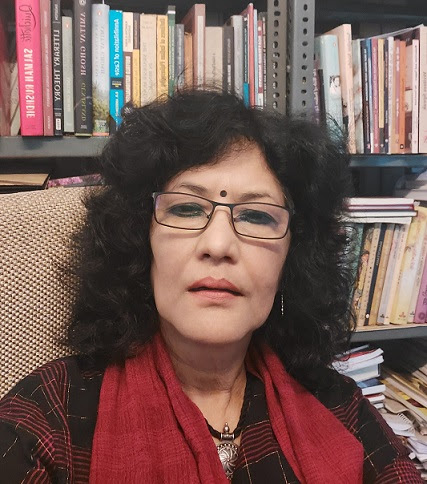 |
| Sanjukta Dasgupta |
It is a difficult proposition to talk about Dasgupta’s poems and do so
with the expected impersonal detachment. The anxiety of influence looms as
someone who relates to things; one is given to think that the couple of years
at the University of Calcutta are a permanent epiphany. At the same time, it is
easy to read the lines redolent of the familiar wit, the occasional bon mots, and the surreptitious jibe at
the positivist view of history as a Marxist-feminist: ‘He himself said he had Greek genes/Remember Alexander’s visit’ – the
rest is history. And that’s no critique of the ethno-religious supremacist
politics – she’s talking of her father, or her mother’s husband, to be loyal to
the title of her poem. She follows up this poem with one on her husband,
beginning with a characteristic tongue-in-cheek ‘Unlike Draupadi, I have just one husband’ but ending on a
neoclassical sobriety. Poetry is
fiction, after all, as Terry Eagleton makes it clear in his How to Read a Poem.
 |
| Koushik Sen |
It was Julian Barnes who had famously written that history is the
crossroad between the shortcomings of documentation and the inaccuracy of
memory. For poets, however much logicians would hate it, it is by their very
vocation that they bridge this gap, and they do it with a personal reading of
history. With poems fashioned as childhood reflections like Tom, My Little Puppy, and Bulbulie, My Little Bird, Dasgupta seeks
to do the very thing that she does in the other poems, at least in their
central fabric: undermining the family without subverting the personal. It
seems like a contradiction in sorts, a Marxist obsessed with the individual –
but that is where the poet trumps over the rationalist – putting fingers on a
history that is so awfully visible yet guarded, carefully picking out the bones
from the flesh, the crenulated mark of personal loss recognizable. The learned
is separated from the instinctive, bond from love; which reminds one of the
late Sankha Ghosh’s often quoted lines: ‘Mukh
Dheke Jaay Bigyapone’ (Advertisement obliterates the identity).
Incidentally, Dasgupta refers to this instinct with her characteristic wit in
one of her poems, Reading, noting
with a chuckle how emoticons are the new antediluvian pictography.


No comments :
Post a Comment
We welcome your comments related to the article and the topic being discussed. We expect the comments to be courteous, and respectful of the author and other commenters. Setu reserves the right to moderate, remove or reject comments that contain foul language, insult, hatred, personal information or indicate bad intention. The views expressed in comments reflect those of the commenter, not the official views of the Setu editorial board. प्रकाशित रचना से सम्बंधित शालीन सम्वाद का स्वागत है।