Showing posts with label Gandhi. Show all posts

My Experiments with the Youth and Bapu: Santosh Bakaya

Santosh Bakaya

My MPhil class was in full swing. I was going full throttle talking about Gandhi, Satyagraha, civil disobedience and non- violence.    
“We don’t need Gandhi. Gandhi has lost his relevance. Hitler is the need of the hour. Madam, don’t keep harping on Gandhi. He was responsible for the partition of the country. He was partial towards the Muslims, he was a casteist …”
Before the vain student, sheathed in an aura of unshakeable arrogance,  could hurl more he was-es at me and use more derogatory words, I asked him:
“Have you read My Experiments with Truth?”
“No.” A vigorous shaking of head.
“Have you read Hind Swaraj?” 
“No.” More vigorous shaking of head.
“Have you read Mein Kamph?”
“Mein Kamph, what, madam?”
“What do you know about Hitler?”  
“He was great.”  A glow on the young face. 
“Really?  Any great deeds you know of?”
“Well, he was brave.” The face sparkled.
“Brave! Was he?”
A vehement nodding of the head.
“You patronize the WhatsApp University, cannot differentiate between fake news and the truth, go hoarse in the throats discussing photo-shopped pictures of Gandhi, I am not sitting here listening to your vile words. If you have to criticize someone, first read about them and then criticize. ” Saying this, I left the class, fuming in rage.
 If I had eyes behind my back, I would have noticed twenty young faces running the whole gamut of emotions- bewilderment, confusion, anger and indignation.
As I raced out of the classroom, I could also hear a babel of voices behind me.
Strident. Shrill. Satirical. Squeaky.  An admixture of good and bad.

“How can Gandhi be relevant in this new age of computers, mobiles, and social media?”  
How could his charkha spinning solve our problems ?”
“How would he have dealt with all this violence all around us?”
 
“He was idiosyncratic.”
“Do you even know the spelling of this word? Had he been around, he wouldn’t have allowed us to mutate into robots.”
This was the voice of a girl who was holding her own against the nineteen other naysaying students.   
  
I was in no mood to give my rejoinders to them, so I did the next best thing – kept silent- with the intention of coming back later with my robust counter- arguments.

 Deep in my heart I felt, it was my responsibility as a teacher to make Gandhi and his simple philosophy simpler to the confused students, who were inadvertently reading complexities in his simplicities.      
On my way back to the staff room, there was a churning in my head. There is a plethora of Gandhian Studies Centers, where, Gandhian scholars are invited to deliver lectures on different aspects of Gandhism, where I have seen the audience, not just students, but also teachers, waiting desperately for the tea break.  It is indeed a paradox that the more books are written on the moral icon, more and more cynics and naysayers are born.
“Gandhi is dead, why revive him?”   Boom the detractors.
In thoroughly researched papers, in international and national conferences on Gandhi, highly erudite scholars reiterate the relevance of Gandhi, frothing at the mouth, using complicated and convoluted vocabulary for the ideology of a simple man, who listened to his inner voice, was perennially experimenting, candidly confessing his mistakes, and evolving every day.

 
“ When Martin Luther King Jr, American Civil rights leader visited India [10 February – 10 March 1959] after the enormous success of the Montgomery Bus Boycott, which had been inspired by Gandhi, he famously said, ‘to other countries I may go as a tourist, but to India I come as a pilgrim’.
“
Really, madam?” One of the students asked me when I said this in another of my talks.
“Can you tell us something about The Montgomery Bus Boycott and his India Visit?”
“If I tell you everything, what will YOU tell me? I am also a student, on a perennial quest.” The student looked askance at me for some time, and then smiled.
 When he met me again after some days, I was pleasantly surprised that he had not only read everything about the Montgomery Bus Boycott, but could also draw similarities between the Dandi March and the Montgomery Bus Boycott.

“The Montgomery Bus Boycott was the first large scale demonstration against racial segregation in the USA; it started the Civil Rights Movement in the United States. They said that the great man, Gandhi had inspired them.” He talked on and on, his eyes beaming.  
 
Agreed, Gandhi had some quirks, he could be idiosyncratic, fastidious, and obstinate – but we shouldn’t forget that he was an ordinary man who rose above the ordinary, through his moral gumption.
I remember telling one of my students, not very long back:
“You are obsessed with the latest brands, try becoming obsessed with the Gandhi brand- the brand of truth and nonviolence.”   
He looked at me as though I had gone insane. It is not easy for a student of the present capitalistic, brand -conscious society to find some commonalities with Brand Gandhi.  How to identify with the soul- force that he so soulfully talked of?
Gandhi walked the talk. But, we, teachers just talk. And talk.
All of us know that he was a great walker and even laughed at the youngsters who felt exhausted after walking a little. But he was always trying to learn from his mistakes, trying to become a better version of himself by walking the talk.  
“You know the Salt march appealed to everyone. During the march, many had blistered feet, many became tired, but not the sixty one year old Gandhi who, considered walking twelve kilometers child’s play.
I told some school students in a talk on Gandhi one day.  
“Did this really happen?”
“Leaning on a lacquered bamboo staff, he and his seventy -eight followers walked two hundred miles in twenty four days, treading on winding dirt roads, uneven terrain, peasants kneeled by the roadside as the pilgrims passed, during the Dandi March.”  
“ Is this true or just heresy?”
“Why did he choose salt as a mode of protest? Salt is such a small thing. ” One youngster wanted to know, his curiosity triggered.
 “You know, Subhash Chandra Bose compared the Dandi March to Napoleon’s March to Paris on his return from Elba.” 
“But wasn’t he Gandhi’s staunch critic?”
“Read for yourself and find out. You need to know things on your own, so Read a lot.  If you read you will come to know many things.” Things grew curiouser and curiuoser for them.
Then they tried to satisfy their curiosity- by reading and reading.   
What the students are in dire need of,  is not scholarly essays, but random  incidents from his life narrated to them with a raconteur’s delight, in a way which makes them yearn to know more. In many workshops in schools and colleges, I have related incidents from his life, and made the students perform skits based on those incidents.  They later told me that they would never forget those incidents, because by enacting them, they had become a part of them. Some youngsters even called me later to inform me that they were reading more and more books on Gandhi, and many cobwebs had been removed from their minds.

I believe that we, the teachers need not have stiff upper lips while discussing Gandhi with students. Getting our papers published in reputed UGC approved journals is only going to add to our academic achievements; the students will not even read them, unless they are in their syllabus.   I am speaking from experience.

Believe me, I have seen students arguing against the idiosyncratic man, and then the same students arguing in favour of the magician in loincloth.  I always tell my students that we should not put him on a pedestal, because like all of us, he was not without his fads and foibles. Many were the times that his best friends bantered with him regarding his points of view which they found na├пve and impractical.
 It was Gurudeb Tagore, who conferred the title of the Mahatma on him. Both respected each other tremendously, but also differed on many ideological issues. Tagore penned the essay The Cult of the Charkha, [an essay by Tagore, September 1925, Modern Review] critiquing the importance of the charkha, but nonetheless was firmly convinced of the authority of the moral colossus, considering him the very embodiment of Shakti.

Sarojini Naidu once quipped, “Do you know how much it costs every day to keep you in poverty?” Undoubtedly, a tongue- in- cheek remark by his feisty, frank friend, which was taken seriously by his detractors. It was this spunky friend who remarked ‘Hail Deliverer’, when on 6 April, 1930, at 8. 30 AM, Gandhi picked up a piece of salt in the coastal town of Dandi left by the waves of the Arabian Sea,   breaking the British law which made the possession of salt, not made by the British, a punishable crime. It marked the beginning of the civil disobedience Movement, dealing a blow to the ‘nefarious monopoly’ of the British to make salt.

No amount of Gandhi- bashing, effigy- burning, mud- slinging, idol desecrating, assassin- glorifying, murder- glorification, can bash or burn or desecrate the values which Bapu stood for. It is time to remember the words of Martin Luther King Jr. ‘Over the bleached bones and jumbled remains of numerous civilizations are written the pathetic words ‘too late’. We still have a choice today, nonviolent co- existence or violent co- annihilation.”
If we do not uphold the principles of truth and nonviolence, the day is not far when humanity will find itself hurtling down an abyss, and it will be too late then.
Why should we wait for it to be so late, when hatred, bigotry and intolerance sharpen their claws to attack the vestiges of humanism and love is gobbled up by the capacious mouth of hate? Reminds me of what a thirteen year old, his face wreathed in utter perplexity, asked me in a workshop on Gandhi,
“Madam, itni saari nafrat aati kahaan sey hai? [What is the root of all this hatred?]
Yes, exactly - From where? And why?
On King’s death, The New York Times said, “A man of peace, he died violently. A man of love, he died hated by many.”  The same can be said about our Bapu.

Peeping from the sepia- tinted pages of history, we can still see images of the Dandi Marchers, led by a frail figure, leaning on a staff, walking briskly, giving the youngsters a complex,  rousing a comatose nation out of its centennial stupor, casting his hypnotic spell on his awestruck disciples, the champion spinner, spinning and smiling toothlessly, people running pell- mell to catch a glimpse of this extraordinary man, the half- naked fakir of Churchill, lying on the funeral pyre fully clothed in the garment of love, compassion and non- violence, while devastated people hung from precariously creaking branches to catch the final glimpse of a man, the likes of which visit the earth just once.


GANDHIAN AHIMSA IN OUR DAILY LIFE (Paramita Mukherjee Mullick)

Paramita Mukherjee Mullick
Ahimsa is respect for all living things and avoidance of violence towards others. Mahatma Gandhi said, “Nonviolence is an active force of the highest order. It is soul force or power of the Godhead within us. Imperfect man cannot grasp the whole of that essence-he would not be able   to work wonders.”
Ahimsa is derived from the Sanskrit word hims. The word hims means “desirous to kill”. The prefix a-is a, negation. So, A-himsa is means literally, “lacking any desire to kill”. So ahimsa means to be without harm, to be utterly harmless, not only to oneself or others but to all living things. It is more than non-violence, more than an attitude; it is a way of life. When ahimsa extends to all living beings, it is protection of environment and nature as well. According to Gandhi, ahimsa meant non-injury, nonviolence, non-harm, the renunciation of the will to kill and to hurt any living thing, the abstention from hostile thought, word or deed, and compassion for all living creatures.

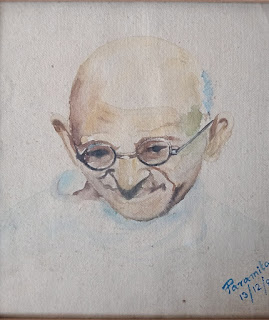
Gandhiji
(by Paramita Mukherjee Mullick)
Relations are breaking today, rampant divorces, fights between siblings, animosity between friends. Wars and quarrels are gearing their ugly heads, nations are crumbling, and the world is dividing into bits. Terrorism in the name of religion; squabbles in the name of caste and creed. It is high time Gandhian ahimsa principles are followed by the society, the nation and the world at large. The abstinence of hostile thought, word or deed and compassion for all living things is the very basic building block on which a relationship remains strong and healthy, whether it is a marital relation, a relation between siblings or friends. Not hurting others because they are different but respecting their differences. Why wars if you follow the principle of non-harm and non-injury? ”Non-violence is a weapon of the strong. Non-violence and truth are inseparable and presuppose one another. We may never be strong enough to be entirely non-violent in thought, word and deed but we must keep non-violence as our goal and make strong progress towards it”. Non- violence means peace so Gandhiji had used his thoughts and energy to bring in peace always. He had relentlessly campaigned for Indian liberation from British rule, and fought against India’s strict caste system. All the while being a strong advocate of non-violence. The UN International Day of Non-Violence is celebrated on the 2nd of October in honour of Mahatma Gandhi.
“The weak can never forgive. Forgiveness is an attribute of the strong”…this quote of Gandhi itself solves a lot of quarrels in society. If we could all forgive mere mistakes, slight wrongs or foolishness, the society would be considerably peaceful. Anger is something which makes us violent and pride or ego engulfs us and sometimes forces us to harm others. So Gandhiji had said, “Anger is the enemy of non-violence and pride is a monster that swallows it up”. Presently there are wars going on, death of hundreds and destruction, so this quote so beautifully talks against non- violence. “Non-violence is the greatest force at the disposal of mankind. It is mightier than the mightiest weapon of destruction devised by the ingenuity of man”. Ultimately Gandhiji’s sermon of love is the strongest weapon of a peaceful society and a peaceful world. He says, “A coward is incapable of exhibiting love; it is the prerogative of the brave”.
I dream of a beautiful world which will be run in the Gandhian principles of ahimsa. I end by a poem of mine which echoes the great Mahatma Gandhi’s thoughts,

ONE DAY

One day all wars will cease.
All around there will be joy and peace.

One day all terrorism will stop.
No guns will boom, no bombs will be dropped.

One day all trees will bloom.
There will for everybody be room.

One day there will be love and love around.
All will be brothers and brotherhood abound.

One day there will be no poverty, no pain.
Everybody will have food and medication and happiness will reign.

One day all hatred will end. 
There will be no foes, all a friend.

Homage: Assassination of Mahatma Gandhi

Today, on 30 January , let me reproduce a few stanzas from my book: Ballad of Bapu, about Gandhiji's last day on earth. 

Gandhiji was a moral icon who stood for non violence and peace. These principles need to be resurrected, to set this fractured world right. 

Below are some passages of his last days from Ballad of Bapu (Vitasta Publishers).

---Santosh Bakaya


With the sorry state of things displeased
Lines of impatience on his forehead creased
It was not a figment of the imagination
But in the absorbing conversation
He had forgotten the prayer time, ire increased.

 Unpunctuality he could never brook.
 His rosary, spittoon, spectacles and note book
With a spurt of vigor
Manu picked up this wealth meager
And to   the ground a shortcut they took.

 Followed by two Congress leaders from Kathiawar
Who wanted a few minutes with this star.
In a mood worried
To the ground he hurried
And smilingly folded his hands in a Namaskar.

Fuming at the unprecedented delay
For which his walking sticks he tried to flay
Lovingly he talked
Briskly he walked
Unaware that he walked to his death that   day.

Lifting his hands and joining them in a salutation
He apologized for the delay, in consternation.
Unseen by him a man edged forward
Was he a mad man or a coward?
He whipped out a pistol, with no compunction.

Three shots he fired in quick succession
Dumb- 

founded was the prayer congregation
In horror they gaped
This time Gandhi had not escaped
There were roars of grief and lingering confusion.

Gandhi is a True Global Citizen

Anurag Sharma
“Generations to come, it may well be, will scarce believe that such a man as this one ever in flesh and blood walked upon this Earth”. ~Albert Einstein

Twenty years ago, a friend of mine went to Turkey on a business trip. He was sightseeing, when a local asked him about his nationality. The friend mentioned, "India". To his surprise, the Turkish guy asked him where is this country. Apparently, he had never heard about India. 

My friend was unprepared. He never imagined that he was ever going to meet an English speaking gentleman who had no awareness of an ancient, and modern nation called India. The friend paused for a second and said, "Tajmahal...". The local asked, "Who is that?"

The discussion went on moving from Kohinoor diamond, to ancient temples to Indian Ocean, to lord Buddha, but the local had no clue.

Shocked and puzzled his newly discovered inability of introducing his country to a foreigner, my friend asked the native about his interests. 

"English movies", the native responded.

"Have you seen Gandhi?"

"Of course, I remember Gandhi, He is not real, right?"

My friend realized Albert Einstein's words about Gandhi were so true.

I saw Gandhi in Quebec

The day I met Gandhi in Mauritius


Gandhi in Pittsburgh

The world has seen many conquerors, but there has been only one global citizen, named Gandhi.

Gandhi: Visual and Video Tribute by Robert Maddox-Harle


Link to video tribute of last year: https://www.facebook.com/watch/?v=644370696444513

Robert Maddox-Harle

Mahatma Gandhi: A Harbinger of Truth and Non-Violence

Mirza Sibtain Beg
Recalling, remembering Gandhi is to rise and awake,
Slept conscience’ swag for humanity’s goodness sake,
Beleaguered brute bigot ostriches’ striptease is to rake,
Bulwark of harmony honed on his sacrifice is to shake
…
Non- violence supples centripetal force to win a battle,
A centrifugal force to make barbarism’s bones rattle, 
A philosophy that can enlighten even a frenzied cattle,
With its bricks and peace, world will be a haven habitable.
…
O’ apostle and advocate of truth and non -violence,
You swam ocean of thorns with sheer nonchalance,
Mollified aching hearts with melody of benevolence,
Tour de force spurred Tagore to call Mahatma in essence.
…
Your tenet of non-violence served the world a light-pole,
You changed history of revolutions with ideology to roll,
You shone in sky like moon with rays of harmony to dole,
Your sacrifice sets to wipe out menace from world a goal. 
…
You changed the definition of victory with thy philosophy,
You exhorted world the power of sacrifice with tenacity,
You practiced peace and turned uprising a serene symphony,
You cuddled oppressed with dalliances of equity and dignity.
…
True homage is to eradicate oppression from the globe,
Peace, truth, no-violence, compassion be world’s robe,
Hegemony, Hatred, bigotry, injustice needs a deep probe,
Light the lamp of love to spread light with amity’s knob. 

Waiting for the Dawn: Mitali Chakravarty

Mitali Chakravarty
As I watch the setting rays smear the sky with hues of gold, red and mauve, the orange sun moves towards the darkness of night. I have been reading about another sky that had lit up with strange vibrant colours under a mushroom cloud to collapse into blackness, wrecking cities and destroying generations of humans. It had happened more than seventy-five years ago, but the residues impact the world and humans to this date. That fateful day, the Little Boy fell from Enola Gay’s womb to bring “peace”. Then, a couple of days later, there was the Fat Man…

I look at the river ripple reflecting shades of the sky and wonder why people miss out on the beauty of life and nature… Were the sky and the water any different that August in 1945? Why would we need nuclear warheads to maintain peace on Earth? Their toxicity destroyed both nature and humans. Was this the ‘peace’ that the last century leadership had brokered for us? 

Long ago there lived a man who tried to get justice as a citizen of the British empire for the unjust treatment meted out to Indians in South Africa. He was incredibly spirited. He wanted justice and he had faith in British fair-play. He returned to his own home country, India, with much fanfare for the young barrister had become a politician. 

That was in 1915. I read his biography. Mohandas Karamchand Gandhi. He was an ordinary man who became extraordinary to meet his need for a just world, a society where people were treated as equals. He said some good things. But was nationalism one of them? I think he wanted freedom from abuse and exploitation for all mankind.

He popularised Satyagraha. Satyagraha, to my limited understanding, is using truth to overcome violence with non-violence, through peaceful resistance and non-cooperation towards abusive laws.

An exhausted man, unhappy with the use to which his ideas were being misconstrued after his return to India, Gandhi wrote that he had made a “Himalayan miscalculation” in his autobiography, My Experiments with Truth.  This is how he described his “Himalayan miscalculation”: “A Satyagrahi obeys the laws of society intelligently and of his own free will, because he considers it to be his second duty to do so. It is only when a person has thus obeyed the laws of society scrupulously that he is in a position to judge as to which particular rules are good and just which are unjust and iniquitous. Only then does the right accrue to him to the civil disobedience of certain laws in well-defined circumstances. My error lay in my failure to observe this necessary limitation. I had called on the people to launch upon civil disobedience before they had qualified themselves for it, and this mistake seems to me to be of Himalayan magnitude.” Can this view be that of a nationalist? 

In any case, I do not understand this word – nationalist -- or too many like it for ‘ists’ and ‘isms’ confuse me. I do not know much about Gandhi really or anything else. I am not a specialist. But reading his autobiography, I felt he did not want independence with the terms it was being meted out in the Indian subcontinent. He wanted something different. He wanted welfare of the people. And most of all kindness, love, harmony and the ability to accept diversity. I remember reading of how he went off to villages — Champaran was one — and taught people to keep their village clean. 

When I was young, I remember reading a book called Bahuroopee Gandhi in which he was shown in myriad roles — that of a sweeper, a teacher and many more. I think this was about dignity of labour. It showed no task should be under rated or be seen as below one’s dignity.  And his autobiography regurgitated what I had read as a child. 

He went into villages cleaned and taught. He wrote: “As I gained more experience of Bihar, I became convinced that work of a permanent nature was impossible without proper village education. The ryots’ ignorance was pathetic.”

While we draw rosy pictures of rural life, he wrote the truth in his autobiography that the villages lacked hygiene and were incredibly dirty. He tried to clean them up as he tried to educate people about cleanliness and hygiene across India. He wrote of the appalling bathrooms in the houses of the rich in Bombay. 

Why would one bring in bathroom hygiene into a discussion of more eclectic issues? Because dirty bathrooms are not just smelly but spread diseases. Like potable water, it is a basic need for a healthy life. Gandhi knew that. He would start his campaign by cleaning up a village. He did so in Bihar. 

He was a strange man. He abstained from giving his sons a proper schooling despite having the means to do so. He wrote: “Had I been without a sense of self-respect and satisfied myself with having for my children the education that other children could not get, I should have deprived them of the object lesson in liberty and self-respect that I gave them at the cost of the literary training.” 

But I am deviating. We were talking of living and dying against a sky with mushroom clouds, though cholera or Covid both demand basic hygiene. They declared ‘Nuclear Armistice’ where the fear of being bombed would prevent war. What kind of a life is that? Learning to live in fear? Where is the freedom? 

 Gandhi had declared: “‘The very frightfulness of the atom bomb will not force non-violence on the world? If all nations are armed with the atom bomb, they will refrain from using it as it will mean absolute destruction for all concerned?’ I am of the opinion that it will not. The violent man’s eye would be lit up with the prospect of the much greater amount of destruction and death which he could now wreak.”

So, what was his solution? 

He wrote: “‘What is the antidote? Has it antiquated non-violence?’ No. On the contrary, non-violence is the only thing that is now left in the field. It is the only thing that the atom bomb cannot destroy. I did not move a muscle when I first heard that the atom bomb had wiped out Hiroshima. On the contrary, I said to myself, ‘unless now the world adopts non-violence, it will spell certain suicide for mankind.’” 

The sun entered the tomb with stars lighting up a ceiling embedded with a new fledgling of a moon. As the darkest hours are said to be before the onset of dawn, maybe, we are all waiting, sleeping in a foetal position, waiting to be reborn into a world where more are converted than lesser. Long ago, no one had thought of Satyagraha, even though Gandhi called his ideas ‘older than the hills’. The thing is he brought them forward and put them before us. Perhaps, if we take his ideas beyond the pages of old books, notes in our wallets, statues and names of roads and buildings, the sun might emerge out of the tomb of night. 

If enough of us believe and speak out the truth — only the truth — nothing but the truth, maybe mankind will wake up to a new dawn and a far better fate than lemmings who are said to commit suicide voluntarily. Research however interprets it as an accidental condition where the mass migration of lemmings leads to their falling into the sea involuntarily. We are humans with brains — not lemmings. Surely at some point, we will just have to wake up as a species to Gandhi’s call, rise above our greed and learn to live by our need. 
We are just waiting for that dawn.

Gandhi Jayanti: Poems by Leonard Dabydeen

Strength does not come from physical capacity.

It comes from indomitable will. ~ Mahatma Gandhi

Gandhi Jayanti

Gandhi Jayanti is an event celebration in India that marks the birthday of Mahatma Gandhi on October 2, 1869 (died in January 30, 1948). The event is celebrated around the world wherever mankind is in search for peace and non-violence among communities and nations.

PEACE and BAPU ji
Suno suno aye duniya waalon, Bapu ki ye amar kahaani
Listen, people of the world, to Bapu’s immortal story…
[Mahatma Gandhi: born Oct 2, 1869; assassinated Jan 30, 1948]

Poking
at each other
eye to eye, blinding the whole world
makes mediation so complex
for peace.

Conflicts
cannot resolve
territorial rights
based on our religious believes
God’s ONE.

Where hate
inflames the mind
and racism colours our
skin to scoff and scorn our canvas
seek Truth.

Gandhi’s
lesson is to
follow his legacy
stand deeply for SATYAGRAHA
in Life.

Only
when Truth becomes
non-inflammatory
nations will relish its sweetness
for peace.

Poking
is no resolve
and racism colours our
stand deeply for SATYAGRAHA
for peace!

***

RACISM 

Deep in the colour of my skin, I live 
Heart to heart and rumble for peace within; 
I traverse this world for freedom, but give 
Not my pride for prejudice or chagrin. 
I walk not alone, but in footsteps 
Where the journey is long, but dream is strong; 
Where civil rights are mine, with no regrets 
That civil liberty is never wrong. 
Non-violence is my definitive creed, 
Through Gandhian spirit I strive and breathe; 
For you and I are equal without plead 
Where discrimination is full of seethe. 
Assassination leaves my world a cloud, 
Racism cannot be dressed in any shroud. 
***

OF TRUTH

How
to
begin
telling you
where to look for Truth
it speaks from your mind, and your heart.
When mind is weak, heart palpitates
and Truth becomes so
fragmented
fragile
as
glass.
***


NON-VIOLENCE

Take
your
weapon
down to ground
Earth is manifold
forbid war; make peace with neighbours.
When you make war, your enemy
is your restless mind
burning hate
raging
with
fire.
***


OUR FUTURE WORLD


“In the end all men have to die. He who is born
cannot escape death.” ~ Mahatma Gandhi – Speech
at Prayer Meeting, New Delhi, January 15, 1948.


They who live by their own chagrin, acquire
moth that spiral in their mind without peace;
fetch hate, animosity as desire
never to see our world a happy place.

Often times by foolish wit denigrate
our hopes and dreams far beyond squint of eye,
they criticize and also peculate
day by day they usher grandiose lie.

Step by step we massage Gandhian thoughts
and follow in faith a path righteous
ahimsa our kindled lamp against krauts
satyagraha our stand prestigious.

Walking in Mahatma’s footpath joyous
we build our future world so enormous.
*** 

Bapu ji (died Jan. 30, 1948)

When
I was
thirteen days
old and crying
Mama said Nathuram shot Bapu ji.

Bapu ji clasped his hands and smiled at him
nod in silence
said, ‘Ram, Ram’.
Eyes closed
gone.

***


NAMASTE GANDHIJI

Footprints on the sands of time
glow with birthmark
each glittering step
unshaken and challenging
not by yielding to temptation
but thirst for truth
for the awakening of men
for soul-searching
in glimpses of the Transvaal
for monsoon moments

in vestibules of maharajas
turnstiles in South Africa
under a mango tree in India
ricocheting in global rumbles
for peace and non-violence
and as the wind whispers
in a stormy weather
where wars create bedrocks
for sleepless journeys
I clasp my hands

in solemn gesture
as if it were the beginning
of the end
namaste, Gandhiji.

***


The Eternal Soul: A Poem by Meenakshi Mohan

Meenakshi Mohan

What do I call you?

Bapu, Mahatma, the Eternal Soul?

You were there

when my horizon had not crossed your shore.

Yet, from the moment

my awakening dawned

I heard of you and revered you

for the person you were.


Pen & Ink Art by Meenakshi Mohan
I heard

your stories of compassion and love.

You advocated for women’s rights,

struggled against discrimination.

You stood for freedom for one’s country and one’s soul

in a nonviolent way.


I learned

of your humbleness and simplicity,

believing in truth and standing for it.

You walked fearlessly with certitude

 in the ostentatious court of King George VI and Queen Mary

in your simple attire of wooden sandals,

 homespun shawl and loincloth,

with your head held high.

Sabarmati ke sant tune ker diya kamal.


Didn’t you say,

An eye for an eye makes the whole world blind?

Peace is the most potent weapon of humankind,

and with this philosophy, you marched

to change the world and the course of history.

You came to the world like the Sabarmati River

to enlighten and purify the minds of many oppressors.


We need you, Bapu

in today’s world of disharmony, conflict, and discord.

Let the eternal flame of Rajghat

ignite the minds of all with awakening

of humanity and truthfulness.

Let your humble dwelling of Sabarmati Ashram

be an icon of peace.

Let the message of your beloved hymn

resonate around the world.

Vaishnav jan to tene kahiye jo peer parei jaane

per dukhe upkar kare toye

man abhiman na aane re!


Notes:

Sabarmati ke sant tune ker diya kamal

Translated: The saint of Sabarmati, you did wonders.

Sabarmati was the humble dwelling of Mahatma Gandhi and his wife Kasturba near Ahmedabad, where the seeds of Indian Independence were planted.

The Sabarmati – The water of the Sabarmati river is considered to be pure. It purifies the water of the Hathmati river, which is impure and makes it fertile and productive for the fields.

Vaishnav jan to tene kahiye jo peer parei jaane
per dukhe upkar kare toye
man abhiman na aane re! 

Translated: A true son of God is the one who knows the pain of others without letting pride enter their minds. Gandhi’s favorite hymn.

Rajghat – A memorial dedicated to Mahatma Gandhi, New Delhi. An eternal flame burns there at one end.


Montgomery Bus Boycott, and Gandhi’s influence on MLK Jr.

Santosh Bakaya

One cold day in Montgomery, Alabama, Rosa Parks, a much respected forty two year old African- American seamstress refused to vacate her seat for a White American, in a bus plied by Montgomery City Lines, thus violating the city’s racial segregation ordinances, and was arrested.
It was 1 December, 1955.

 
“Why do you push us around?” she asked the officer.
“I don’t know, but the law is the law and you are under arrest”.  Rejoined the officer.

 Yes, the law was the law, an unjust law, which said that the African- American passengers were expected to sit at the back of the bus and to give up their seats, if the white section became full. The whites sat in front.

 After Parks’ arrest the Montgomery Improvement Association was created, spearheaded by a twenty six year old pastor, Rev. Martin Luther King Jr, and they started the Montgomery Bus Boycott on 5 December, 1955.


Planned for only a day, it lasted for 381 days, in which 40 thousand blacks participated. On 21 December, 1956, whites and Afro- Americans rode for the first time on previously segregated buses.
 “And we are determined here in Montgomery to work and fight until justice runs down like water and righteousness like a mighty stream.” MLK Jr. said in Montgomery, Alabama, and they held on steadfastly fighting with their nonviolent weapons, despite efforts to break their spirit and quash their spines.


 A quiescent conscience was yanked out of its slumber and a new sense of dignity was injected into the Afro- Americans.  In words so reminiscent of Gandhi, King said,
“If we are arrested every day, if we are exploited every day, if we are trampled over every day, don’t ever let anyone pull you so low, as to hate them. We must use the weapon of love.”  

The Montgomery Bus Boycott was a great success and during the boycott, Gandhi’s name was mentioned many times. King had helped straighten the backs of his brethren, tried to revive a comatose nation, unfazed by high-powered hoses and Bull Connors’ dogs, the invisible shadow of Gandhi their beacon light. King wrote:  
“While the Montgomery bus Boycott was going on, India’s Gandhi was the guiding light of our technique of nonviolent social change.”


King was only a nineteen year old youth when Gandhi was assassinated in 1948, hence the two could never meet, yet Gandhi’s ideology of non- violence influenced him greatly.


But, his discovery of Gandhi did not take place during the Montgomery bus boycott; it had gripped him during his study of Divinity at Crozer Theological Seminary in Chester, Pennsylvania [1948-1951]. From the Seminary, one day he travelled to Philadelphia to listen to a sermon of Mordecai Johnson, President of Howard University, who had just returned from India, highly impressed by the teachings of Gandhi. King found his sermon so ‘profound’ and ‘electrifying’ that he immediately bought half a dozen books on Gandhi.

On 10 July 1959, he was asked by Christian Century editor Harold Fey to write an essay on How my Mind has changed. He was one of the many significant thinkers who talked of their spiritual and intellectual evolution during the past ten years and in that article of April 13, 1960, he wrote that at the Crozer seminary in 1949, he studied various theories, liberalism, works of Reinhold Niebuhr, Kierkegaard and existentialism, Jean Paul Sartre, Friedrich Nietzsche, Paul Tillich, Rauschenbusch, each of whom enriched him and stoked his intellectual curiosity, but he also came to know  “for the first time that the Christian doctrine of love operating through the Gandhian method of non- violence is one of the most potent weapons available to a nation in their struggle for freedom.”


A revised version of his essay was later reprinted in a collected volume edited by Fey Pilgrimage to Non- Violence, and he talked of how he had been knocked out of his ‘dogmatic slumber’. [Cleveland: Meridian Books, 1961, pp 105- 115] 


“During this period I had almost despaired of the power of love in solving social problems. The ‘turn the other cheek’ philosophy and ‘love your enemies’ philosophy are only valid when individuals are in conflict with other individulas; when racial groups and nations are in conflict, a more realistic approach is necessary.  Then I came upon the life and teachings of Mahatma Gandhi. As I read his works, I became deeply fascinated by his campaigns for nonviolent resistance. The whole Gandhian concept of Satyagraha was profoundly significant to me. As I delved deeper into the philosophy of Gandhi, my skepticism concerning the power of love gradually diminished …..”
At this juncture of his life , he had merely gained an intellectual insight into the Gandhian  philosophy, little realizing that one day he would himself be resorting to non- violent resistance.


No “longer lost in a fog of theological abstraction’, he realized that love was indeed a powerful force. Earlier he had been cynical about the redemptive and therapeutic power of love, believing that the ethics of Jesus could be relevant only in individual cases,  but a study of Gandhi,  Satyagraha and  Salt march removed the cobwebs of confusion and It was from a reading of his works, that he received an “intellectual and moral satisfaction.”  

During the Montgomery bus Boycott, “my mind, consciously or unconsciously, was driven back to the Sermon on the Mount and the Gandhian method of non- violent resistance. The principle became the guiding light of our movement. Christ furnished the spirit and motivation while Gandhi furnished the method”.  He said.  As the movement progressed, he became more and more convinced of the power of non- violence.  His brethren showed great patience, resiliently plodding forth even on rainy days, covering their heads with umbrellas and newspapers, but saying an adamant No to the segregated buses.   

On December 12, 1955, a letter by a white librarian, Juliette Morgan was published in Montgomery Advertiser saying, that the Boycott had been influenced by “Gandhi – and our own Thoreau, who influenced Gandhi…  Their own task is greater than Gandhi’s for they have greater prejudice to overcome.” Freedom without any bitterness was King’s mission too. But it was definitely not an easy task to tackle this centennial injustice, which had warped many mindsets.

Every Afro- American was the Invisible Man [1952] of Ralph Waldo Emerson, hibernating in his invisibility, trying to discover himself, trying to become visible, to the Whites who deigned never to see him. As the unnamed protagonist says in Invisible Man, “When I discover who I’m, I will be free.”


As the President of the Montgomery Improvement Association, in the periodic meetings, King  talked about the efficacy of non- violence, not naively optimistic about its success, considering the hostility among the majority of the whites. Working on a planned out strategy, on 5 December, 1955,   the Afro- Americans  refused to ride the unjustly segregated buses, some rode mules to work, some walked twelve hours to their jobs, some travelled in horse drawn buggies, students hitchhiked, raising slogans, ‘No riders today’  as empty buses passed by, and they continued the boycott for one whole year.
 

On 30 January 1956, the King house was attacked as the continuing success of the Montgomery Bus Boycott had raised the heckles of the segregationists. That night, at 9. 15 pm, while he was speaking at Rev. Ralph Abernathy’s First Baptist Church, in the vicinity,  before an assembly of  two thousand people,  a bomb was hurled in the porch of his house.  It tore a hole in the porch, splintered floor boards, and ripped through one of the pillars in the porch, but his wife Coretta, and their infant daughter, Yolanda were not harmed.

 It was this attack that was the testing time of his unflinching commitment to non- violence.
To the angry mob that had gathered outside his house, raising slogans that resounded in the neighborhood, the twenty seven year old pastor of Dexter Avenue Baptist Church, Montgomery, delivered an impromptu speech from his damaged front porch:

 “Don’t get your weapons. He who lives by the sword, will perish by the sword. We are not advocating violence.   We want to love our enemies.  Be good to them, love them, and let them know you love them.”  His words fell onto the ears of the protesters, with an impassioned intensity- words exemplifying his robust conviction in the power of nonviolence as a tool in the civil rights movement. The mob slowly dispersed, merging into the night. A blood bath was avoided by a mere raising of hand, and powerful oratory laced with love and forgiveness.

The entire night, the hostility of human beings towards one another, hammered away at his mind and his body quivered with hate and vengeance, even making him entertain the idea of getting a gun permit, but he checked himself in time, forgiving the white segregationists, reasoning that they were merely the children of their culture, doing what they had been taught for ages- namely the inferiority of the blacks.
 
Nonetheless, he allowed sentries in his house to carry guns and pistols, for self-defense.
This created a moral dilemma and he eventually ordered the guns out of the house reasoning that “I’ve got to be totally non- violent because the guns here are going to attract guns.”  


During the entire period of the Montgomery bus Boycott, every effort was made to break the boycott by widespread intimidation, circulation of racist handbills and eighty nine leaders were indicted of violating a law that prohibited boycotts.
On March 22, 1956,   King was found guilty, but proclaimed that he was proud to be a criminal and proud of his crime of leading a non-violent protest against injustice.

Rangnath Diwakar, one of Gandhi’s chief lieutenants in the Quit India Movement paid the Kings a visit in mid- August 1958, and it was during this three day visit that Coretta King, said:
 
“We began to think more deeply about the whole philosophy of nonviolence. We talked about how superficial and shallow our whole knowledge of nonviolence was.”  An invitation from Pt. Nehru inviting them to India, lay unheeded on his table.  Visiting the land of Gandhi had always been his earnest dream, so this dream, triggered by Rangnath Diwakar’s visit was finally realized in 1959.   

When they reached Delhi on 10 February, 1959, for a one month visit, a grand reception awaited them.
To the reporters at the airport, King said, “to other countries I may go as a tourist, but to India I come as a pilgrim”.
Regarding the gains of the Montgomery Bus Boycott, he said, “Our real victory is not so much the desegregation of buses, as it is a new sense of dignity and destiny.” 
As a result of his India visit, he was able to develop a greater understanding of nonviolent warfare, his commitment to achieve freedom for his people through non-violent means becoming stronger.

It was the Montgomery Bus Boycott that had catapulted King to the center stage of the Civil Rights Movement, his powerful voice rising above the ominous rhythm of demonic violence, fusillade of threats, blizzards of racist slurs, billy clubs and gun butts, telling his brethren, in a voice reminiscent of Gandhi, that they could overcome and stand up to brutality without compromise, which they did with weapons of love and nonviolence.  

Writing in New York Times, the eminent Indian writer Ved Mehta said that at the end of the twentieth century, Gandhi and King would be called the influential men of our times, because “they were imaginative artists who knew how to use world politics as their stage.”   [Mehta, Ved. Gandhism is not Easily Copied, New York Times, 9 July, 1961]  

 
In the introductory chapter of his book, James A Colaiaco says, “King and Gandhi were successful because they realized that nonviolent protest is basically an art – and they were quintessential artists”.  He further says that they “orchestrated dramatic moral confrontations with their adversaries, compelling them to make reforms in the interest of justice.” [Martin Luther King Jr. Apostle of Militant Non- violence, Palgrave, Macmillan, UK, 1988, P 2]

So, King, the Dreamer, strongly influenced by Gandhi, and honing the art of nonviolent warfare at every step, stood up to oppression with “truth-force, ” partially succeeding in the realization of his dream, of freedom and equality for his people, yanking off of the shackles of segregation, and breaking out into a  ‘joyous daybreak.’


Bapu: A Poem about Gandhi

Glory Sasikala
Bapu lies in state
In Delhi
while darkness camouflaged as Sunshine
spreads across the country
to a daybreak with no promise of dawn.

No white man this time
Revolution is not because of lathi charge
So subtle that we wonder if there should be a revolution at all?

Who are we fighting, who are the Black Sheep
among us 
who have redefined Democracy as Anarchy
Redefined Secularism as Religion?
When did “Minority” replace “Indian”?
Our farmers being razed to the soil 
they once knew so well, now asking
“What do we sow?”
“What do we reap?”

We don't understand—or is it that we don’t care?
And yet, as we look down at Bapu’s grave, sure enough
A prayer slips the lips
“Bapu, please come back! 
We need you!”

MOHANDAS K. GANDHI, Thoughts, Words, Deeds and His Inspiration – Bhagavad-Gita by Ramnarine Sahadeo

Book Review by Leonard Dabydeen

MOHANDAS K. GANDHI, Thoughts, Words, Deeds and His Inspiration – Bhagavad-Gita

Author: Ramnarine Sahadeo

Published by Reprographic and Printing Services, Secunderabad, India,

ISBN 978-0-9868393-1-3


This second edition of author Ramnarine (Ramji) Sahadeo’s philosophical book: Mohandas K. Gandhi, Thoughts, Words, Deeds and His Inspiration: Bhagavad-Gita is a long overdue, guiding clarinet call to people of every religious belief, race, creed, sexual orientation, or political interests to follow the non-violent principles of the indomitable Mahatma (Great One) Gandhi, in an attempt to seek peace, prosperity and happiness in our troubled world.

The book is a studied embellishment from the debut first edition, which was launched to mark the 10th anniversary of 9/11 – the unforgettable atrocities of the bombing of the twin towers of the World Trade Centre and the loss of thousands of lives of people of all walks of life. It is an attempt to point all of us to look at other 9/11s in history where visionary leaders have pleaded with human beings to live in peace, unity and harmony. Particular emphasis is highlighted in the speeches of Swami Vivekananda on September 11, 1893 to the World Parliament of Religions in Chicago, U.S.A. And more in grace to the guidance of famous world leaders, in the likeness of Martin Luther King (Jr.) and Nelson Mandela is the speech by Mohandas K. Gandhi, The Moment of Truth, on September 11, 1906, in Johannesburg, South Africa at the Empire Theater. Gandhi, who is acclaimed the Father of Indian Independence (1947), displayed an impeccable stand for the principle of non-violence in the remarkable practice of Satyagraha – “soul force”; “truth force”; “insistence on truth”.

What was essentially Gandhi’s inspiration? It is this pertinent question that stirred Ramji to dwell in the body of the book on the Bhagavad-Gita. This is the scriptural poem that influenced and inspired Gandhi all through his life. In the end we come to appreciate the Mahatma (Great Soul) as one of the greatest souls that set foot on this earth. Readers will no doubt shuffle the pages of this book in its various sections and headings to look for answers to bring peace and harmony in their own lives. In the words of Mahatma Gandhi:

“When disappointment stares me in the face and when I am all alone and I do not see even one ray of light, I go back to the Bhagavad Gita.”

The author, Ramnarine Sahadeo, is a Guyanese-born, Canadian lawyer in the Greater Toronto Area since 1980 [Retired]. It is his fervent hope that this book will promote the change which people wish to see in their homes, their social environment and the world at large. In the back cover he writes:

“Justice systems would need fewer resources if residents can just avoid lust, anger, and greed, for these vices clog the courts with expensive, unpredictable, and unnecessary litigation. Health and social systems experience lower demands from those who exercise, perform yoga, meditate or follow a vegetarian diet, practices followed by Gandhi and recommended by the Gita.”

The book is set in three parts: Part I greets the reader with an overview of how the Gita reaches the West, with a distinction of Nine Elevens apart from September 11, 2001; Part II brings the reader to the core verses of the spiritual poem of the Bhagavad-Gita; and Part III offers power-point comments on the Gita by Gandhi, along with influences of the Bhagavad-Gita that shaped the destiny of this great soul. In the end there is a glorifying explanation of the universal greeting of Namaste for all of us.

***

---Author Ramnarine Sahadeo is also currently involved in the initiatives of establishing a Mahatma Gandhi Scholarship for students at the McMaster University in Hamilton, Ontario.

---Leonard Dabydeen is the author of: Watching You, A Collection of Tetractys Poems, Xlibris Publications, ISBN 978-1-4691-4802-1(2012). He is also listed in the World Poetry Movement’s BEST POETS & POEMS 2011 ISBN 978-1-61936-038-9 (2012); Hardcover.


A Man is Known by his Words: Paramita Mukherjee Mullick

Paramita Mukherjee Mullick
Mohandas Karamchand Gandhi was a great personality who was named Mahatma by another great mortal Tagore. His political exploits and what he has done for our country is known to all. I am fascinated about his quotes. Each one of his quotes show the clarity of his thought and purpose. Each one, a life lesson.

Every quote is a treasure chest of motivation and inspiration. Bapu, as we lovingly call him has expressed his motto in life in these quotations.  In the phrase, “An eye for an eye will only make the whole world blind” he expresses why non-violence is a priority, not an alternative.  If we go on fighting, there is no end to fighting, the world will be destroyed one day. “When I despair, I remember that all through history the way of truth and love have always won. There have been tyrants and murderers, and for a time, they can seem invincible, but in the end, they always fall” …what an ode to truth and love! In simple words Bapu has explained that truth and love will always prevail. He also tells us “Freedom is not worth having if it does not include the freedom to make mistakes”. Yes, when we truly work hard, we can make mistakes, to err is human. Not only were his words inspirational during the British ruled India but his words are universally true and can be applied even now for the well being of humans.  We only talk about how society should be changed for human betterment but do we help in that change? NO. So, Gandhiji’s words are so relevant when he says, “Be the change that you wish to see in the world”. He has again and again talked about communal harmony, about unity among diversity. He shouted out, “God has no religion”. He clasped mankind in love and compassion so to him, we should even be kind to a sinner. He said,” Hate the sin, love the sinner”. He believed in mental strength and dignity of individuals. So he inspired others to go forward with mental strength and dignity by saying, “Nobody can hurt me without my permission”. 

Gandhi by Paramita Mukherjee Mullick
What better a way then to use his inspirational quote to motivate young minds. Mahatma says, “Your beliefs become your thoughts, your thoughts become your words, your words become your actions, your actions become your habits, your habit becomes your values, your values become your destiny”. Again, he repeats, “A man is a product of his thoughts, what he thinks he becomes”. He energizes us with his words saying, “There is no alternative to hard work”. He had total faith on humanity so he reverberated the words,” You must not lose faith in humanity. Humanity is like an ocean; if a few drops of the ocean is dirty, the ocean does not become dirty.” He motivated all by saying,” The Future depends on what you do today”. His every saying is like a motivational speech. He says, “Let the first act of every morning be to make the following resolve for the day: I shall not fear anyone on earth, I shall fear only God, I shall not bear ill will towards anyone, I shall not submit to injustice from anyone, I shall conquer untruth by truth. And in resisting untruth, I shall put up with all suffering”. He believed in helping others, in serving others. Such noble thoughts are expressed in his noble quotes. “The best way to find yourself is to lose yourself in the service of others”.

His quotes are fountains of happiness and hope. He says, “Happiness is when what you think, what you say and what you do is in harmony”. His lessons on life and how to not just survive but TO LIVE is, “Live as if you were to die tomorrow. Learn as if you were to live forever.” All his life he has taught love and forgiveness. So, the Mahatma says, “The weak can never forgive. Forgiveness is the attribute of the strong".

A very interesting aspect of his thoughts is it is all encompassing.  He not only thought about love and brotherhood but he also advocated conservation of flora, fauna and resources of the Earth. So, his quotes, “The greatness of a nation and its moral progress can be judged by the way its animals are treated” and “Earth provides enough to satisfy every man’s needs, but not every man’s greed”.
Let us follow the teachings of Mahatma Gandhi and   build a beautiful world of hope and happiness where we will be reborn every new day. As Bapu says, “Each night when I go to sleep, I die. And the next morning, when I wake up, I am reborn”. His philosophy of encompassing all with love will surely make the world a better place to live in. I end with the most beautiful of his quotes, “Where there is love, there is life”.