** ISSN 2475-1359 **
* Bilingual monthly journal published from Pittsburgh, USA :: рдкिрдЯ्рд╕рдмрд░्рдЧ рдЕрдоेрд░िрдХा рд╕े рдк्рд░рдХाрд╢िрдд рдж्рд╡ैрднाрд╖िрдХ рдоाрд╕िрдХ *
A Once Upon a Time Story: Santosh Bakaya
To my own sparkling butterflies: Anoucheka Gangabissoon
Redness Looms: Parinita Mandal De
I was in standard six then. I still remember the day as if
it happened the other day. It was the third day of the great Durga Puja, the much coveted one for the
Bengalis. We were living then at Adra, the famous rail city of Bengal. In the
afternoon my father took a ride to Kashipur Rajbari
(the royal palace) with my mother in his moped. It was a must visit in
those days for the Adrabasis (the
dwellers of Adra) then as there happened to be a balidaan (goat sacrifice) on the sandhikshan (the transitional period in between the second and
third day of the puja). I was left
along with my elder brother and sister in our railway quarter. No wonder I made
a harsh cry as I was deprived of witnessing the sacrifice. 
Parinita Mandal De
I remember my elder
sister brought me the variety of sweetmeats and snacks my mother had cooked for
us and for all our guests. The next morning it was the Dasami and it was a custom of visiting the houses of kith and kins
in the evening.
I watched it first
when I went to the toilet soon after consuming the sweet dishes. Instead of the
straw colour there were those bloody drops. I heard of period by then as a
couple of my friends already had an experience of that and told me about that.
Yet I had a mixed feeling of excitement and nervousness. Fearstriken I came to
my elder sister and told her everything.
In those days using
sanitary napkins was beyond imagination for a middle-class family. Didi (my elder sister) dragged me to our
corrugated washroom outside the quarter, loosened my trousers and put a cotton
thread around my waist. In my little mind I realized why women are not free
even at least for once in a month as I was literally waistcuffed for the coming
days. Didi put a piece of white cloth
soon to be reddened. She strictly forebode me to touch anything related to
puja.When we came out together from the washroom my elder brother's curious
eyes left me ashamed for the first time in my life before him. I felt sharing
everything with my beloved dada had come to an end from now.
I slept early that
night thinking how should I relate the incident to my mother.
My mother did not come that night. She came next morning.
Not in my father's moped, but overlaid on a hearse. She was garlanded all over.
Yes, my father's little moped could not bear the heavy load of the truck it
faced. I looked at my father, he was completely dumb. I found spots of red
patches on the white shroud my mother was covered.
It was Mahadasami that afternoon. I saw from
afar brides were lapping red vermillion to each other. My father also put a
bright vermillion mark on my mother's overhead. Perhaps it was brighter than
the red I experienced last night.
***
Bio: Mrs. Parinita Mandal De, is a teacher by profession. She spent her childhood in Adra, the South Eastern Railway junction town, where she lost her mother in a road accident in her early childhood. At present she lives in Bankura district, WestBengal. She likes to spend her days in the serene hill station with her poet- painter husband Soumik Kumar De and her offsprings Adrika and Adrij. She is also fond of preparing mouthwatering experimental dishes for her family members.
Memoirs of a daughter
![]() |
| Nivedita Roy |
Nivedita Roy
The Small Things that our Parents did
![]() |
| Santosh Bakaya |
“Dad, do get my Honours certificate and mark sheet from the
university.” I asked my dad so many
years back, my attitude marked by a breezy nonchalance- An attitude that comes
from the smug belief that fathers are for all times, and nothing can happen to
them, ever.
A fond daughter’s eyes refused to acknowledge the pallid hue which had replaced
his forever twinkling eyes. His eyes beseeched, and his baritone quivered.
“Why don’t you get it yourself, Baby? You are such a great cyclist, and the
Administrative Block is just a kilometer from our house. It is high time you
learnt to do your things yourself.”
“No Papa, I have to finish my home assignments. Please, get it.” I held his
hands and pleaded, ignoring mom’s glares. Shrugging, he headed towards the
University. This time not taking the bicycle, but walking.
My eyes even refused to notice his unsteady gait.
Unbeknownst to us, a dreaded demon had stealthily crept into his supposedly fit
body, which would villainously sabotage his plans of getting his novel, poems
and short stories published and see his children carve snug careers for
themselves.
Often, the scenes in our house appeared to be straight lifts from Gerald Durrell’s, delightful book, My Family and other Animals, all due to dad’s love for animals and birds. There was a harmonious blending of chirps, meows and barks in our house. At one time, a whole family of cats resided in our house, along with a pup, a constantly jabbering parakeet and an injured pigeon, in an atmosphere of peaceful coexistence.
Dad could never afford the luxury of a car, although he craved one. His salary was enough only for the kids’ education, the household expenses, and of course books!
He would often quip, “If a burglar were to come to burgle our house, he would scurry back in helter- skelter haste, petrified at the sight of so many books.”
Yes, our house was a bibliophile’s haven. There was a profusion of books in
Hindi, English, Urdu and Persian. When
my dad relocated from Kashmir to Rajasthan, he did not know Hindi, but taught
himself Hindi by reading Parag and Chanda Mama, and later, to the immense amusement of his post- graduate
students would use words like Vidambana and Antar anushasanatmak adhyan [irony
and inter-disciplinary approach] with
great linguistic aplomb.
“Wow! When did you learn Hindi, Sir?” They would remark, incredulous.
“I am still learning. I am a perennial learner.” He would rejoin, the twinkles of his eyes more pronounced with anticipatory glee.
I have never come across a person with a greater sense of humour – incisive, sharp and poker- faced. He would often throw back his head and laugh his trademark laugh, intrigued that some people could not catch the satire hidden in his remarks.
He loved to render ghazals in impeccable Urdu and sing Kashmiri songs to us, so that we may not forget our roots. I remember him often quoting from Mehjoor, and reading to us from the works of Robert Browning – his doctorate being on The Dramatic Monologues of Robert Browning.
Robert Hayden’s poignant sonnet, ‘Those Winter Sundays,’ had
greatly impacted me when I had read it some years back.
‘Sundays too my father got up early’, is how it began.
Yes, my father too got up early even on Sundays, helping mother in the kitchen,
making pancakes, washing dishes when the maid was absconding, kneading the
flour, his deft hands giving the kneaded flour different shapes- a hen, a cat,
a dog, a giraffe, and a fat, paunchy man, making us, the excited kids, go into
paroxysms of laughter at his creativity, meant to tickle our funny bones.
Yes, he was an artist, but alas, this artist went unnoticed
by the world. His creations were only meant for his family. An exemplary cartoonist, a painter, a poet, a
novelist, died unsung. Unheard of.
I often recall him hunched over his desk, in his study, evaluating
answer-sheets, grimacing at the students’ grammatical gaffes, in our bedroom, combing
his daughters’ hair, while we pouted and sulked, as he got us ready for school,
and even polishing our school shoes, while mom packed our tiffin boxes.
My mind’s eye still recalls three pairs of shoes standing grandly against the
girls’ bedroom wall of our University Quarters, sparkling under the ministrations
of a fond father’s deft hands, which were good at everything.
‘No one ever thanked him’, Hayden laments, and I also find myself echoing his sentiments, often wondering whether we had thanked our dad enough for the little things that he did, especially for his daughters.
I have preserved his last letter to me in a box very dear to me. His
handwriting embellishes the cover of my book, Runcible Spoons and peagreen Boats: My
Father’s Last Letter to me and other
Poems.
His last words to my eldest brother were,
“Even when you reach the topmost rung of the bureaucratic ladder, never give up
your humility. Always remember, that you are a Civil Servant – a servant of the
people.”
My brother never forgot that.
Don’t we take our self- effacing parents for granted? Have we ever realized the
small things that they have done for the realization of our bigger dreams?
Their own dreams that they have throttled so that the dreams of their children could
be realized?
As memory after memory unspools, in the backdrop of this collage, our beloved dad
keeps on keepin’ on - singing that Mehjoor song, ‘az roz saanye dilbar
myanay’ [stay with us tonight, my beloved], with that wistful look on his face.
Yes, he had unobtrusively ‘driven out the
cold,’ like Hayden’s father.
Now, in his absence even the summers are cold.
The weather bureau had predicted that January 9, 2015, would be the coldest day
of the year. Indeed, it was.
The cold that crept into our entrails that day, refuses to leave our bodies to
this day. On that morning, a frail woman, who had exhibited a rare grit and an
incredible strength, in carrying on the responsibility of bringing up her five children,
after father’s untimely death, suddenly shed her earthly raiment, leaving us
dumbstruck.
Tightening her pashmina shawl around her frail shoulders, our vibrant, and vivacious
mother, who was knitting and crocheting till her last breath, lay down on her
bed, gave one last lingering look around her snug room, and unshackled herself from
all earthly bonds, with a smile playing on her lips.
It has
been eight years since she left us, and the sapling that she planted is nine
years old. Every year when we go to Jammu, I make it a point to inhale the
fragrance of the tree that she had planted. Under the shade of that tree,
memories come back to me in staccato bursts of joy and sorrow, and
inadvertently, a tear trickles down my face, which I surreptitiously wipe away.
She was
very fond of wrist watches and bottles of perfume, so we always presented her
with bottles of perfume, which she kept in her drawer in safe custody, very
possessive about them. When I went to Jammu in October 2022, I saw a bottle of
perfume standing in her washroom shelf in all its fragrant glory, and all of a
sudden, I could feel her presence all over her room.
Whenever, I go for literary events, it is her
watch that I wear- A watch she had given to me one day, when she had seen my
wrist watch-less.
“You are so careless. Why don’t you wear a wrist watch? You have so many of
them.” She had admonished me, tying the watch herself on my wrist.
“My heart beats in five different places- In my five children. My heart tells
me when things are right and even when things are wrong for them.” She
would often say.
“When I am gone, you should come and stand under this tree, you will feel my
presence.” She had remarked, as we stood riveted, watching her plant the
sapling with her small, soft hands.
“Don’t talk like that. You have to walk many a mile, before …”
At my remark, she had merely smiled, and
started walking towards her room.
It has been eight years since she left us, and the tree is nine years old, but
it always welcomes us with a mother’s love.
On 9 January, 2020, I
wrote a poem And the Temple Waits,
which is now part of my book, Runcible
Spoons and Peagreen Boats
[AuthorsPress, 2021] I would like to reproduce it here:
And the Temple waits
“9th January, 2015, was the
coldest day of the year.
An eagle sailed in the blue sky,
as a sprightly figure inside her
room,
got ready for her morning
prayers; her tiny temple waited.
A spiffy sun peeped through the
window and smiled a sunny smile.
She tightened her shawl tightly around her fragile frame,
and smiled too.
She always did.
In the sky, the eagle was going round
and round in circles.
On the sun- spangled earth, in the flower beds in the lawn,
petunias, marigold, zinnias,
chrysanthemums and oodles
of tiny pink blossoms, bloomed,
airily.
Beauty and kindness abounded in every nook and crevice
of that house where resided that kind soul.
She tightened her shawl around herself,
lay down on the bed, and smiled.
She always did.
The temple waited.
It waited perpetually.
It has been waiting for the past five years now-
for that prayer that never came.
That cold morning, my mother became a
prayer.
A prayer that refuses to leave my lips.
But that cold day she still smiled in her sleep-
a warm smile.
Like she always did.”
Her scent still permeates her room, in Jammu, making
me feel that it is the heady scent of the blossoming earth at springtime.
It is almost surreal that with half closed eyes, I have often seen a boat with
my parents sitting in it, fingers intertwined- homeward bound.
A thing of unending joy and sunshine.
Centre Fresh: Snigdha Agrawal
![]() |
| Snigdha Agrawal |
Covid Days
| Glory Sasikala |
Glory Sasikala
Memoir: Enlightenment
![]() |
| Rameshwer Singh |
The tree in heaven…. my sister Parijat
![]() |
| Roopali Sircar Gaur |
Mother: Memorabilia
![]() |
| Lopamudra Bannerjee |
[For my mother, on the event of her birthday in heaven. She would have
turned 76 this year on Mother Earth on February 26, 2023, but fate had other
plans ten years back.]
“Jokhon porbe na more payer chinho ei baante/ Ami baibo na,
ami baibo na more kheya toree ei ghaate go…”
(When you will not be able to trace my footprints,
imprinted on the roads, you won’t see me then, in the jetties, I won’t be then
to row my boat.)
---Rabindranath Tagore, Geetabitan.
Dear Ma,
A picture of you stands unassumingly, along with old and
new DVDs and books, in the top-most shelf of one of our old glass-showcases
that have traveled with us from one home to another. I see you today, as I see
you every day, in the blissful sheen of smile with my first born tucked
blissfully in your arms, surrounded by your erratic husband, my father, who
loved you in his own queer, idiosyncratic ways, surrounded by me, your only
child and my husband. “A complete family portrait, I will keep it snugly in my
heart always!” You had expressed in unbridled joy that day, a decade years ago
on the New Year’s Eve, while returning with a bunch of family pictures that we
had taken together at Portrait Studio, Omaha, Nebraska, where you had come to
visit us.
Years after, a copy of the same picture lay, along with a
stack of other pictures and memorabilia in a damp nook of your Barrackpore home
from where they took your lifeless body away, but where the imprints of your
being still lurk, crawl at the old, chipped walls, the unkempt furniture, the
dusty staircases. A home, its bricks and roof and floors that you had built
with your sweat, your diligence and utmost resolve, a home where your words,
your silence and your fatigued breath still echoes, calling out my name.
In a different home now, in faraway Texas
where we live now, unbeknownst to you, pictures of you, in various phases of
your life peep from our laptop screen, which I, your only daughter randomly
saved in digital formats from old, tattered, sepia picture albums. They were my
last desperate, painstaking attempts to hold on to you with my parched heart;
in all the sights, smells, noises and touch and their smooth, velvety feel in
which love was formed since the day I was born, till the day I gave birth. The
sensations and their impact seized to be physical, yet whenever I touch the
framed pictures, printed and gleaming, whenever I run my fingers through the
elusive screen that freezes those sepia and coloured moments of you and me, the
sensations gush through my veins, real, lingering.
“Ma-r shob jinish shonge kore niye ja, ekhane kichhu fele
rakhish na.” (Take away all belongings of your mother with you, do not
leave anything in this house) …
Relatives, neighbors had commented on the day of my return to the US, following the rituals of your first death anniversary in our Barrackpore home. They had quite obviously referred to the more valuable worldly stuff that you had left in the house, but do they all know what else you had left inside the rooms, interspersed with moments of love and beauty, with which the mundane glittered, glorious? There, in the eerie silence of the old steel almirah of your bedroom, lay a stack of your saris, starched, folded, nourished with unconditioned love. In the middle rack of the almirah, old, almost archaic bank documents, question papers from the school where you taught, handwritten notes and old, tattered inland letters of your old students, old papers, souvenirs from my father’s office rested inside files piled up against one another.
Inside the drawers of our old dressing table in Barrackpore, a gift from your parents for your wedding, my old report cards, the raw sketches of my preschooler days cough up the blood and phlegm of my washed out childhood days. You had wrapped them all in the blanketed warmth of the rooms, your old tanpura which you had brought from your parents’ home, your rusty vermilion cases, your combs that still carry thin, curly strands of your hair. You had shielded them from the ever-changing world outside that was unaffected by your sedate, solitary life.
In the kitchen of our new home in Texas, every week,
ritualistically, I chop bottle-gourd, spinach and potatoes in much the same way
you had told me to, still working on your signature recipes that you wanted me
to acquire skills in.
An old voice echoes in the thin air while I do the cutting,
chopping, stir-frying and tempering with masalas. “Never ever tell me to cook.
I am not born to cook. I am only born to read and write poetry…”
I would boastfully tell you on your face in my carefree
student days. You would laugh it off, convey my immature statements to other
women you knew, who told you it was just a temporary phase, a perspective that
would never hold good once I would marry and enter domesticity. I had your
genes, after all. The genes that carry poetic veins, the genes that know how
the fish and vegetables dance in a geometric swirl and traipse across the
aromatic blend, inside the mouths of the oiled, heated pots and pans. Cooking
in my later life, came to me in the ether waves of the long-distance phone
calls and long, descriptive e-mails from you, wooed me and overtook me as yet
another sacred journey solidifying our bond, much in the same way as your
poetry, your recitations did.
“Lau-te kokhono ada dibi na, panch foron, hould, nun, dudh
ar narkel dibi, amrit er moton lagbe khete.” (Never add ginger to
bottle-gourd curry, a concoction of the five whole spices, turmeric, coconut
and milk will do wonders to the dish, believe me, it will make it taste heavenly)
…
I smile, my eyes misting over, the tinkle bell of your
bangles, the conch shells in your hands still reverberating in the damp, molten
kitchen of our Barrackpore home, sprinkling salt and turmeric in the giant fish
pieces in smudged utensils.
“Pooja kori more rakhibe urdhe, shey nohee ami/Hela kori
morey rakhibe pichhe, shey nohee ami./ Jodi parshe rakho more shonkote
sampad-e,/ Sammati dao Jodi kothin brote shohay hote,/ Pabe tobe tumi chinite
morey.” (I am not the one you hail in the alter, worshipping, nor
am I the one you keep behind you, in negligence. Recognize my essence while you
keep me beside you always, in your bounty and amid deep hours of crisis,
allowing me to be a true partner in your life’s journey, a true accomplice in
your missions) …
I can still hear you mumbling the lines of Tagore’s ‘Ami
Chitrangada’ (I am Chitrangada) to yourself, in the ethereal twilight of your
everyday kitchen songs.
In your young, struggling days, when you and Baba (father)
came together in the same music school where the numinous beauty of
Rabindranath Tagore’s songs made both of you create your own universe of love,
you had held his hand tight, learning to love yourself more with each passing
day, for his sake. You had come to his ancestral home as a new, demure bride
amid 25 odd, unyielding members who never understood your true worth; you had
embraced his handsomeness and youth, his strengths as well as all his quirky
ways, his occasional bouts of temper, and took upon yourself the mammoth task
of supporting his demanding family, financially, emotionally, even while
draining yourself excruciatingly.
“What was the purpose of all your sacrifices for them, tell
me, when all they did was to exploit your resources, your inner goodness? They
made you give up your music, stopped your recitation classes. They didn’t even
let you eat properly when you were expecting me, years back. Do you expect them
to change and love you unconditionally in return?” I would ask you quite often,
when I grew older and wiser, unable to come to terms with what you had faced,
while you covered up with a smile when it hurt you the most. I never got a
concrete reply, but your silent resolve spoke volumes. You had loved my father
till your last blood drop, and his entire realm, both in its pleasantness and
its disagreeable mess, was your own. Right from the moment you discovered him
as your young husband in your first nuptial night, to the last evening before
your fatal stroke many years later, when you were washing his soiled clothes in
the bathroom.
My mornings would never be the same, Ma, without your
little love-notes inscribed in our Barrackpore home, swaying with the lilting
tunes of your Sanskrit chanting at the wake of dawn when with eyes shut and
hands folded in a gesture of pranaam, you would utter the divine mantra,
“Om jabakusuma sankasang kashyapeyang mahadyuting”, invoking the Sun-God. A
sliver, a chunk of my childhood and adolescent days, with lines of Rabindranath
and Jibanananda Das, and most prominently, the lines of a poem, “Bhoraai”, by
your favourite poet Satyendranath Dutta dangles in the rusted, dusty corners of
the rooms, the verandah and the terrace of the house, trying to reach me every
day, crisscrossing the haywire traffic of the continents. The lines that you
had recited with flawless diction and the inimitable prowess of your elocution,
the lines and their literary essence that you had taught me with utmost care,
lines which had then, unknowingly, laid the foundation of my love for the
scribes.
“Your daughter will be one of us, nothing
greater, who has ever seen a grape growing to be a banana tree?”
You had silently
listened to one of my elder cousin sisters predicting an inconsequential future
for me, while I sat in your lap, reading out my favourite books to you one day.
In your silent resolve, you had held me closer to you, whenever the uncertainties
in my life spiraled out of control, for you knew, in your heart of hearts, that
I will rise and shine, and find my own little firmament in the vast galaxy of
voices, visions and expressions.
Today, I dedicate each and every small or big publication
to your loving memory, to your simple, yet profound teachings. I cook the
recipes that you had taught me across the miles of our distance, I watch my
teenage daughters grow with starry eyes every day, much in the same way that
you did while I was growing up, knowing that perhaps my own words, thoughts and
actions, my own aspirations would find their way in posterity. Perhaps, many
moons later, when my bare form will meet yours, suspended in time and space,
trying to gauge the vacuum in between, perhaps then our words and silences, the
pauses in between will resurrect us. Till then, let your clumsy, messy, soppy
remembrances tell me your stories, every day.
I will remain your daughter in this life, whichever domain
you may have crossed over to.
Happy birthday, Ma!
Yours’,
Papai.
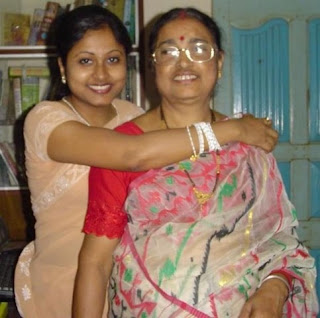
![]() |
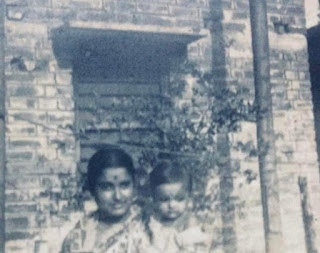
| (With Ma in 2005) |
![]() |
(With Ma in childhood) |
Bio: Lopamudra Banerjee is an author, poet, translator, editor with eight books and five anthologies in fiction, nonfiction and poetry. She lives in Texas, USA with her family, but she is originally from Kolkata, India. She has been a recipient of the Journey Awards (First Place category winner) for her memoir ‘Thwarted Escape: An Immigrant’s Wayward Journey’, the International Reuel Prize for Poetry (2017) and International Reuel Prize for her English translation of Nobel Laureate Tagore’s selected works of fiction (2016). Her poetry has also been published in renowned platforms including ‘Life in Quarantine’, the Digital Humanities Archive of Stanford University. She has been a Featured Poet at Rice University, Houston in November 2019. Her recent publication ‘Bakul Katha: Tale of the Emancipated Woman’, her English translation of Ashapurna Devi’s award-winning Bengali novel ‘Bakul Katha’ has received Honorable Mention at London Book Festival. Her recent poetry collection ‘We Are What We Are: Primal Songs of Ethnicity, Gender & Identity’ (2022) is a collaboration with Mexican-American poet and storyteller Priscilla Rice.