 SetuVolume 9; Issue 9; February 2025Setu PDF Archives EditorialPoetryExclusiveSpecial: Art & PoetryCollaborationAuthor of the MonthPersonal EssayFictionPeer ReadingsBook LaunchBook Review
New Titles
Setu Video Series of Literary and Critical Conversations/ PoetrySetu Initiative: Setu Series of Virtual Readings (Facebook Page)
|
Showing posts with label 202502E. Show all posts
Showing posts with label 202502E. Show all posts
Setu, February 2025


Special Edition: Baijnath Gupta
 |
| Baijnath Gupta |
The Helpless Earth
The Saturn from
The murky sky
Holds a conference
With the earth.
Why do you
Pull a long face?
How have you withered
At such a pace?
I lived happily
With my children
Till they tilled and lived with grace.
Then knowledge and science
Tamed their spirit
And they began a Glorious race.
They worked against nature
And cut all sources of life
With no trees in the vicinity
Began their endless strife.
In their cosy, closed cabins
Their nostrils struggled to breathe
Their dainty dwelling became their grave
And their science could not save.
The structures they had built
Have now become their tomb
I'm sad as even my tears
Cannot now irrigate my barren womb.
***
Bio: Dr. Baijnath Gupta is Associate Professor and Head Department of English, DSN Postgraduate College, Unnao (Affiliated to CSJM University Kanpur). He has edited an Anthology of Poems and has contributed twenty-nine research articles to various National and International journals of repute. He has published several of his poems in different anthologies, journals and magazines. A collection of his poems is under publication.Micro Fiction: Ethan Goffman
 |
| Ethan Goffman |
1. Context Error
I awoke vaguely prepared to slog through another day feigning patience with idiots who can’t figure out basic computer stuff. I didn’t know how much longer I could keep up the veneer of sympathy. But since I’d faced a couple of complaints when I first got the job, including one from a senior vice president, I had no choice. The whole thing just proved that senior vice presidents aren’t any smarter than the rest of us—probably dumber. The idiot executives were mandating that we spend three days a week at the corporation, although we could do the work just as well from home.
Before I left the house, though, I would have to verify my identity using the new protocol. Clicking on my smart phone, I took a snapshot of my face and uploaded it to Duo Mobile. “Context Error,” it stated. “Sign in on the Universal Website to verify your identity.” I attempted to do so on my laptop, but was sent back to Duo Mobile for verification, where I again faced an error message.
I spent much of that morning toggling back and forth between my smart phone and my laptop, hoping I could charge this all to company time. Finally, I called the company IT number. After a 17 minute and 32 second wait, a calm voice informed me that I must verify my identity on Duo Mobile before I could be helped.
“Duo Mobile is refusing to verify my identity,” I said. “Perhaps I should come to the company headquarters in person. Besides, you know me—I’m Dan Smith. I work right in your department.”
“I still need verification” said the calm, unrecognizable voice. “The new protocol won’t allow us to work with you, even in person, until you’ve verified your identity.”
“That’s impossible,” I said. “I have to verify my identity to verify my identity. It’s an endless loop.”
“I don’t make the rules,” said the infuriatingly calm voice. “I’m sorry, sir. I’d like to help you, but I can’t.”
I flung the phone across the room where it bounced off the wall and landed on my worn carpet. Grabbing the phone from the floor, I sprinted to the door, planning to hop into my slightly used Hyundai, rip across town, and confront the source of that calm voice. (Was it my coworker, Maggie, who had always infuriated me with her lack of emotion? Perhaps she is herself an AI robot.)
I flung open the door to my house to reveal, not my unkempt lawn and pre-owned car, but a blankscape with an enormous error message flashing across the sky. “Please verify your identity,” it said. “We cannot provide you with an appropriate landscape until you do so.”
***
2. The Quest for Greatness
Our friend Sherri had ratted on her brother, Lionel Bernstein, and we were all smirking at his YouTube videos. He dressed like Liberace-meets-Prince, in some videos utterly in purple, with purple face paint, in others enveloped by a flowing scarlet gown the color of fever, or a rainbow sweater with immensely long arms and a rainbow scarf that flowed to the floor. Perched on the piano bench like a lopsided peacock, Lionel Bernstein half sung, half screeched his pieces, always playing the same three or four chords, in slightly different combinations, with random runs of notes for the intro and finale. I don’t remember the exact lyrics, and I truly don’t want to refresh my memory on YouTube. But a typical one went something like: “I’m the purple pickled prince of pomp / Oh so glamorous / on this mad musical romp / my words copulate, so amorous.” He did ones with political messages, too, such as: “The planet is dying / an egg yolk is frying / I’m still getting high and / my guts out I’m crying.” People in our group would select choice moments to laugh at, picking a particularly ridiculous sentence or melodramatic gesture to deride.
“He’s always sending these out,” said Sherri. “And he gets, like, two Likes, one from our mother and one, I bet, from himself.” I wondered if their aged, arthritic mother was even able to get on YouTube.
“He’s confused,” said Krishna, with a soulful smirk. “He thinks because his name is L. Bernstein, that’s enough to make him great.”
“It’s delusions of grandeur,” said Serena, when Sherri informed us that Lionel had spent $30,000 for the baby grand and God knows how much for the array of outfits. “He thinks if he spends enough money, that’ll make him great.”
I kept quiet during these sessions, once they began opening the meetings of our little philosophy discussion group. We continued to meet every week, as we had during the pandemic. The inertia of familiarity meant that most of us had decided to remain with the group even when life was back to normal, albeit a new normal, never quite the “before” times. It was harder than ever to get out and meet new people. Personally, I could no longer stand a crowded restaurant or a live concert, despising the noise and terrified of catching some disease. Serena had even left the city and was “roughing it” in the woods, although she’d inherited enough money to have whatever she needed delivered.
I felt a certain kinship with Lionel Bernstein. Like him, I was an obscure artist, writing my little stories, publishing on tiny websites, sending them to my friend groups, trying to achieve some level of meaning and respect.
The world remained indifferent. The world would not even bother to laugh at me.
***
Groggy Monday Morning
 |
| Glory Sasikala |
-Glory Sasikala
Sometimes full, sometimes gone, sometimes not all there
Moon, despite my discomfort, your many moods I bear
Last night, at around midnight, the power went off in my bedroom... Cheepie, my pet duck, is scared of darkness and he is very vocal, the reason I don’t feel lonely at all although I live alone.
“It’s gone! The power is gone! Quack, Quack!”
Right! I switched on the torch in my phone for him and was just deciding to patiently wait for the power to come on when I remembered that the lights in my bedroom had flickered in the evening.
So I looked out the window and found lights burning in all the other towers in the apartment complex. Why do people stay up so late? So many houses had lights on.
And so, I called the Help Desk to confirm power shutdown. He said no, power had not shut down; so, it was only my bedroom. There was power in all other parts of my house. He said he’ll look into it, and I thanked him, and once again, decided to wait. But after a while, I thought I’d better go down and see for myself what the problem was. It was now around 1 am. I took the lift and went down to the gate. The water lorry was there, loading. I asked if the electrician had looked into the problem. No... he was out fixing something else.
The electrician came after a while, and I followed him to the room where all the fuse boxes were. Meanwhile, he got a call from another house in the same tower and floor as mine. Door B. He checked the fuse and found that the fuse for more than 30 houses had burnt out. Why hadn’t I reported the flickering in the evening? I don’t know. Lights flicker sometimes from voltage fluctuations.
He told me to go back home and that he would fix it. He told me to inform the Door B lady. I was so happy downstairs, wandering about late in the night. It’s lovely over here, with trees and benches and people around still... I saw a girl sitting in one of the benches and reading. I wasn’t the only one around...
I took the lift and went back to my floor, but I did not have my spectacles on, so knocked on H instead of B. They were not asleep! Again, why are people not sleeping??
Apologized...I then knocked on B and shared the information. I came back home and made a bed in the living room, and just as I lay down, the power went off for the whole house. I called the Help Desk frantically.
“What’s happening?”
“We’re repairing and have shut down the power. Please wait.”
I said okay and drifted off to sleep.
Just as I was enjoying my sleep, the power came on. Cheepie quacked joyfully, “It’s on, it’s on, it’s on!!!”
“I know. What do you want me to do, go downstairs and give them an award?”
The phone rang, “Is the power on, Ma’am?”
“Yes, but it’s still fluctuating.”
“We’ll fix it in the morning. You’re okay for now.”
“Thank you so much!”
I made my bed again in the bedroom and settled down to sleep once again.
But I was traumatized, and my mind was restless.... Food! I need food! I went into the kitchen and made a very crisp dosa with podi (it’s called idli powder and made out of two lentils and dry chilli) and ghee. I made a cup of tea.
The low bedroom light burned, and Cheepie had fallen asleep. I opened my window and sat there in the darkness, watching the night traffic pass by on the highway. I’m not sure why this excites me so much, but it does.
I’m 60 years old now, and life has become a measure of small happinesses.
I like that the light appears far away on a higher ground. Then, because of the bumps on the road, the vehicle slows down and snakes its way over. I like to try and guess what vehicle it is. It fascinates me that people are out at this hour, especially two wheelers...because this is forest area with trees on both sides and rather scary and lonely. Sometimes, a lot of times, I see very costly cars on the road at this hour...cars you would never guess were there in Chennai. One day, I saw a lovely vintage jalopy go by—red and gold. Like I said, there’s a fascination for you.
Far away, near the city lights, I can see the light of a plane gliding by every so often; the light glides down lower and lower as the plane lands... Then at the same point between two city lights, the plane light disappears.
Power cuts have interfered with my days and schedules and dreams throughout my life. I propose, the Indian Electricity Department disposes. God, I presume, has no say in the matter.
I just woke up...groggy, grumpy. It’s not enough that it’s Monday, but here I am, yet to get my two winks.
La!! I’m just warning you, I don't like Positive Inspirational Thinkers on a miserable Monday morning. Talk low...keep voices low...don’t talk...while I down caffeine and frown at my computer...
***
Bio: Glory Sasikala is a writer, poet and editor and publisher living in Chennai, Tamil Nadu, India. She is the author the ‘Sundays With Glory Sasikala’ series of short stories on Amazon. She is the author of the ‘Glorees Poems’ series on Amazon. She is the Editor and Publisher of GloMag, an International Poetry and Prose Magazine, and she is the administrator of the GloMag Group on Facebook. She is also a published novelist with two novels to her credit: Goodbye Papa (Writers Workshop, Kolkata) and She Spoke In Tongues (Setu Mag).
Painting a dystopia and beyond
 |
| Sunil Sharma |
“In Brueghel's Icarus, for instance: how everything turns away
Quite leisurely from the disaster; the ploughman may
Have heard the splash, the forsaken cry,
But for him it was not an important failure; the sun shone
As it had to on the white legs disappearing into the green
Water; and the expensive delicate ship that must have seen
Something amazing, a boy falling out of the sky,
Had somewhere to get to and sailed calmly on.”
Quite leisurely from the disaster; the ploughman may
Have heard the splash, the forsaken cry,
But for him it was not an important failure; the sun shone
As it had to on the white legs disappearing into the green
Water; and the expensive delicate ship that must have seen
Something amazing, a boy falling out of the sky,
Had somewhere to get to and sailed calmly on.”
– "Musée des Beaux Arts" By W. H. Auden
How prophetic!
The words of W.H. Auden.
A critique of a post-humanist culture of cold inheritance; the self-centred mindset, an inheritance of a post-industrial society’s atomised existence.
The lack of fellow-feeling.
Signalling the death of idealism and finer values, in a manner of speaking.
This month’s call is also linked to a similar sentiment, a kind of prescient warning, and a cautionary tale about where humanity is mainly headed!
In February, the ongoing dialogue continues with the visionary artist-philosopher Robert Maddox-Harle, the eminent Australian known for his works that decode the civilization, going for dystopia, warts and all.
A stark caveat for those who tend to be listening!
Rob Harle continues to sound the alarm bells for the cynical.
He is consistently painting and writing about the pitfalls of such a descent into a state of "techno-humanist-surrealism", a stage of development that spells the doom of humanism and liberalism as practised in democracies worldwide---the leitmotifs of parliamentary democracies; the end of the post-Enlightenment project in the Western world, due to the greed of capitalist class and other critical factors like rise of authoritarianism, a deepening climate crisis and emergence of a techno class as the dominant, over-determining modes of perceptions and reality itself.
Rob's android figures are haunting!
Like his paintings, digital and otherwise.
His photographs also capture moments and the eeriness of an absence, so beautifully, in images and words!
February’s visual supplied by him is no different to this.

Talking of the motivation, Rob says:
"This is my most recent (and probably my last) digital techno-surrealist artwork. The background shows an antiquated nuclear reactor, next to this a public alert system in case of malfunction or danger. Why? The Mamata, or universal mother, has manifested and with downcast eyes and worried countenance looks on
in grave concern. In the sky is Saturn, the planet representing earthly reality. To the left is the “Death” Tarot card, indicating not so much death but transformation through the end of one phase and the beginning of another. The image is dystopian, and is warning of the long and short term dangers of unsustainable/outmoded human practices."
The responses to this digital artwork are individual interpretations of this disturbing "warning" by an artist with a foresight.
Hope you enjoy the dialogue in the special section.
Other works are equally captivating!
Thanks to dear Rob and all the featured authors and artists for kind support.
Please enjoy!
Sunil Sharma,
Managing Editor, Setu (English)
Managing Editor, Setu (English)
BOOK REVIEW: THREE YOUNG POETIC VOICES
REVIEWED BY SANJUKTA DASUPTA

VOICE OF THE MUFFLED MELODIES
Poems
by Misna Chanu
ASIN:
B0BGDNRPL2
New
Delhi: Authorspress, 2022
Price:
295

By
Utpal Chakraborty
ISBN:
9788196793296
Kolkata:
Penprints, 2024
Rs
250
LOVE
RELIGION & POLITICS
By
Pranab Ghosh
ASIN:
B0CXTF368K
Kolkata:
Virasat Publishers, 2023
Price:
Rs 250

The uniqueness of the voice of the poet made
the English poet PB Shelley declare that poets are the unacknowledged
legislators of the world. Perhaps in sync with Shelley’s definition of poetry,
Salman Rushdie stated in his inimitable style that, “ a poet's
work is to name the unnameable, to point at frauds, to take sides, start
arguments, shape the world, and stop it going to sleep.” James Joyce too felt
that poetry had a power of dissent implied within its aesthetic wordplay. Joyce
observed that ‘Poetry, even when most fantastic, is always a revolt against
artifice, a revolt, in a sense, against actuality’.
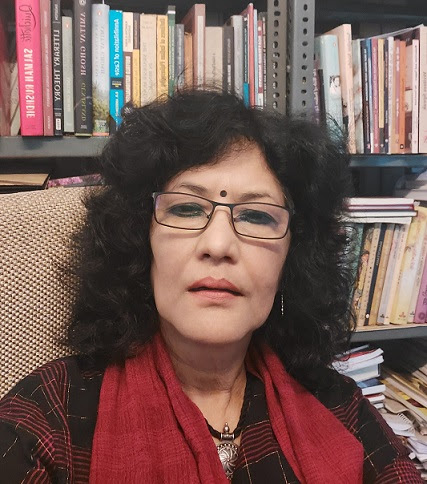 |
| Sanjukta Dasgupta |
The
Silent Whispers Voice of the Muffled Melodies is a bi-lingual
poet, writer, and editor Misna Chanu’s third book of poems. She writes in
English and Manipuri. The seventy-five poems in this book of poems are all
poems of love, love that has experienced indifference, rejection, outrage, or
even disenchantment. Love is one of the most dominant themes in poetry, each
poem therefore can be regarded as a love story, some ending in joyous fulfillment
of dreams, some experiencing excruciating pain or disappointment, shock and awe,
and unbearable experiences of trauma and hurt. So the very first stanza of the
first poem in this volume resonates with the whispers that echo in all the
poems, that speak of the love of the land, the ravaged nature, the suffering of
children, the reaching out to parents, the feeling of indignation and
resolution as one of the titles declare with conviction, ‘I Don’t want another
Son of God to be Crucified’.
So in the first poem
in her book ‘My Verses Are Stained’ Misna Chanu foregrounds the struggle of
survival, the battle that each life has to wage. The six lines of the first
verse reverberate with unrelenting violence, as she declares, ‘my verses are
stained with/silent cries/Of the unborn poems/Inside the womb of
feelings/aborted by the cruelty of time/Before the birth of a dream’. In the
poem ‘Poetry’ she describes poetry to be the portrait of unbreakable silence on
the canvas of the soul. Mystical, spiritual, illusory, sense perceptions and
affect resonate in the lines of her poems of protest and resilience such as
‘Humanity That is Murdered’, ‘Children of the Lost World’, and ‘On the Barren
Land of Forbidden Dreams’, among others. Intense monologues of love and longing
feature in many of her poems, that touch the heart and moisten the eyes.
The powerful and sensitive lines of Misna
Chanu’s third volume of poems The Silent Whispers will undoubtedly
whisper in the minds of the readers for a long time- ‘then sing,/ sing/Until
silence consumes all.’
Utpal
Chakraborty’s riveting book of poems Moonwalk in the Afternoon is truly
an experience in moonwalking, as the motion of the poems both in the wordplay
and the precision of ideas, imagination, and reflection in the content, is
stepping in time, shuffling backward towards the roots and essence of human
existence. The 51 poems in this volume span a wide trajectory, with certain
peaks projecting over the rest, in terms of the poet’s concern and engagement
with the world within and the world around. The negotiation of the experiential
reality with the subjective persona of the poet is explored and represented with
adroit use of metaphors, images, allusions, and inferences. There is also an
element of irony as well as wry cynicism in the young poet’s desire to
experience the trials of geriatrics, as he reflects in the poem ‘ A Desire’
that he is after all in the evolutionary stage of drifting from one childhood
to the second. The poem ‘Civilization’ is unabashedly tongue in cheek that
creates surreal images of ‘boiled roses and roasted lilies’. Biblical
allusions, the last supper, crucifixion, resurrection, a sense of deep
soul-searching, and confessional candour permeate a number of the poems such as
‘Love Incarnate’, ‘The Last Supper’, ‘Monochrome’, ‘Revelation’, ‘December 25’
among others. Also, the intriguing use of ‘tamarisk’ a shrub well known in
Hebrew culture, suggests the poet’s familiarity with the cultural values and
practices of the Old Testament.
Not all the poems in Moonwalk
in the Afternoon foreground Biblical allusions or address the artistic
splendour of Leonardo da Vinci. There are quite some poems that express
contemporary concerns about environmental hazards, climate change, and restitution
of nature. Among these poems the relatively longer poem Hey Thunberg stands out
as it is addressed to the teenaged climate activist Greta Thunberg. Chakraborty
draws the activist’s attention by addressing her as ‘Hey Thunberg/ See how
those who had lost the unequal battle/on the bank of the ganges/amidst the fire
of the amazon are blooming/into flowers by the roadside’. Moonwalk in the
Afternoon is a captivating read as it experiments with content and form,
including haiku, senryu, and tercets with commendable skill.
Love
Religion and Politics is Pranab Ghosh’s fourth book of poems. This
slim book of 54 poems bears all the evidence of a poet who can use language,
images, and ideas in a fine balance, steering clear of excess or blurriness.
Each of the poems addresses the poetic persona’s dilemma in negotiating with
the varied challenges of the human world. Though love is an overpowering
signifier in the poems of Ghosh, the signifier ‘dream’ recurs often in his
poems. The world that Ghosh describes is a world of hopeful and hopeless
dreams, dreams nurtured and dreams shattered. So Ghosh etches the precarious
predicament of dreams as he writes in the poem, ’Outliving the Nightmare!’ that
‘they moved, dream in/Their eyes. The world around with/Reptile eyes
observed/Threatening to devour ‘The dream’. Elsewhere the poet thinks of a
world of peace as in three half-lines we sum up a non-militaristic, non-violent
world of peaceful co-existence- Dream of a place where/No jackboots and
bayonets/Keep peace.’ ( Dream 2.0).
Love, Religion, and Politics
also include two long prose poems titled ‘After He Lost His Soul Existential Question’
and ‘After he lost his soul 2.0’. These poems are deeply introspective, and self-analytical,
gesturing to an existential dilemma and a sense of deep psychological stress
that made the poet converse with his inner-self of anxiety. These ten pages
that focus on an interiorized soul-searching, is the poet’s unique manner of
breaking free from the experiential world around. The process of rising out of
depression and renewing one’s commitment to the magic of love and life is
graphed as the poet’s way of reclaiming his lost soul. In Ghosh’s poems, the
search for love and harmony are pervasive, and the final poem in this volume,
‘The Song’s Over: Remembering Pink Floyd’ engages once again with the
postmodern indeterminism that overwhelms the poet’s mind- you look into/The
roots of/ Creation and find/A ticking heart/Pumping blood into/The veins of
civilization/The destroys itself/Before and after/ Renewals!’
All three books of
poems, The Silent Whispers, Moonwalk in the Afternoon, and Love, Religion
& Politics prove beyond doubt that Indian poetry in English has
undoubtedly claimed a significant space for itself in the domain of 21st-century
Indian literature.
Fiction: Rain
 |
| Pranab Ghosh |
-Pranab Ghosh
I.
Sound of rain, as if from a distant land, from another day of half-forgotten past, lashes the window pane. It has a sweet resonance. A cadence. Rising and falling. Rising and falling. Sound of wind... of rain...of rain and wind! Rosita's face contorts. ...Sound of wind hissing...rain beating against the glass window...a thunderbolt... rain, wind, thunder...sound of rain...wind...thunder...of gurgling cloud pervades Rosita!
She twists and turns...
“Who is he? Or She? Or...?”, Rosita turns!
A figure, so crooked yet so bright! He is taller than the trees! He is on a horse.
“A figure so twisted? Riding a horse...”. Rosita raises her hand to cover her eyes!
She cannot stand the twisted man, drenched in rain.
A lightning... a pair of burning eyes. A pair of eyes on a horseback... a black horse...! A pair of red, swirling eyes pierces Rosita, who shrieks and rolls over.
A pair of glaring eyes... faint sound of rain beating the window pane... wind hissing!
Rosita wakes up. Her mouth is dry and bitter. She looks for the water jug.
It’s 4.30 am. It’s pitch dark outside. The sound of rain and wind, of gurgling cloud is so pervading! “Where is the jug?”. Rosita looks for her mother!
She has had dengue. She had fever a few days ago. Her temperature was normal yesterday. She was however, confined to her room. She had been there for the last six days.
It’s mid-September and it’s still raining in Delhi. The monsoon refuses to leave. There isn’t so much rain every year. There wasn’t so much rain even last year or the year before. In fact, there wasn’t so much rain in the last 25 years! The news channels said so.
Rosita has not gone to school for the last six days. The bitter taste in her mouth, effect of antibiotics, makes her bitter. She wants to yell at her mother.
“Where’s the jug of water?”
Rosita remembers the pair of burning red eyes. She looks out of the window. She sees streaks of light. It’s 5 am. She has been sitting on the bed for half-an-hour now!
A black horse? A twisted man. Rosita is recovering. She can go to school in a day or two.
“Who is the twisted, mounted man?”
Rosita calls out, “Ma...Ma...”!
...................
II.
A shepherd boy. He is sitting under a tree in a forgotten valley. Is he humming a tune? Where is his herd of cattle? Why will he be a shepherd boy? So thought Nilanjana!
He has big dreamy eyes... locks of hair kiss his shoulder. Unmindful of the admiring eyes of Nilanjana he is humming a tune in the forgotten valley.
Nilanjana no longer remembered the name of the valley that she visited with her parents years ago. She only remembered the big dreamy eyes, the unknown tree under which he sat and the rolling greenery that met the horizon in an unknown place. Where would that place be? Had the shepherd boy ever been to that place?
It’s mid September. Nilanjana is standing alone in the verandah overlooking the Calcutta Medical College. The street below is busy. It’s not so wide. It connects College Street with CR Avenue.
Nilanjana had walked down the street, how many times, she had forgotten. She knew every building on the street... the booksellers on the pavement, the person selling sugarcane juice, the bookstall specializing in second-hand medical books... she knew them all!
She looks down at the street. She sees a cart puller... a taxi...she hears the honk of the yellow taxi. She recognizes nothing! Everything, from the cart puller to the red brick wall of the Medical College, fades away, dissolves into nothingness!
Her hands are on the rail of the verandah. Her grip on the iron fastens. She likes the touch of the cold lifeless metal. A drop falls on her left hand. A raindrop. She looks up.
The sky is overcast now. Where did all the clouds come from? When did they gather?
It was sunny when she had come to the south-facing verandah of her university. The classes had been called off that day and everybody had left! Nilanjana stayed back. Who was she waiting for?
‘What time is it?’ Nilanjana thought. She had forgotten to put on her watch that day, and she did not carry a mobile phone! It looked like 6 o’clock in the evening.
The valley comes back with its trees and lush green fields... the horizon... the shepherd boy!
Rain began to fall. First in a trickle, then gained momentum. Nilanjana was hit by the incessant drops – big ones. She did not move an inch! Why was she standing there? She had forgotten.
The valley is all over the place!
Nilanjana’s eyes moistened.
Someone touched her shoulder. The shepherd boy? She looked back. “Oh! It’s you, Rohit? It’s been hours now that I have been standing here!” Nilanjana’s voice trembled.
Rain drenched Nilanjana touched Rohit’s forearm.
Is he the shepherd boy?
...........................
III.
“Do you remember Sayan?”
“Ah! Who can forget him Mridul? Mridul, you and Sayan were inseparable! Weren’t you”
“Where have you been all these days, Mridul? Mridul, do you still remember September 15, 1975? It had rained all day... . The roads in our village had become muddy. You could barely walk on those. My father had come to know about our relationship! He was keeping an eye on me.
“He was an orthodox Brahmin. He could not stand the thought of her only daughter getting married to a Kayet*- that too unemployed! You were 21 then. 21. You had dream in your eyes. Dream. You wanted me to dream too. I used to get scared. You spoke about a new ‘morrow’, which would belong to us, our children!
“It was almost seven in the evening. I managed to sneak out. You were waiting near the Shiv mandir* where Ichhamati* turned left. ...
“Do you remember Ichhamati, Mridula? The fishermen in their boats? The bhatiali* they sang in the evening? How we sat in trance listening to the sad melody, which the breeze brought to us. The song, sometimes so close to you that you could, as if, touch the fishermen singing it; sometimes coming from a distant land, far far away from you. Mridul, you held my hand that evening and vowed by the fishermen’s song to stay together till death.
“That was the last I saw of you!”
It’s mid-September. Urvashi is walking down the Orchard Road, a high street in Singapore, oblivious of the surroundings. The neon, which had always enthralled her for reasons unknown, had lost their spell! The shoppers, the merrymakers, the busy executives – all walked past her unnoticed. Their broken voices, honk of cars, the sound of her high heels hitting the pavement – could barely break her trance.
“Mridul. Mridul.”
This was one of those days when darkening clouds transported her to her forgotten past.
To Mridul!
It had been cloudy all day. Clouds, however, thickened in the afternoon. It was 4.30 pm. She had been walking for half-an-hour now!
A car screeched to a halt. A black BMW. The door was thrown open. “Here I am, sweetheart!”, said a known voice. She had been serving the voice for six months now. The BMW picks her up every Friday at 4.30 pm sharp, from somewhere on the Orchard Road. It had been a weekend business. The voice paid her well! “Come,” the voice got louder.
“Mridul will have hated me for this and for all that I do now! Will he not? But what else could I have done?
“I have kept my spirit alive! I rebelled against my father. Not for you, Mridul. You weren’t even there then. You were nowhere. Not for anyone else...! I am lost today, Mridul. Or am I?”
The dreamy eyes of Mridul, his smiling face, his unkept promise beckoned her from the horizon.
She ignored the ‘voice’! She walked on. A big drop of rain fell on her forehead. She walked on.
It began to rain. It rained hard. She walked on!
It has been raining in her mind! She walked on... .
........................
IV.
“The bloody hellhound! The rotten basrard! Do they not have wives at home? Mothers? Sisters?”
He almost gagged her last night. So great was his urge to satisfy his desire. He had been doing this for six nights at a stretch now. For six nights she had endured hell. She liked it at the beginning! Almost. It’s, however, hell now.
She was sitting at the corner of the pavement. It was 9 pm. Mid-September. She had been sitting there for two hours at a stretch. Hurling abuses. Playing with dust, all the while!
Occasionally she was picking up a stone and hurling it with all her might at the passing car. It had been her favorite pastime for some days.
He had beaten her up once for doing this. “The son-of-a-bitch”!
He had coaxed her on the first night..., bought her puri-sabji in the evening..., then took her to the deserted field at the side of the highway, at the middle of the night. There were only heavy trucks plying then. No one missed the constable at the traffic intersection! It took him 10 minutes. She did not resist.
The last night, however, was unbearable. He was off duty. He tore her into shreds. So great was his lust. She shrieked. Cried for help. Fought hard to set herself free, but could not. She went through hell. “Let me lay my hands on the bustard tonight, I will cut him up in pieces,” she promised herself.
She was suffering from pain even after 21 hours of the rape. She did not even know what to do. She clutched the dust on the road with a bitter force that made her fingers ache. She spat on the pavement. She remembered his stranglehold on her last night and felt the same breathlessness. She pulled at her hair, hard. Something moved inside her abdomen. She threw up.
Rain began to fall. It washed away all that she had vomited. It was raining hard. She was wearing the yellow sari, which he had given her two nights ago.
....
A baby – a boy or a girl – she knew not, was crying at some distance! Somewhere, where it also rained. Hands took the baby away from her...! A baby was crying, as it always did. Hands took the baby away, as those always did. She heard footsteps, hurried; voices, muffled; as she always did.
... Muffled voices... baby crying... footsteps...! Hands pulling at her...!
A loud bang. Excruciating pain. Is she going blind? Pain in the head. A fall. Muffled voices. Footsteps. Hands pulling at her. A sense of loss...
Rain always brought these sounds and images to her! Of a baby crying somewhere, where it also rained.
Drenched she stared ahead. A blank, lost look!
He appeared. In a fit of rage she stood up. Then bend. Picked up a stone and threw it with brute force at him. He stepped back, bewildered. She had never been violent at him before!
She spat on him. Turned away from him. Then turned towards him. Moved a step closer. Pulled the sari away from her body and threw it at him. Spat on him again. Spat on the pavement. Turned around. Began to run! She was running with rain beating hard on her face, on her naked breasts, her abdomen, her back. She was running.
The baby was crying somewhere, where it also rained!
..............
Notes:
Kayet, colloquial of Kayastha, a sect of people among Hindus in India.
Shiv Mandir: Temple of Lord Shiva
Ichhamati: A river that flowed through West Bengal
Bhatiali: A genre of Indian music
Poems by Laksmisree Banerjee
 |
| Laksmisree Banerjee |
The Phoenix and Cacti
(In memory of a Corporate Fire Tragedy in
1989 causing a lifetime Injury to the Poet)
Survival
is a gruelling task
when
severely injured through
cruel
negligence of another
One
more day of their heat-eyes
standing
erect as a black reminder
afflicting
me into perpetuity
Their
glare a spike in my flesh
though
they often conspire
against
my pulpy softness
I
manage to return the spike
with
struggling deliberation
against
destiny and the doers
Their
eulogies, emptiness, flowers
Explode
into envious slips of flame
ignited
callously at my back
Pushing
them into some unknown
judgement
day I am sure of
yet
my injuries remain irrevocable
On
that haunting day of hailing the Visionary
with
unforgettable cramping memories
of arrogant pomp with no vision or piety
Their
incendiary pavilion full of
meteor-eyes
fuming as if to
have
me burnt to ashes
When
the flames ate my flesh and silk
someone
enthused with callousness
“but
isn’t she scarred beyond recognition?”
That
day I garnered my realization
from
the ruins of reality
from
the cinders of cruelty
The
fire tearing at my spirit and body
writhed
upwards and inwards
like
a hungry, lascivious female ---
My
arms and soul outstretched
an
umbrella hard to open
to
save my only fledgling
Times
have gone by since that inferno
but
I have risen with the rainbows
in
rain and sunshine from the ashes
A
tigress or a phoenix I do not know
never
debilitated nor sunk
yet
unable to cremate
The
charred corpses still deep inside
bristles
over-crowding within
a
tangled forest of cacti---
REPAIRING A BURNT BODY
The
doctors saw my body,
scarred,
naked
and
shamelessly identifiable
The
scorched moon dying
with
the shrinking sun
in
my blood
My
splintered self
breaking
under the scalpel
with
my simmering corpuscles
A
lump of flesh examined
closely
by burns specialists
while
I made my consciousness
and
awakening
wait
outside ---
The
body had to revive
and
the spirit to die
with
wilful erasure
Though
I never allowed
the
hard rocks in me
to
ever wane or dissolve
Photographs
of my
snake-skin grafts
helped
Dr. Bhargava
to
fetch his degree
Masters
or Doctoral
in
the skilled art
of
redeeming
burnt
bodies
I
wailed in searing agony
with
outstretched, dishevelled limbs
While
he pulled out my bandages
to snap-shoot my bleeding wounds
BOUQUET
OF FLINTS
My
body feels like a grave
With sprouting flowers
Adorning
its lovely crafted facade
My mind a lonely peak
Free
and breezy at the summit
In its dizzy stance of
World-watching
in aftermath
Defying the storm.
The
cinders inside have
Caused efflorescence, transformed into
Endless
contentment of victory
And forced tumescence
At
having known and conquered it all.
I
have learnt to walk on burning coals
And feel yet the icy cool,
The
balmy wind playing on my face
And the slag of black pains
Which
I have waded across
Gathering still in memory
The
aromatic white sprinkles
Of the springtime grounds.
I
have faced it, fought it,
Learnt to accept the scars
Of
hidden illness as trophies
To make my bouquet
Of
flints and sparks of victory.
Now
I see
A scintillating, slim ray
Across
an endless foliage
Perhaps my fractured sun
Will
rise yet again
From the violent billows
And
touch me with his baby-pink
Soft incandescence
To
light my thorn-ridden path
Perhaps, perhaps someday ---
Special Edition: Candice Louisa Daquin
 |
| Candice Louisa Daquin |
Our mother is concerned
After
Robert Maddox-Harle
You have stayed out late again, light in the streets
your only route home, they dim and sputter with a
ransacking irregularity, like a heart beating beneath
wood. You didn’t attend the funeral, there in the
uncluttered
part of your soul —you
remained behind as we
gathered all our black clothes and tutting at their
fading, ran for the car on thin heals. Rain blocked
all sound
that day —the
same day you turned from the window like
a flower angled out of light, dropping your folded
arms
into space, into a room of your own, nobody could ever
enter.
I sit by your bed, fidgeting with the loose hems of
your blanket
familiar and all strange; your mouth is loose and
silent, your
long pianist fingers rest atop the sheet, like gentle
brail. I read
our favorite children’s books aloud —my voice cracking with disuse
and tears. There is a jar of old flowers, dried by the
sun, that sit
in a simple poise on the window sill. I think if you
could; you’d
ask me not to disturb them, even if our mother wants
to
claim this space and clean it of its mote and its
memories.
I will not let anyone in —this
will be our time. perhaps in a month
or two, the clock will start ticking again —and you, tired of
death, will shrug it off and open the piano.
***
The faraway claimed world
Evaporate plays on the brown lines of your skin
where birds challenge balance and crowd budding trees
I think of you. The way you combed your hair erratically
leaving curls in every direction, how soft the tips of
your
fingers, when I brought them to my mouth. There is a
quietude
in loss —terrifying
and opiate like. I have sat in the same position
for the whole day, unable to think of one thing to
say. Your
shadow passes the dining room, crosses past the old
mirror
in the landing and flickers with daylight up the
stairs. I long
more than once —and
less than twenty times, to follow you —
to discover you lying on our bed, smiling that secret
smile you
know entranced me. The contrast of your skin against
white sheets
your smell enveloping me. I want to turn around and
not see
shadows from the corner of my eyes, but the wholeness
of you
never broken —never
lost, reclaiming your place. It is midday now
and the light has changed; casting latticed strips of
blue and purple
on our walls. I say our, but they are only mine
now. Your mother is
concerned —I
don’t return her calls. The pen you used to write something
the last day of your life; sits atop a stack of
letters, neither of us wrote.
I can taste ink in my mouth, the flowers keep being
sent —
one day they will need burying too, along with my
sense of
safety. A kingfisher swipes a small fish from the pond
and
as it lifts out —wet
and shining, the fish spasms in a last vain
attempt, to free itself.
***
The insidious mastery of grief
In the unfolding world of your mouth
Asian lilies bloom their heady perfume —rogue
with wild. It has been 1245 hours since you died
the sun stubbornly shone, despite you being put
in a box under earth. My hair is short now; entirely
unlike
the me you knew. I have cast off the compunction to
exist
beneath your gaze. It rains like a mirror into another
universe
catapulting me back to afternoons I lay under you —listening
to the catch in your chest turn and wind. Our ghost
steps
from an over-hot bath, her ebony skin releasing steam
like a
hot-house plant. Even though I cannot see her face, I
know she
is smiling in the luxuriate of solitude. Fast-forward
and nobody
smiles at being alone. We gather balls of yarn and
attach them
to people when they’re not looking. Kites as bright as
your eyes
were once, fill skies with lament until unseasonable
rain
pulls them downward, plummeting wet red birds to
reaching
hands. You filled our walls with art —I removed all of it, save one
painting of you as a child. like a photograph, you are
watching
something out of view, as if your life depended upon
it. I see
the clutch of your little fist, how your thick hair
fell over your
shoulders in much the same way. Micro-aggressions
flicker
at the corner of your eyes and mine. I am older now
and years fall heavily with a patchouli sorrow, stirring
through
the deep coffee mines of your pupils —trying to adjust to the dark.
Bio: Of Egyptian/French heritage, Candice Louisa Daquin is an immigrant working as a Psychotherapist in America. She is also Associate Editor for Raw Earth Ink and Queer Ink and Poetry Editor with Parcham Literary Magazine and Tint Journal. She co-edited the award-winning anthologies; The Kali Project and SMITTEN. Daquin’s last collection of poetry was Tainted by the Same Counterfeit. Her debut novel, The Cruelty, comes out fall, 2025, published by FlowerSong Press.
Subscribe to:
Posts
(
Atom
)