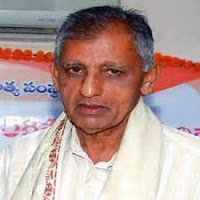
Dr. Basavaraj Naikar. M.A., Ph.D., D.Litt. (California), UGC Emeritus Fellow, & former Professor and Chairman, Department of English, Karnatak University, Dharwad-580003, INDIA, is a bilingual writer both in Kannada and in English.His English publications include The Vacanas of Sarvajna, Critical Articles on Nirad C. Chaudhuri, The Folk-Theatre of North- Karnataka, Sandalwood, Sparrows, Beloved Poems, Kanakadasa, Critical Response to Indian English Literature, The Literary Vision, Perspectives on Commonwealth Literature, Indian Literature in English Translation, Glimpses of Indian Literature in English Translation, The Dramatic Imagination, The Dramatic Vision, English Literature in India: A Literary Communion, A Harbinger of Harmony, Sri Krisna Parijata, Nirad Chaudhuri As a Critic of Modern Culture, Focus on Indian Drama in English Translation, Indian English Drama, Essays on Comparative Literature and Translation, and Paradise Lost & Regained: A Modern Prose Translation.
His The Thief of Nagarahalli and Other Stories was shortlisted for the Commonwealth Fiction Prize for the Best First Book from Eurasia for the year 2000. His first historical-political novel, The Sun behind the Clouds deals with the colonial encounter between Bhaskararao Bhave of Naragund kingdom and the East India Company during the 1857 Indian War of Independence. The same theme is dramatized in A Dreamer of Freedom. His second, philosophical novel, Light in the House deals with the life and mission of Sharif Saheb of Shisunal, an apostle of communal harmony between Hindus and Muslims. His third novel, The Queen of Kittur depicts the heroic life of Rani Chennamma of Kittur and her struggle with the East India Company around 1824. His Rayanna, the Patriot and Other Novellas depicts the extraordinary lives of Jakkanacharya, Kanakadasa, Raja Mallasarja of Kittur Kingdom and Rayanna of Sangolli. Bird in the Sky & A Pontiff of Peacockshire, delineate the miraculous lives of the super-saint of Hubballi, Sri Siddharudha Bharati and Nagalinga Avadhuta of Navilugund. His latest novels are Intrigue at Ikkeri, A Noble King of Bidanuru, The Warrior Queen of Keladi, A Democrat of Devotion, and A Glorious Emperor of Vijayanagara.
His translations from the Kannada into English include Fall of Kalyana, Sangya Balya: A Tale of Love and Betrayal, The Vacanas of Sarvajna, The Holy Water, The Frolic Play of the Lord, Sri Krisna Parijata, The Collected Short Stories of Kuvempu, The Mystic Utterances of Basaveswara, Mystic Warbles of Akkamahadevi, Ecstatic Wonder of Allamaprabhu and Songs of a Ferryman.
His critical and research articles in Kannada and English have been published in regional, national and international journals. He reviews Indian literary works for World Literature Today, Oklahoma, USA and for many Indian journals regularly. His research interests include Indian English Literature, American Literature, Commonwealth Literature, Anglo–Indian Literature, Shakespeare Studies, Translation Studies, and Comparative Literature. He has a passion for music and philosophy in general. He is married and has a son.
He lives in Dharwad, Karnataka, India.

*****

Prof Basavaraj Naikar:
Good morning, sir. I am glad to note that you are interested in translation
studies.
T.S.C.M:I
request you to share with us details about your childhood, education, career
and academic as well as creative work.
Prof B.N:
I was educated at the Practising School of the Government Training College for
Men at Dharwad up to my fourth standard. Then I continued my education at the
Municipal High School at Naragund, my native place. I was seriously trained in
Hindustani classical music and used to participate in many programmes along
with my guru, Sri Dattubuwa Thakurdas. My father wanted me to be a great
musician by discontinuing my education, but my music teacher Sri Dattubuwa
advised him not to discontinue my education until I pass my Matriculation Examination,
and that I could shift to a musical career afterwards. Meanwhile my father
expired when I was only 13 year and my younger brother Chandramouli was only
ten. Thus there was a radical change of direction in my life. After passing my Matriculation
exam from Naragund I went to Dharwad and joined the Karnatak Arts College and
the Karnatak University and passed my M.A. in 1972. In my college days I
studied English as my major subject and Kannada and Sanskrit as my minor
subjects. In my M.A, I studied American Literature taught by Professor
T.R.Rajasekharaiah and Indian Writing in English taught by Dr. M.K.Naik. By
then Professor Armando Menezes had retired as a Professor & Head of the
department, but used to teach us some texts. He was a classical scholar with knowledge
of several European languages like Portuguese, French and German etc. He was a
very inspiring teacher and very genial to his students. He recognized my
artistic sensibility as I used to play on the stringed instruments like Bulbul Tarang and given me an excellent
testimonial, which I have preserved even now. In my youthful enthusiasm, I had
promised him that I would translate Milton’s Paradise Lost into my mother tongue, Kannada later in life. But I
could not fulfil that promise until after my own retirement. Recently I have
published Paradise Lost & Regained
not only in Kannada prose form but also in English prose form for the benefit
of all the graduate students. After passing my M.A., I was appointed as a Research
Assistant in the Department of English at the Post-Graduate Centre of Karnatak
University, situated at Gulbarga, where I carried out my doctoral research on
Shakespeare’s Last Plays under the guidance of Professor T.R.Rajasekharaiah.
Then I was promoted as Reader in English and again re-appointed as Reader at
Karnatak University, Dharwad. Subsequently, I was promoted as Professor and
served as the Head of the Department for three times and retired in 2009. Then
I became a UGC Emeritus Fellow between 2011-2012 for two years and completed my
project on “Representation of History in Indian/English Drama” successfully and
published it from New Delhi.

T.SC.M:
As we all know translations of literary works enrich a language and enhance
opportunities of intercultural understanding. Kindly throw some light on the
practice of translation in India.
Prof B.N:
Although India has a rich tradition of as many as twenty two officially
recognized regional languages; the translation activities have not been
proportionate to its rich traditions, which is a sad state of affairs. Only
recently some voluntary publishers have opened their eyes to the publication of
translations, but there has been no systematic attempt by any Sahitya Academy (including State and central) or
University (State as well as Central) to get all the well-known Indian classics
of all the major religions and cultures translated into Hindi and English at
least, if not into other sister languages. The entire adventure is left to the
sweet will of so-called big publishers, who are shamelessly commercial,
nepotistic, communal and provincial in their selection of books for translation
and publication. The translation of all the classics into all the twenty
languages will result into a big number of 440 translated texts. But who will
bell the cat? The Harvard University Press has set a model for the Indian
academies and Universities to follow the adventurous task of getting the
classics translated into English and Hindi. Translation will definitely enhance
the understanding of people about their neighbours and will pave the way for
national integration. In India translation has been the choice of voluntary
scholars who are looked down upon as second-rate citizens with no proper
recognition, fat prizes, awards and rewards for them. What I wish is that at
least some four Central Universities of India in the north, south, east and
west should begin the publication of a series of translations on the model of
Harvard University by appointing or inviting veteran translators by offering
them fat salaries. The classics of all religions like Hinduism, Virasaivism, Sikhism, Jainism, Parsi and tribal cultures
should be selected on a fair basis without any partiality or prejudice. Otherwise,
the publication of translations will be slipshod and chaotic as it has been
now. In my view, the first priority
should be given to the translations (into Hindi and English) of all the ancient
and medieval classics and not to the modern or contemporary mediocre works like
fiction and short fiction. It is surprising to know that many of the English
translations of Indian regional texts are published in America and studied in
their universities for the last two hundred years, but the same translations
are neither available in India nor studied or taught seriously by our
University professors due to their slavish colonial mindset.
T.S.C.M:
Did you study translated texts as a child and as a student subsequently?
Prof B.N:
I did not study any translated text as a child or even as a High school
student. But when I joined College, I started reading some Kannada translations
of the Ramayana, the Mahabharata, and the Bhagavata. I was really fascinated by
A.R.Krishnashastri’s Vacana Bharata.
As I was to be a student and teacher of English literature, I did not have to
study Kannada translations extensively as it was outside the purview of my
research and teaching. Later in my teaching career I read and appreciated the
English translations of Greek classical Drama, French fiction and short fiction
(of Flaubert’s Madam Bovary and
Maupassant), German poetry like Goethe’s Faust,
Dante’s The Divine Comedy, Spanish
fiction like Don Quixote, and Russian
classics like Mother, Crime and Punishment and Dead Souls and Sanskrit plays like
those of Kalidasa, Bhasa, Bhavabhuti and Sudraka etc. You may be surprised to
know that I found the English language in the English translations of European
literature more fascinating than the English language used by the native
British writers, perhaps because, as I think, it involves two slightly
different cultures, regions, manners and philosophies.
T.S.C.M:
What are the salient points of Indian tradition as regards literary translation,
sir?
Prof B.N:
There is no one India, but there are twenty two Indias hidden in the twenty two
regional languages. Nobody can generalize about them. Even the big Central
Sahitya Akademi cannot make any comments on such a problem.
T.S.C.M:
Could you trace history of translation in Kannada?
Prof B.N:
Kannada has a sufficiently rich tradition of translation. Shakespeare’s plays
including many tragedies and comedies have been translated into Kannada right
from the 19th century. Nilakanthegowda and Basavappasastri were the
earliest translators. Masti Venkatesh Iyengar has translated a few plays of
Shakespeare into Kannada. A few of Kalidasa’s plays and Moliere’s Tartuffe have been translated into
Kannada and have been quite popular. BMSri is well known for his English Gitegalu. Nowadays there is an
increase in the translational activities in Kannada, especially due to the
Kuvempu Bhasa Bharati and offering encouragement to translators in terms of
assignments and awards. It is getting a history of Kannada translations written
by somebody, which is a welcome venture and will be highly useful to the future
students and scholars. Nowadays several European and even Russian texts are
being translated into Kannada by voluntary scholars, although there is no
systematic direction to it. There is no systematic planning in undertaking the
task of translations into Kannada. For
example, many Western epics other than the Iliad
and the Odyssey have not been translated
into Kannada. Similarly, the Chinese Yuan Drama and the Japanese Noh Drama have
not been translated into Kannada. Leave alone Europe, even the plays and novels
of other regional languages of India are not translated into Kannada in a
systematic and on a large scale. Little is done, but there is more and more to
be done. This apathy is due to lack of institutional encouragement to
translations. Until and unless world literature in Kannada translation is
prescribed, taught and learnt by the teachers and students, translation theory
and practice will not thrive and comparative literature will not burgeon forth.
In my view translation Theory and Praxis and Comparative Literature are the
crying needs of the hour in India now. The Kannada scholar babble a lot about
the concept of ‘Visva Manava’ but are not willing to read the world literature
in translation, which is a great irony.
T.S.C.M:
What differences one may notice between Indian aesthetics and those specific
to Kannada, sir?
Prof.B.N:
You mean Sanskrit aesthetics by Indian aesthetics. In my view there is no
‘Indian’ aesthetics. We generally mean Sanskrit aesthetics by Indian
aesthetics. There is a lot of difference
between Sanskrit aesthetics and Kannada aesthetics, but it has not been
theorized by our scholars so far. Nowadays they have started talking about a
separate Kannada aesthetics or poetics, but it is very simplistic and not as
scholarly as the Europeans have developed. Again the Kannada poetics has to be
subdivided into Virasaiva poetics, Jain poetics and brahmanical poetics. The
brahmanical poetics is a continuation of the Sanskrit poetics with its belief
in the concept of Nine Sentiments (Nava
Rasas) and eighteen descriptions (Astadasa
Varnanas). It is still hung up on mythological themes and obsessions like
the Ramayana, the Mahabharata and the Bhagavata traditions. But the Virasaiva poets of twelfth century
Karnataka rebelled against the Sanskrit poetics and developed their own poetics
by giving up the tenets of Sanskrit aesthetics. They gave up the concept of
Eighteen Descriptions, rebelled against the elitist language of Sanskrit and
advocated Bhakti literature which could be understood by the common man. But
even then they did not overcome their obsession with gods, especially Siva.
Likewise, the Jain poets also rebelled against Sanskrit poetics as well as
Virasaiva poetics and developed their own forms of poetry based on their
religion, but neither the Virasaiva nor the Jain scholars have developed
advanced theories of poetics which could be placed in a wider perspective of
the international theories. But the Jains also have not overcome their
obsession with gods and spirituality. There is hardly any secular, elemental
and universal depiction of man’s life in Virasaiva and Jain literature. They
just talk about simple differences between different schools of poetics, only
because they lack an international perspective due to their ignorance of
English language and literature and the related philosophies. Here again some
British or American or German or French scholar has to come and theorize their
poetics for them, which is ridiculous. It is like the post-colonial theories
developed by the Western scholars for the colonized people, who have that
experience but cannot theorize about it. I complained against this desideratum
as early as 1988 in a public lecture. Nowadays young scholars are toying with
the idea of developing such theorization, but have not made any conspicuous
progress in that direction. Many English professors who have turned out to be
‘great Kannada scholars’ babble a lot about the Western theories with supreme
confidence, as their scholarship is nothing but an adventure of memorizing and
summarizing. But they also cannot theorize about Kannada poetics as they lack
the deep knowledge of old and medieval Kannada literary tradition, because they
are too westernized and have no roots in their own cultures.
T.S.C.M:
How did the practice of translation of literary texts enrich culture among
Kannada speaking society?
Prof B.N:
It has opened the vistas of world literature to the Kannada people to some
extent, but not to a conspicuous extent. It is only bilingual scholars who
engage themselves in this activity, which is not properly recognized and
rewarded. The pure Kannada scholars (i.e. who know nothing about English
literature) do not respond properly to these translations due to their
ignorance and unwillingness to extend the frontiers of their knowledge.
T.S.C.M:
Do you translate from Kannada into English or from English into Kannada, or
both ways?
Prof B.N:
I have translated from English to Kannada and vice versa also. For example, my Kannada translations include Androsina Kanye mattu Phormio, ,Jogibhavi
mattitara Natakagalu, Nigudha Saudha, Govardhanaram, Bharatiya English Sahitya
Charitre, Kempu Kanigilu mattitara Natakagalu, Vira Beowulf, Gilgamesh
Mahakavya, Lusiads Mahakavya, Shakespearena Sunitamale, Kaledukonda Bhukailasa
mattu Marali Padeda Bhukailasa, and
Divya Prahasana or Danteya Darsana (which is to be published shortly).
Likewise, I have translated many Kannada
works into English, which include The
Frolic Play of the Lord, Sangya-Balya: A Tale of Love and Betrayal, Sri Krisna
Parijata, The Holy Water, Fall of Kalyana, Collected Short Stories of Kuvempu,
the Vacanas (mystic utterances) of Sarvajna, Basaveswara, Allamaprabhu,
Akkamahadevi, Ambigara Chowdayya, Sri Satya Sai Baba’s Bhagavallila, and Paradise
Lost & Regained: A Modern Prose Translation.
These two experiences of translating from
English into Kannada and from Kannada into English have sharpened my linguistic
sensibility and knowledge and in turn helped me a lot in my creative writing of
fiction, short fiction and drama also directly and indirectly. In fact, the
experience of translation has acted as my impersonal teacher in the absence of real
or willing teachers in my academic life. Initially I engaged myself in the act
of translation due to my terrible loneliness (both physical and intellectual),
which was a great curse for me during my exilic life at Gulbarga University,
Gulbarga.
T.S.C.M:
You are a well-known creative writer, eminent literary critic, erudite
academic and prominent translator. Did you have any formal training in
translation work?
Prof B.N:
No sir. I did not have any formal training in translation. During my M.A.
course, I had to opt for Indian Writing in English and American Literature in
lieu of Linguistics and Phonetics. I hated phonetics as well as the arrogant
teachers of phonetics with their up-in-the air feeling from the bottom of my
heart. (The main reason for my anger with phonetics was not against it, but it
was against the teaching of it at the post-graduate level. According to me this
phonetics should be taught at the beginning level, i.e. PUC level of the
college education and not at the post-graduate level. What they have been doing
now is as ridiculous as putting the cart before the horse. I am dead against
that practice.) But I read a lot about linguistics on my own and greatly
appreciated Chomsky’s writings on language, because Chomsky was not a mere
linguist but a philosopher. During my teaching career translation had not been
popularized as it is now. So I had no formal training in translation. I learnt
the art of translation on my own by trial and error method and my fascination
for bi-cultural vision of life and ideologies.
T.S.C.M:
What are the issues you encountered in translating fiction?
Prof B.N:
The main problem for a translator from Kannada into English or vice versa is the two different
linguistic sentence patterns. That requires an inwardness or intuition to
communicate the thought of the source language to the target language without
sounding very artificial. This is not always possible. What an Englishman says
in a lengthy and complex sentence has to be divided into many independent
sentences in Kannada. Contrary to this problem What a Kannada writer says or
writes in many independent sentences could be compressed into one long and
complex sentence. Both these arts require sufficient mastery over two
languages, which is not a joke. It takes decades together to accomplish this
expertise. Secondly, the difference between two texts belonging to two
different cultures like the Western/Christian and Indian/Hindu cultures adds a
lot to the problem. Many times we do not easily understand the meanings of
English words with French, Greek and Latin quotations and other technical terms
of religion and theology. Even if we understand them, it is not possible to
find convincingly equivalent words for them. Similarly it is not possible to
find English equivalent words for Kannada culture-specific words like pranalinga, prasadi and jangama etc.
T.S.C.M:
Did you translate drama from Kannada into English? Share information, sir.
Prof B.N:
I have translated Dr. Kalburgi’s Fall of
Kalyana, Pattar Master’s Sangya-Balya
and Kulagodu Tammanna’s Sri Krisna Parijata
into English. I found all these plays very difficult to translate due to
several songs or vacanas contained in
them and the culture-specific technical terms of religion and philosophy,
idiolects along with Sanskrit tags and several classical references in them. I
had to struggle hard to domesticate my translation to the maximum extent. Many
times I despaired, but then again took it as a challenge and completed the
translation successfully. I found all these three texts tough to translate.
T.S.C.M:
Which text proved tough to translate?
Prof B.N:
My translation of Camarasa’s Prabhulinga
Lile into The Frolic Play of the Lord
was the most difficult of all for me to translate. I prepared the first draft
of it as early as 1975 itself when I was suffering exile in Gulbarga
University. The script was in the handwritten form. When after ten years or so,
I wanted to get the same type-written, I had to revise it radically, as I had
grown more experienced within the intervening ten years. My great guide
Professor Rajasekharaiah had rebuked me by saying that I was wasting my time.
But I knew that Prabhulinga Lile is a
classic not to be neglected by any scholar. That is why it had already been
translated into five South Indian languages like Telugu, Tamil, Marathi and so
on before the seventeenth century itself. Again after my retirement, I tried to
get the typed copy of the manuscript into a soft copy I had to revise it
conspicuously and finally until I was totally satisfied with it myself and made
it ready for publication. I found this text most tough to translate simply
because I had to convert poetry, especially bhamini
satpadi (six-lined stanza form) into modern English prose. I had to
struggle with the words of medieval Kannada and their clear meaning by
consulting dictionaries and Kannada scholars. Then it contains the most difficult
to translate technical vocabulary of Virasiava philosophy and religion,
metaphysics and cosmology. I faced the problem adventurously and solved the
problem simply because I had been reading philosophy, both Western and Eastern
right from my youth. Thus my knowledge of philosophy came to my help and
conquered the difficulty.
T.S.C.M:
You have dramatized a historical novel written by you in English. Why?
Prof B.N:
I have dramatized not one but five of my novels into drama simply because I
wanted to learn the difficulties involved in converting the same material from
one genre into another. I wanted to learn the technicalities of trans-genre
transformation. Then I learnt from self-experience that drama required a
greater intellectual clarity than fiction and greater action than narration and
greater compression than elaboration of fiction. The vast material, both
historical and contemporary, has to be either shown on the stage or suggested
through the dialogues, references and imagery. The time –factor will be haunting
the playwright, who has to show within one or two hours what happened within
fifty or hundred years. Besides, the dramatist has to be selective in his
scenes and present only that which can be relished and tolerated by the
spectators. Plus he has to entertain them also to some extent. The playwright’s
vision of life or meaning has to be accentuated by music, scenery and the
intelligence of the drama-director, because drama happens to be a co-operative
art. But writing novels and short stories is comparatively easier, because
there are no restrictions of time, space or action, or inhibitions or
intolerances. He can indulge in the play of his extensive imagination,
elaboration and linguistic skills to the maximum extent. I had felt this
problem of trans-genre transformation when I was trying to summarize in Kannada
prose some of the famous plays of Shakespeare like Charles Lamb. I found it
rather difficult to convert Shakespeare’s plays into the form of easily
readable stories. Thus the transformation of both kinds i.e. from drama into
fiction and fiction into drama requires a lot of hard work, insight and
double-edged talent. I wanted to face this problem and learn some insights by
myself without anybody’s help, because nobody was there to help me in this adventure.
T.S.CM:
Your translation of Kuvempu’s work is well known. Please elucidate your
experiences.
Prof B.N:
Kuvempu had been my favourite writer right from my graduate days in Karnataka
Arts College where I had read some of his important critical essays and was
fascinated by his melodious style. His Kannada style was Sanskritized
vocabulary and elevated thought. Later I studied his provincial novels, short
stories and mythological plays. I was surprised to know that nobody had
bothered to translate his novels or stories into English until very recently.
Many of the contemporary Kannada writers had neglected him because of their
interest in self-aggrandisement and were trying to get their own second rate
novels and stories translated into English. Besides I smelt a concealed streak
of communalism in neglecting Kuvempu with regard to English translation. As I
had read all of his stories during my teaching career and was fascinated by his
provincial depiction of elemental and provincial life, rustic humour, pathos
and tragedy, I was tempted to do my little service to him by translating them
into English and give them a greater, national and international visibility. In
1982 itself I had translated one of his stories, ‘Audarya’ into English and
sent it to Indian Literature, New
Delhi (where it was published). I intimated the same to Sri Kuvempu by letter.
I was extremely happy to receive his reply in his precious handwriting thanking
and congratulating me for having done this service to him. This gesture
testifies to the truth that great men are quite simple and responsive in their
relation with people. By contrast, ordinary men do not even care to reply to
our letters.
T.S.C.M:
You have extensively translated Vacana
poetry from Kannada into English. What motivated you to take it up, sir?
Prof B.N:
Vacana Poetry happens to be great
storehouse of spiritual wisdom, social satire about Vedic karmakanda and caste-and-gender discrimination. It is at once
lyrical, mystic and metaphysical, though their degree may differ slightly from
poet to poet. Right from my high school days I had read a few earlier
translation of vacana poetry by
S.M.Angadi, Armando Menezes, S.S.Basavanal, Srinivas Iyengar, P.G Halakatti and
others published by Karnatak University and other institutes. All these stalwarts
had done yeoman service to vacana
literature and struggled a lot to give it national and international publicity
and visibility. But when I grew from year to year in my intellectual life, I
felt that their translations smacked strongly of Victorianism. I therefore
thought of translating them in the modern style, which can appeal to the modern
reader. Professor S.S.Bhusnurmath had translated the magnum opus, Sunya Sampadane
(V vols) with detailed annotations along with other scholars like R.C.Hiremath,
M.S.Sunkapur, S.C.Nandimath and Professor Armando Menezes and published it from
Karnatak University, Dharwad around 1968-70. Then A.K.Ramanujan, who happened
to be a junior colleague of S.S.Bhusnurmath at Lingaraj College of Belagavi
before he left for Chicago in search of a better job, was inspired and guided
by Professor Bhusnurmath to translate a few stray vacanas into English and publish them in some Indian local
journals. But when he settled down in Chicago, he published his well known Speaking
of Siva from the Penguin International Publishing Firm. So vacana poetry got some boost in terms of
international publicity. Ramanujan was lucky enough to get an international publisher
for his translation. Many British and American readers liked it. But
unfortunately I did not like it for a variety of reasons. For example, I did
not like his translating the proper names like Kudala-Sangama into Lord of the meeting
rivers and Cennamallikarjuna into Lord of the white jasmines. Secondly I found
his translation to be too American in its terseness and lack of emotion (of bhakti). He was influenced by the poetry
of E.E.Cummings. His translation looked rather cut and dry to my Indian taste.
In fact I quarrelled with his fan, Dr. Ayyappa Panikker, when he was alive by
writing to him about my dissatisfaction with Ramanujan’s translation. Dr.
Ayyappa Panikkar wrote back to me that I was right in my response to Ramanujan’s
translation, but the Americans and Canadians and even the Britons liked his
translation because it agreed with their materialistic taste. I have always
felt that Ramanujan’s translation lacks the mystical aura of vacana poetry in it. (This does not mean
that I am contemptuous of Ramanujan’s effort. I have great respect for him as a
folklorist and I met him once at Dharwad when my teacher Dr. Mokashi-Punekar
introduced me to him.) But this is only an ideological difference. I therefore
thought of translating vacana poetry
in my own way, in a modern way without bringing in the old-fashioned
Victorianism. As vacana poetry
deserves greater international publicity and visibility I have rendered my
‘squirrel’s service) to it in my humble way.
T.S.C.M:
Do you feel there is sufficient encouragement and patronage for translation
work in India?
Prof B.N:
Sorry sir. There is neither proper recognition nor encouragement to translators
in terms of translation fees, salaries, remunerations, prizes, or awards and
rewards. Translators are treated as second rate citizens, who are not capable
of original writing. This is a blatant lie. Although some snobs look down upon
translators as second rate, they secretly wish their own books in regional
languages to be translated into English and publicized worldwide, which is a
great irony. Translators are potentially creative writers and masters of two
languages and have insight into two cultures. They can be greater scholars than
the original writers whom they translate. It is generally said that sometimes
the English translation of a work in some regional language is far better than
the original work as far as its international reach is concerned. It is
commonly said that the English translation of Anthony Borges’ Hundred Years of Silence is far better
than the original work. Likewise, Fitzgerald’s English translation of the Rubayats of Omar Khayyam is said to be
far better than the original work. This happens because the translator happens
to be greater than the translated author in scholarship, insight and
perception. He lends his latent creativity to the translated work. There cannot
be any world literature and Comparative Literature without the availability of
translated works. When as the Chairman of the Board of studies of our
University I had to frame the syllabus for a course called Indian drama in
English Translation (as part of Indian Literature in English translation) I was
hectically searching for English translations of some famous Hindi plays,
especially historical plays or social plays or absurd plays, I could not find
any. Therefore I had helplessly to prescribe the only available translation, Andh Yug by Dharmavir Bharati. It is a sad
state of affairs to notice that in India it is the publishers who control the
Universities instead of the Universities controlling the publishers (unlike in
England and America). It is like a tail controlling the dog and not the dog
controlling the tail. The Universities have to make do with whatever is
available in the market, which is controlled by the commercial publishing
ventures. Excellent historical plays of old days have not been reprinted by
them, although there is a great academic demand for them in the University
syllabi.
T.S.C.M:
How can we sustain translation work, sir?
Prof B.N:
The best way to encourage standard translation work is to set up a national
level Institute of Translation, prepare a master plan of translation of all the
Indian regional classics from the
earliest days up to the twentieth century, invite the seasoned translators by
paying them fat and regular salary, scrutinize them in the committee of
translators, publish and distribute them nation-wide. Then make the translation
theory and practice compulsory in the colleges and universities right from the
B.A. level up to the doctoral level. The Universities should award Ph.D. degree
to a scholar who translates a great regional classic into English with a
standard introduction and notes as it is done in European universities. Then
institute grand Awards like Jnanapith Awards named as Savyasachi Awards for the veteran translators also by recognizing
their life-time achievement.
T.S.C.M:
Do you feel that Eurocentric theories and practices need be followed by
Indians?
Prof B.N:
The Eurocentric theories of translation are very insightful, scholarly and
inspiring, but they are all formulated against the background of European
languages. We must be inspired by them, but should develop our own theories of
translation with special reference to our regional languages and literature.
Vilas Sarang has written a book on the problems of translation from Marathi
into English and offered some interesting insights. But such books are not
available about other regional languages like Kannada, Tamil and Telugu etc.
Our fake-scholars trained in CIEs and CIILs have not produced any handbooks of
translation or bilingual or multi-lingual dictionaries, which are absolutely
necessary for the progress of translation work. Once in my public lecture in a
conference, I took the then Vice Chancellor of EFLU, Hyderabad to task for not
catering to the needs of Indian students by preparing bilingual and
multi-lingual dictionaries from regional languages to English (not from English
to regional languages). He apologized and confessed to their inability to do so
and promised that such work would be taken up in future. There are no thematic
and pictorial bilingual dictionaries in India. Mere alphabetical dictionaries
will not be useful to the students completely. Monolingual dictionaries are
totally useless for Indian students. Different kinds of dictionaries of
homonyms, antonyms, thematic dictionaries, dictionaries of words with similar
beginnings or endings should be published and lexicology should be taught and
practised widely in our Universities. An ambience for the translational work
should be built up before launching upon the adventure of translation.
Translation is an act of academic heroism.
T.S.C.M:
Are retranslations needed? How do they contribute to the socio-cultural
history of a speech community?
Prof B.N:
Yes, very much needed. For example, many Greek epics have been translated again
and again in every century in order to satisfy the target language readers. For
example there are more than four verse translations and one prose translation
in English of The Divine Comedy, but
yet the meaning of these translations cannot be grasped totally by the Indian
students and even the teachers. In such a situation, simpler and simpler
translations are required for academic purposes. Prose translations of original
verse or poetry are urgently required for the scholars for various reasons. For
example, I cannot read a text in medieval Kannada easily as I have no patience
with its antique vocabulary, tight poetic structure, rhyme and rhythm. I just
want to know the summary of the theme of the poem for my enlightenment. In such
a situation a modern prose translation of an epic poem or long narrative is a
great necessity. Similarly, while I
appreciate the Shakespeare industry in the world, I expect eagerly for the
British Shakespeare scholars to produce modern prose translations of all the
plays of Shakespeare for non-British students and teachers. Having securely
understood the logical (prose) meaning of the plays, the students may go back
to the local (poetic) meaning of the original plays. If I understand your idea
of a re-translation correctly, I wish to give my own example. I translated J.M.
Synge’s The Well of the Saints into
Kannada by thoroughly Indianizing it as Jogibhavi,
which became very popular on the stage and was prescribed as a text for BA and
MA of two Universities in our State, broadcast and telecast repeatedly. After
nearly twenty years of this success, it occurred to me that I can re-translate
my Jogibhavi into Standard English
and I did so by entitling it as The Holy
Water, in which I had presented the Indian culture back to Ireland. It was
writing back to Ireland. In the first attempt the Irish English and the
Christian culture were transplanted into Kannada idiolect and Lingayat culture
whereas in the second attempt the Kannada idiolect and Lingayat culture were
transplanted into Standard English and represented to the Irish readers. As Dr.
O.P.Mathur (of BHU, Varanasi) opined, such attempt of re-translation was
something unprecedented in Indian literary realm.
T.S.C.M:
Do you feel that a translator should function as an interpreter also?
Prof B.N:
Yes, a translator must and should act as an interpreter also. Otherwise he
cannot communicate his vision completely to the target language reader.
T.S.C.M:
What is your prognosis as regards translation work, sir?
Prof B.N:
Sooner or later translation work will be recognized and encouraged as the
Indian scholars will realize its enormous importance due to their intellectual
growth and widening the horizons of knowledge.
T.S.C.M:
Do you recommend special courses and workshops in academic institutions to
enthuse learners to develop interest in translation activities?
Prof B.N:
Yes, definitely. All the Indian colleges should introduce translation: theory
and practice in all the language departments at the starting level, i.e. PUC
level itself and should be continued up to doctoral and post-doctoral level
with greater depth and width of the subject. If the students are trained like
this gradually, they will be able to formulate theories of translation as the
Western scholars have been doing. And for those unfortunate students and
teachers who are not formally taught the art of translation, regular workshops
should be conducted once or twice a year in the Universities and research
Institutes.
T.S.C.M:
What is your advice to budding translators, please?
Prof B.N:
My advice to the young translators is that they should overcome their
inferiority complex that is attached to translators right now in our country.
They should know that translators are ambi-dexterous heroes (Savyasachis) with a mastery over two
languages and two cultures. They should not only master the lexicons of two
languages but also read extensively in the literatures of those two languages
in order to acquire an inwardness into them or an intuition into them, if you
like, so that they can be more and more creative in their translations. They
should be proud of being cultural ambassadors and bridges between different
cultures of the world.
T.S.C.M:
Thanks for sparing your precious time to share your views and experiences
about the art and science of translation, sir.
Prof B.N:
Dear Dr. Chandra Mouli, I should thank you profusely for eliciting my views on
this interesting subject.
*****
 |
| T.S. Chandra Mouli |
T. S. Chandra Mouli, an
academic, poet, translator and critic, is a Fellow of Royal Asiatic Society,
Great Britain and Ireland. With 5 books of poems in English to his credit, he published 36 books including 10 books of literary translation
and 21 books on literary criticism and ELT. His poems in English and
translations of Telugu poetry and fiction are extensively published. He is the
Chief Editor of VIRTUOSO, a Refereed Transnational Bi-Annual Journal of
Language and Literature in English. Vice Chairman of AESI [Association of
English Studies in India] for two consecutive terms, Dr Mouli made
presentations in International Conferences in universities in China, Thailand,
Philippines, Malaysia, Indonesia, the U.K, France, Sri Lanka, Brazil, Cambodia,
Australia, Taiwan, Borneo [East Malaysia], Japan, Italy, Spain, Romania,
Lithuania and Poland. He is
associated with International academic organisations as a senior member on
Review Committees. He visited Vietnam and Singapore. He lives in Hyderabad,
India.