Showing posts with label Abhay K. Show all posts

Interview: Abhay K

Abhay K.
Abhay K. is an Indian poet-diplomat and the author of 9 poetry collections and the editor of The Bloomsbury Book of Great Indian Love Poems. His translations of Kalidasa’s Meghaduta and Ritusamhara into English have won the KLF Poetry Book of the Year Award 2020-21. His forthcoming book length poem is ‘Monsoon.’ His Earth Anthem has been translated into over 150 languages.

Setu is going behind the scenes to uncover the inspirations and secrets of Abhay K.:

1. Tell us about your childhood. What were your hobbies?

Abhay K. - I grew up in a village called Chhabilapur near the ancient city of Rajgir, in Nalanda district of Bihar. I very fondly remember visiting my grandparents and uncles and aunts in a remote village named Bhattu Bigha, where I had to go walking and had to cross the river Paimar to reach there. I loved going there as the place was full of fruit trees—guavas, ber, mangoes, papaya among others, and sugarcane fields, all kinds of vegetables grew there, a gobar-gas plant in those days, and lots of birds including parrots. Above all this my grandma used to tell me stories at night. It was my garden of Eden, from which I have been banished, and I am ever searching for it wherever I am in this world. 

Then when I was in class five or six, I shifted to a boarding school in Rajgir, where I continued studying till class 10th. Those days I loved watching Hindi movies and just hanging out. I have always enjoyed reading. My father was a teacher in a primary school and we had lots of books at home. So one day I found a copy of Rashmirathi by Ramdhaari Singh Dinkar somewhere and read it and the effect was electric, since then I have always loved poetry. 

Those days, I probably wanted to become a movie star, after watching so many Hindi films in a video-hall in Rajgir. 

2. When did you start writing?  What inspired you to take it up and what was your goal?

Abhay K. - And then I went to Patna to do 10+2 with the view of preparing for the medical entrance exam. My father thought I could become a doctor or an engineer. Obviously, no one wants you to become a poet or a writer including yourself. So, I completed my Intermediate (10+2) in Patna, but could not get through any medical entrance exam, so I decided to go to Delhi University and study Geography there in order to become a Civil Servant. Again I had no intention to study literature. Becoming a writer never came to my mind. Afterwards, I went to JNU to study Geography and prepare for the Civil Services Exam. And only after getting into Indian Foreign Service in 2003, I started writing. So it began with a blog ‘Ideas and Universe’ which I started writing in April 2004. When I went to Moscow to learn Russian on my first foreign assignment, I started writing my first book ‘The River Valley to Silicon Valley’- a memoir of my first 24 years. It was published in 2007. Then poems started flowing within me. My first poetry collection is titled- Enigmatic Love: Love Poems from the fairy-tale city of Moscow. It was published in 2009. Since then I have been writing poems regularly and have so far 9 collections of poetry—
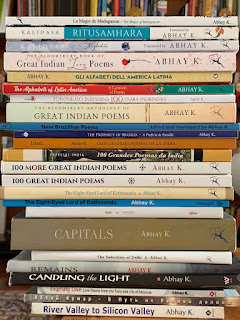

Enigmatic Love (Bookwell India, 2009)

The Fallen Leaves of Autumn (Amazon, 2010)

Candling the Light (Yash Publications, 2011)

Remains (Har Anand, 2012)

The Seduction of Delhi (Bloomsbury, 2014)

The Eight-eyed Lord of Kathmandu (Bloomsbury, 2018)

The Prophecy of Brasilia (Colletivo Editorial, Brazil, 2019)

The Alphabets of Latin America (Bloomsbury, 2020)

The Magic of Madagascar (L’Harmattan, Paris, 2021)

My book length poem ‘Monsoon’ is forthcoming in 2022.

As you can see from the titles of these books, I initially wrote about love and nature, but now I write about places. I create poetic-portraits of the places I visit and live by bringing together myths, history, geography etc. 

I have also selected and edited a number of poetry collections—

CAPITALS (Bloomsbury, 2017)

100 Great Indian Poems (Bloomsbury, 2018)

100 More Great Indian Poems (Bloomsbury, 2019)

New Brazilian Poems (Ibis Libris, Rio, 2019)

The Bloomsbury Anthology of Great Indian Poems (Bloomsbury, 2020)

The Bloomsbury Book of Great Indian Love Poems (Bloomsbury, 2020) 

I have also completed editing The Book of Bihari Literature (Harper Collins), which will come out in 2022.

100 Great Indian Poems which includes poems from 28 Indian languages spanning over three thousand years of Indian poetry has been translated and published into Italian as '100 Grandi Poeme Indiane' by Edizioni Efesto, Rome, into Spanish  titled 'Cien Grandes Poemas de la India’ by the National Autonomous University of Nuevo Le├│n (UNAL) Monterrey, Mexico, into Portuguese, titled '100 Grandes Poemas da India', published by the University of Sao Paulo, into Malagasy as 'Tononkalo Indianana 100 Tsara Indrindra' by Tsipika editions, and into Arabic as '100 Qaseedat Hindiyah Raiyeh' by Sharjah Institute for Heritage, UAE. 

It has also been translated into French, Irish and Nepali and it is likely to be published in these languages soon.


3. Tell us more about The Magic of Madagascar.

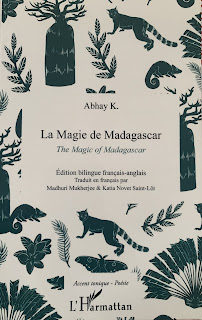
The Magic of Madagascar is a collection of haiku on the unique flora and fauna of Madagascar penned during my stay in Madagascar.

When I arrived in Madagascar in March 2019, never in my wildest dreams did I imagine that I would start writing haiku here. I began with usual length poems but soon felt that I was not able to capture and express the multiple enlightenments taking place within me while waking up with birdsong, looking at mynahs, hoopoes, black Vasa parrots, red fodies, yellow wagtails, green geckos, colour changing chameleons, butterflies and dragonflies of all possible colours, bees sucking nectar from flowers, making beehives, while I was upside down on the grass in a yogic headstand pose and gazing at the sky, or while travelling across Madagascar listening to the calls of the critically endangered Indri-Indri, watching silky Sifakas dance,  seeing turtles swimming freely in the emerald sea and watching sunset at the alley of baobabs or merely wandering around like a fakir following the tradition of Basho, Buson and Issa, though in another island, and in another space-time.
Here are some selected haiku from the book-

sea of innocence

exuding amber light

lemur’s eyes


an ascetic meditating

turned upside down

the baobab tree


sings incessantly

even in dreams

Malagasy Coucal


having engulfed the fishermen

the sea waves

crave the moon


eggshell fragments

on windswept dunes

once Elephant birds


4. Tell us more about your forthcoming book-length poem Monsoon?

‘Monsoon’ is a  poem of love and longing wherein an Indian poet and diplomat in Madagascar exhorts monsoon to take his message and the sights and sounds of whatever it comes across on its way to his beloved in the Kashmir Valley in the Himalayas. The poem, a  quatrain (rubai) of 150 stanzas, introduces the reader to the rich beauty and splendour of the islands of Madagascar, Reunion, Mauritius, Seychelles, Mayotte, Comoros, Zanzibar, Socotra, Maldives, Sri Lanka, and Andaman & Nicobar and the Western Ghats, Aravalis, Gujarat, Rajasthan, Madhya Pradesh, Uttar Pradesh, Sundarbans, West Bengal, Bihar, Sikkim, Bhutan, Nepal, Uttarakhand, Delhi, Punjab, Haryana, Himachal Pradesh and Kashmir Valley, their  flora and fauna, cuisine, festivals and monuments as Monsoon travels through these places. Monsoon is a must read for all those who believe in its magic to rejuvenate life and love.


5. What impact has your poetry had on the community?

Abhay K. - Well, it is difficult for me to assess that, but Maharaja Gangasingh University in Bikaner has awarded a PHD to Amit Dhawan on the topic ‘Cultural Construct of the Self: A critical study of Abhay Kumar’s poetry’ in 2018. A number of other academic papers have been written on my poetry books. My poem ‘The Partitioned Land’ was taught at Cornell University in Fall 2021 on a course on Revisiting Kashmir taught by Dr. Asiya Zahoor. University of Bath is going to have a panel discussion on The Alphabets of Latin America which will be chaired by Jessica Sequeira from the University of Cambridge and include Prof. Jorge Heine, Boston University as a panelist.

Gulzar has translated my poem ‘Shantipath’ from The Seduction of Delhi into Hindustani and included it into his monumental anthology ‘A Poem A Day’ (Harper Collins, 2020), which included poems from over 30 Indian languages. 

My poems have appeared in over 100 literary magazines across the globe including in Poetry Salzburg Review, Asia Literary Review, Gargoyle among others. My books have been reviewed in the Times Literary Supplement, World Literature Today, Asian Review of Books, The Hindu among others.

I co-founded ‘Poetry at the Monument’ initiative in Delhi to involve people in reading and listening to poetry at Delhi’s landmark monuments in 2011-12, which received huge appreciation.

I received SAARC literary award 2013, citation of which read—‘He co-founded Poetry at the Monument movement to bring poetry back to Delhi and to pay homage to 3000 years of Delhi’s heritage. The movement that started in Delhi has spread across the whole of South Asia.’

When I was posted in Kathmandu, I started a monthly poetry event named ‘Poemandu’ which ran for 39 months. In Brasilia, I continued this monthly poetry reading with a different name ‘Cha Com Letras’ for 36 months and it continues in Madagascar with the name ‘LaLitTana’. So far 12 editions of LaLitTana have been organised. These events have brought a lot of poets together and given them recognition, inspiration and support to continue writing poetry. 

I wrote Earth Anthem in 2008 in Russia, which was put to music first in 2013 by Sapan Ghimire and in 2017 by Dr. L. Subramaniam. It has been translated into over 150 languages across the world and is played to celebrate Earth Day and World Environment Day every year by thousands of schools, organisations and people globally. It was played at the United Nations to mark the 50th anniversary of the Earth Day celebrations in 2020. 

I also wrote a South Asia/SAARC song which was extensively played during the last SAARC Summit in Kathmandu in 2014.

I penned a Moon Anthem, which has been put to music by Dr. L. Subramaniam and sung by Kavita Krishnamurti. It was played live on major Indian TV channels hours before the landing of Chandrayaan on the moon in Sept 2019. 

I have also penned anthems on all the planets in our solar system, which have been received well. 

Hope all these above have had some tangible or intangible impact on the community.


6. When and why did you pick up the quill? How much time did you devote to it, and did you keep your job alongside? How did you juggle both?

Abhay K. - As I mentioned earlier, I started writing in Moscow, first to record the story of my journey from a humble village in Bihar to the ramparts of the Lal Bahadur Shashtri National Academy of Administration in Mussoorie and then to express the sense of awe and wonder I felt in Moscow and St. Petersburg, Russia. Then it became a habit to read and write poems. 

I have not only kept my job but thrived in it. I was appointed India’s Ambassador to Madagascar in 2018 when I was merely 38, perhaps, one of the youngest Indian Ambassadors in the history of the Indian Foreign Service. Now I am almost on the verge of completing my tenure in Madagascar.

I have found synergy between the two. I think poetry and diplomacy complement each other. I have written in detail about the connections between poetry and diplomacy and poet-diplomats who have excelled in poetry to the extent of six of them winning Nobel Prize in literature. They include Gabriela Mistral, Pablo Neruda, Octavio Paz, George Seferis, Saint John Perse and  Ceslaw Milosz. Ambiguity, brevity of expression, sensitivity and carefully choosing one’s words, are some of the characteristics shared between both poets and diplomats. 


7. Who is Your favorite Poet/ inspiration and why?

Abhay K. - I have many favourite poets who inspire me. However, just to name a few as it is not possible to name them all— Ramdhaari Singh Dinkar, Kabir, Kalidasa, Vidyapati, Amaru, Bihari, Walt Whitman, Emily Dickinson, Neruda, Octavio Paz, T.S. Eliot, Wis┼Вawa Szymborska, Khalil Gibran, Rumi, Hafiz, Rabindranath Tagore, Basho, Buson, Issa, Du Fu, Rilke, Baudelaire among others, because they show me extraordinary in ordinary. 


8. Mention the success you have experienced.

Abhay K. - My biggest success has been to find motivation and inspiration to keep writing new poems and being able to do so along with a very demanding job as an Indian diplomat. Besides, I have been lucky to find publishers for the books or poetry collections I have written so far. My publishers have never complained. They have been able to sell the books, some of them like The Seduction of Delhi and 100 Great Indian Poems becoming the bestsellers.

I have also had the opportunity to interact with the leading poets of our times such as Nobel Laureate Derek Walcott, Pulitzer Prize winners for poetry such as Vijay Seshadri, Forrest Gander and poet laureates at the Library of Congress in Washington DC such as Tracy K. Smith and Robert Hass and poet laureate of UK Simon Armitage whose poem ‘Lockdown’ recently inspired me to translate Meghaduta of Kalidasa , Ruth Padel, George Szirtes and Benjamin Moser, winner of Pulitzer Prize 2020 for his biography of Susan Sontag, among others. It feels great to have some of them as friends. 

I was invited to record my poems in the long running ‘The Poets and the Poems’ programme at the Library of Congress in Washington DC by Grace Cavalieri in 2018. That time, I was the first Indian poet to record for this prestigious programme, and it was such a great honour. My poetry recording for that programme can be heard here

A museum in Brazil in the city of Formosa has put one of my poems titled ‘Formosa’ on permanent exhibition. 

My poem-song Earth Anthem has been performed by the National Symphonic Orchestra of Brasilia and played by the musicians of Amsterdam Conservatorium. The first line of the Earth Anthem was quoted by the Christian Science Monitor in an article to mark the 50 years of Apollo Missions. BBC featured Earth Anthem video on 22 April 2020 on the occasion of the 50th anniversary of Earth Day.


9. Do you have any particular audience in mind when you write, an ideal reader?

Abhay K. - No, not really. Poetry is written for oneself. Others also find it interesting that it is a mere coincidence.


10. What are the greatest lessons you have learned from your journey?

Abhay K. - Miracles happen. My own life is proof of that. That one should never stop dreaming and working hard, staying focused, to make one’s dreams come true.


11: What are your future plans?

Abhay K. - To continue writing poems and editing anthologies and translating literary works from other languages. I am working on a poetry collection titled 'In Light of Africa', which will have poems on various personalities, monuments, cultural practices and traditions of Africa.


12: Your message for fellow poets.

Abhay K. - Please keep writing, one poem at a time, or even a line at a time and you’ll surprise yourself one day. Even if you just write one good poem during your whole poetic journey, you have done your job well. 


13: Anything you want to share about Setu.

Abhay K. - - Setu is a great initiative to bring good literature into the lives of our generation which is gradually becoming addicted to social media. Kudos to Sunil Sharma ji and his dynamic team for this noble endeavour to serve the muse of poetry. I wish Setu all the success!


An ambassador and a poet: Abhay K: Organising the Literary Events in Madagascar

Recently the Embassy of India, Antananarivo, this month, revived a literary meet on its premises by inviting select authors/poets.An initiative of Abhay K, the ambassador who is also a top poet, among many other avatars.
It was a celebration of creativity in its full form.
Editor

Here, the brief release from the concerned embassy:
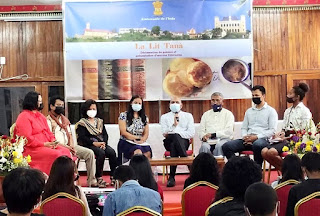
The Embassy of India, Antananarivo’s Monthly Literary Program, known as La Lit Tan├а resumed after a long hiatus. The program initiated by Abhay Kumar, Ambassador of India in Madagascar in 2019 provides a literary platform to the talented Malagasy writers and poets to showcase and perform their literary works. The 12th Edition of La Lit Tan├а was held on Friday, November 26, 2021, at the premises of the Embassy of India in Tsaralal├аna.


Seven Malagasy poets and writers took part in the event including J. Nalisoa Ravalitera, a poet and the founding member of the Circle of Poets Faribolana Sandratra, Research Professor at the University of Antananarivo and Vice-President of the Malagasy Academy.

The event included participation of the poet Na Hassi, who shared an extract from her collection Zana-bolana (Lunar Woman). Essence of her poetry was that in a society where women are blamed for everything, she finds her own destiny and frees herself from that imposed by others. Without memory, she observes herself in front of the Moon, her mirror. With the thread of her story, she struggles  herself against her sufferings and heals herself in silence. The wounds open. Then close.

Poet Hobiana read his poem titled “Madam" which made the audience laugh, "Embona Alina" the melancholy of a twilight, "Anjely Moana" a poem that explores another world difficult to explain. A silent, soft-spoken angel is called to sing a poet's song aloud, so that the deaf can hear the poet's poetic beauty.


Anne Muriel, an outstanding slammer and poet expressed her love for Madagascar during the event. She brought a message of hope, of love, from a poet who believes in the rise of Madagascar.
Riambola Mitia, a well-known poet in the world of Malagasy poetry, made his audience dream with his poems. His poems speak of beauty in poetry, of positive attitude,  of song of hope, of inner peace, but above all the importance of preserving the environment.

Poet Ny Vetso shared her personal life with the audience. Her poem "Sombinaiko" was about her experiences as a mother of her first child when he was still in her womb, her poem "Ny Tsiambarateloko", said - no matter what is in my life, good or bad, I always smile, " Iny zanako any iny", her prayer for her child.

Ny Eja Storyteller and poet made the audience ecstatic with her poems “Mamela ahy” or Forgive me for loving you, “Masiaka ianao ry fiarahamonina” or Society you are so cruel, and “Zanako” To my children which talks about love for her children: it is for you that I am fighting, you are my pride.

The Auditorium was packed with an audience composed mainly of young university students and Poetry lovers as well as poets.

Ambassador Abhay Kumar read from his latest poetry collection The Magic of Madagascar that celebrates the unique flora and fauna of Madagascar through haiku.

A preview of The Alphabets of Latin America: A Carnival of Poems by Abhay K.

* Author of the Month *

The Alphabets of Latin America

Author: Abhay K.
Publisher: Bloomsbury
ISBN: 9789389867909
138 pages, Paperback

Organized alphabetically from A-Z, The Alphabets of Latin America, a collection of poems written by poet-diplomat Abhay K. during his travels across Latin America between 2016-2019, takes you on a roller coaster ride to one of the most culturally and geographically fascinating continents, known for its legendary Maya and Inca civilizations, sizzling Samba and Tango, the world's biggest carnivals, labyrinths of Borges, magic realism of Gabriel Garcia Marquez, great poetry of Ruben Dario, Pablo Neruda , Gabriela Mistral, Cesare Vallejo, Octavio Paz, fascinating art of Frida Kahlo and Fernando Botero, among others. As you flip its pages, you will find yourself swimming with pink dolphins in the Amazon river, watching the sunset in Martian landscape of Atacama desert, kissing the heights of Machu Picchu and admiring a thousand rainbows at Iguazu Falls.
The noted Cuban poet V├нctor Rodr├нguez N├║├▒ez writes –“Latin Americans must be grateful, today and always, to Abhay K. and this fundamental book. Armed with intelligence and sensitivity, with calculation and passion, The Alphabets of Latin America is a love poem that honors us as a society and culture. In these pages, poetry, as a way of thinking and a response to adversity, reaches breadth and mastery, depth and splendor. Our region’s past and present are approached not only as reading but also as experience, with the knowledge of cause and the authenticity of memory. What’s more, in these texts, narrative and lyric, intellectual rigor and formal play, description and reflection happily shake hands. Likewise, identification predominates over differentiation, and an essential link is established between Indians and Latin Americans: “A people, a tribe, a nation is destroyed, / only to reincarnate in another form.”


Atahualpa

I, Atahualpa, the last Inca emperor,
born a sovereign, died a prisoner

mercilessly strangled by a garrote
under the cunning friar’s watch

then burnt without a dignified
Inca burial, to prevent my rebirth.

Spaniards brought a strange disease
to the Andes, that killed my father

his successor died soon, plunging
the Inca empire into a succession war

Huascar and I fought for years,
subduing him, I emerged victorious

soon armed intruders entered my empire
with sixty-nine horses and a hundred more men

being ingenuous and benign, I called them
for a dialogue falling into their trap

the deceitful friar offered me a breviary
asking me to convert to Christianity

disgusted I threw it down in rage
Pizarro ordered his men to charge

a handful of them, heavily armed
butchered my army of five thousand
none of them was wounded or killed
they captured me alive in the battlefield

to be set free, I offered to fill
my cell with silver and gold

but Pizarro conducted a mock trial
and sentenced me to death by fire.

Huascar: half-brother of Atahualpa


Favelas

Party-coloured
                      islands
    in the sea
           of an indifferent
humanity
                   suffering,
celebrating
               the carnival
i.e. life.


Zocalo

In the middle of this vast square
I stand alone, meditating—
racing back and forth in time

hearing jeers of the victors
silence of the vanquished
all swept away by time’s broom

does it matter who loses, who wins a war—
a people, a tribe, a nation is destroyed
only to reincarnate in another form.


Octavio Paz

History is one thing, our lives something else...I have survived,
that’s enough…’ – Octavio Paz

Staring at a draft of shadows
I straddle between two pasts

my feet on two boats
I keep afloat composing poems

I am alone in a library
reading forbidden books

I lose my faith reading Voltaire
the library crumbles in front of my eyes

I am happy
I have survived

I come across godemiches in Paris
don’t know what are these

embarrassed, I ask a surrealist,
who whispers in my ears—

‘these are objects to overcome
profound human loneliness.’

I think all fighting is absurd
but cannot tell it to anyone

so I go to see Neruda
he calls me a traitor

then embraces me affectionately
calling me—‘son.’

Meeting Buddha in India
on the footpath, I ask—

‘what is Self?’ Buddha smiles
and turns into a pile of stones.


Abhay K. is the author of a memoir and eight poetry collections including The Seduction of Delhi, The Eight-Eyed Lord of Kathmandu and The Prophecy of Brasilia. He is the editor of CAPITALS, New Brazilian Poems, The Bloomsbury Anthology of Great Indian Poems and The Bloomsbury Book of Great Indian Love Poems. His poems have been published in over 60 literary journals across the world including Poetry Salzburg Review.

He received the SAARC Literary Award in 2013 and was invited to record his poems at the Library of Congress in Washington DC in 2018. His poem-song 'Earth Anthem' has been translated into over 50 global languages and is performed across the globe. He has recently translated Meghaduta and Ritusamhara of Kalidasa.

Talking Civilizations and Arts with Abhay K.

Sunil Sharma
Sunil Sharma, editor, Setu (English), catches up with the noted poet-editor-translator and diplomat Abhay K. on issues wide ranging: From continents, cultures, poetry and translation.

The interesting conversation through email below:

Q: You recently lived the magical continent. How was the experience in the land of the greats like Borges, Vallejo, Mistral, Neruda, Marquez and Paz among others?

Abhay K.
Abhay K.: I lived in Brasilia, the capital of Brazil where I was posted as the Deputy Ambassador of India 2016-2019, and had the opportunity to travel across Latin America attending poetry festivals and visiting tourist sites. It was a dream for me to visit Machu Picchu, Isla Negra, Buenos Aires, Atacama, International Poetry Festival in Medellin, Colombia, Mexico City, Panama Canal, Rio de Janeiro, Lima and meet the poets, writers and artists of contemporary Latin America, to walk with them the streets where once Machado de Assis, Borges, Vallejo, Mistral, Neruda, Clarice Lispector, Cecilia Meireles, Carlos Drummond de Andrade, Marquez and Paz used to walk. Each of them were alphabets that made the book of Latin America for me. During these three years (2016-2019), I was able to complete CAPITALS, select and edit 100 Great Indian Poems, 100 More Great Indian Poems, write a collection of poems on Brasilia and write poems about the historical figures, places, flora and fauna, culture and traditions of Latin America. I was invited to read my poems at the major international poetry festivals in Granada, Nicaragua, Medellin, Colombia, Santiago, Chile, and for poetry readings in Lima, Buenos Aires and Mexico City.  At the end of my tenure in Brazil, I was appointed as Ambassador to the Indian Ocean islands of Madagascar and Comoros. So it was a very important period of my creative and diplomatic life.

Q: What lessons did the Mayans and Inca teach you as a poet and outsider, coming from another era and civilization?

Abhay K.: I have travelled to Cusco, the centre of the Inca Empire, which rose in the Peruvian Andes in the early 13th century and conquered a large part of western edge of South America in the Andes facing the Pacific between 1483-1533. Quechua was its official language. Incas worshipped the Sun god—Inti. Incas had developed a sophisticated civilization. Machu Picchu, a 15th century Inca citadel is now a UNESCO World Heritage Site and is considered one of the Seven Wonders of the World. Inca moral code – ama suwa, ama llulla, ama quella (do not steal, do not lie, do not be lazy) is still worth emulating. Inca poetry—The Sacred Hymns of Pachacutec, have been translated into English. Here is another Inca poem titled ‘Beautiful Princess’ translated from Quechua into English—

Beautiful princess
your brother
has broken
your vase
and that is why
thunder rumbles, the lightning glares
and the thunderbolt falls.
However it is you, princess,
who must give us water
by making rain
and sometimes even
hail
and snow.
The creator of the world,
Pachacamac
Viracocha
created you
and charged you
with this task.


The Mayans, on the other hand, built their civilization in Central America. The first Maya cities developed around 750 BC while the last Maya city fell in 1697.  The Mayans developed sophisticated art forms and a complex system of hieroglyphic writing that was the most advanced in the pre-Columbian Americas. Mayan’s practices of sustainable organic farming, holistic healing, storytelling tradition, unique architecture, love poetry are noteworthy. The Book of the Dances of the Ancients is the source of almost all the ancient Mayan lyric poems that have survived to our day. Popularly known as Songs of Dzitbalch├й, it is closely connected to the Books of Chilam Balam, sacred books of the colonial Yucatec
Maya.

Here is some exquisite Mayan poems translated by Dr. Alfredo Barrera V├бsquez  and Munro S Edmonson, worth preserving--


Tz'utz'                                        Oh to kiss
A chi                                          Your mouth
T u caap cool                             At the loose railing
Hok che                                     Of the picket fence!          


Bin in tz'uutz' a chi                 I am going to kiss your mouth
Tut yam x cohl                        There among the little reeds.
X ciichpam zac                       Oh beautiful shining lady,
Y an y an a u ahal                   You must, you must wake up.

Q: In your poem "Atahualpa", the trauma, sadness and betrayal, and loneliness and resignation of a ruthless colonialism, can be acutely felt by a reader. You have transmitted and channelized the collective anguish of a wounded civilization so succinctly and economically in it. 
How real is this pain and recall of the subjugated history for the current Latin Americans there? Are the ghosts still roaming there or have been buried?

Abhay K.: Athaualpa was the last Inca emperor and he was invited for a dialogue by the Spanish conquistador Francisco Pizarro, where his men were tricked and defeated and captured. Centuries of their civilizations became subjugated to colonial whims. The indigenous community could not bear the double shock of disease and brute colonization and perished. Whoever survived were absorbed in interracial marriages. They are still tackling the cruel realities of colonial conquest of Latin America. The ghosts of history are still out, roaming in the streets. Neruda, Paz, Kahlo, Riviera, Marquez, Llosa, they all tried to make peace with them and in turn great literature and art have been coming out of Latin America because of the prevalent juxtaposition of incredible magic and harsh reality on the ground.

Q: What motivates you to write quality poems consistently and with such artistic finesse, moving from one country to another, in the corridors of power, very much like Octavio Paz?
Some kind of inner need for communication? Clarity? Or, articulating the non-heard voices?

Abhay K.: My writing comes from the deep quest within me to write about places I visit, civilizations I encounter, to document my experiences of my interaction with living people, historical and mythological figures, monuments, landscapes, flora and fauna in different parts of the world, some never sung/written about in popular realm of literature.  Octavio Paz is a much more gifted poet and essayist than me. There is a glorious tradition, though not so well-known among the literary community, of  poet-diplomats or poet-ambassadors writing great poetry while representing their countries as Ambassadors such as Pablo Neruda (Chile), George Seferis (Greece), and of course Octavio Paz (Mexico)who also received the Nobel Prize in literature. There are other poet-diplomats such as Gabriela Mistral, St. John Perse and Ceslaw Milosz who have been awarded Nobel Prize in literature.
There are a number of common elements between poetry and diplomacy. Both poets and diplomats deal with words and choose them very carefully (‘poetry teaches you, if nothing else, how to choose your words.’—Rita Dove) day after day during their whole career, are sensitive individuals and communicate through slant (‘tell it but tell it slant’ –Emily Dickinson) and pithy (say more in less) expressions. No doubt, so many poet-diplomats have made immense contributions to the field of literature.


Q: What are your views on contemporary world poetry, its contours and messages? Does it connect with the public?

Abhay K.: There is not one contemporary world poetry, but many, written in diverse languages, in diverse geographies, some of which we have not even heard of. Poetry happens when a poem is read by someone and the effects a poem produces. Sometimes, poems are read by a select circle of audience and not by the general public. There are all kinds of poets and all kinds of poems. So it is difficult to make a general comment about it.


Q: How do you handle writing and diplomacy in a high-pressure environment? How authentic is the creativity and the solitude required for it, in view of being constantly surrounded by diplomats and diplomatic work, in your context?

Abhay K.: I would like to quote the words of French writer Francoise Sagan—‘I shall live badly if I don’t write, and I shall write badly if I don’t live,’ to present my case. I’ll be a mediocre diplomat if I don’t write poetry and a mediocre poet if I am not a diplomat. Both are existential for me and I find time for both of them, even in a high pressure environment.

Creativity requires solitude, that’s true, and strangely I find solitude in the crowded places, like traveling in a metro in Moscow, or sitting in a caf├й in Kathmandu buzzing with young couples or in a Saturday market in the outskirts of Brasilia or on the top of Machu Picchu full of tourists from all corners of the world, or in a meeting full of officials in South Block in New Delhi. I think solitude is a state of mind. We can be all alone with our mind crowded with all kinds of thoughts.

Q: Memorable incidents as a diplomat and as a poet?

Abhay K.: When I joined the Foreign Service, my first assignment after completing training was to be a Liaison Officer of a former Prime Minister of Indian origin of a Caribbean country who was invited to attend a function in India. He was a very humble, sweet and generous person and I really enjoyed being with him for a few days. Later when I was travelling to London I wrote an email to him unintentionally asking him how he was and he replied immediately and incidentally was in London at that time and invited me to an Indian restaurant for lunch. That time I was just a Third Secretary, basically ‘no one’ in the diplomatic hierarchy. I always think of this sweet memory and get warmed up. On another occasion, the President of a neighbouring country invited me to have ‘khir’ at his palace cooked with the milk of his own cow. That time I was merely a First Secretary. Such sweet memories keep coming back from time to time.

As a poet, to my surprise, when I was editing CAPITALS, an anthology on the capital cities of the world, once I called Derek Walcott and he, himself picked up the phone and spoke to me from St. Lucia and told me he loves eating at the local Indian restaurant there. Poet Mark Strand replied to my email just before succumbing to cancer giving me his permission to include his poem ‘There is no wind in Oslo’ to include in CAPITALS. Later in 2018, to my wildest surprise, I was invited to record my poems at the Library of Congress, Washington DC by Grace Cavalieri in her long running programme The Poet and The Poem. It was a great honour. Traveling to poetry festivals in Wardha, Thimpu, Kathmandu, Nicaragua, Medellin, Santiago, Jaipur, meeting Tracy K. Smith, the poet-laureate of United States in 2018, having long conversations over breakfast with Robert Hass in Washington DC, lunch with Pulitzer Prize winning poet Vijay Seshadri in Brooklyn, New York, bus journey with Simon Armitage, poet –laureate of UK to Amer fort, signing a copy of Bloomsbury Anthology of Great Indian Poems for Pulitzer Prize winning poet Forrest Gander and Nigel Newton, the owner of Bloomsbury Publishers, dinner with Nobel laureate Abhijit Banerjee and William Dalrymple at Sava Haveli, conversations with Ruth Padel, Chris Agee  and Pulitzer Prize winner Benjamin Moser on the sidelines of Jaipur Literature Festival, are some of the memorable moments of my life as a poet , so far, among many others.

Q: How different is the Latin American prose and poetry scene from the ones of the UK and the USA literary scenes?

Abhay K.: Latin America excels in hosting poetry festivals. Both the International Poetry Festival of Nicaragua and the International Poetry Festival in Medellin are world class poetry festivals and are held at the public squares in which people can participate freely. I have not lived in the UK and USA, but most of the literary festivals are paid events for which one has to buy tickets to attend. The UK, USA both have a number of reputed literary magazines, some like Poetry, founded over a hundred years ago and some well-known literary prizes to promote literary culture. Latin America, I think, has a very strong literary culture visible in the writings of Machado de Assis, Neruda, Paz, Marquez, Llosa, Lispector among others.

Q: On translation as an art? On translating the immortal Kalidasa?

Abhay K.: Translation is an art that makes the World Literature possible. Every time a translation happens, the world literature gets enriched. It involves transporting the thoughts, lyricism, images of the original work into a language understood by the target audience. The point of translation is to communicate something valuable which is worth preserving and propagating from one language into another.

Reading and translating works of Kalidasa has been a pure delight and wonder for me. He can be our contemporary. A great eco-poet writing about nature using the trope of love. Even flowers, plants, animals, seasons, rain, rainbow, wind, sun, moon, stars, stones, rivers, mountains among other things animate and inanimate have their own sensual personas and feature prominently in Meghaduta. Kalidada mentions twenty-six different kinds of plants and flowers in Meghaduta such as Mango, Ashoka, Rodhra, various species of Jasmine, Kakubha, Kurbaka, Mandara among others. Women’s physical beauty and sensuality is vividly depicted using the metaphors from the nature—
Your slender limbs Syama-creepers
your glance the doe’s tremulous eyes
your face the moon
your luxuriant hair the peacock’s tail
your eyebrow play the brook’s ripple
O fair one! you alone have all these                   
there is no one like you in this world.        101 Meghaduta

I have translated Meghaduta and Ritusamhara, and feel very happy about it.


Q: Your ultimate dream as a human and an author in a post-truth world of divisions and racial tensions?

Abhay K.: The world was, is and will be full of suffering because we have desires. If we solve one problem, another will arise. Anne Frank wrote—‘Think of all the beauty still left around and you’ll be happy.’ And here is Czeslaw Milosz— ‘My generation was lost. Cities too. And nations./But all this a little later. Meanwhile, in the window, a swallow…/would compose from fragments a world perfect at last.’

My dream is to have a common anthem for our planet—not only for our large human family but for millions of other species with whom we share this beautiful planet. My dream is to have a global poet laureate at UNESCO someday, a poetic voice for the planet. My dream is to leave behind some memorable poems for the coming generations. My dream is that someday rivalries and wars among nations come to an end and we see ourselves as citizens of one planet and devote our energies in addressing real challenges of biodiversity loss, climate change, environmental pollution, global pandemics and rising income inequalities.

Q: The fate of a disenfranchised poet in today's world?  Are they still relevant?

Abhay K.: Poets wield their power with a pen and a blank paper, so I don’t think they are ever disenfranchised. Poet Alicia E. Stallings recently wrote in the Times Literary Supplement—
‘Poetry was around before the alphabet. Poetry is not useful, and it is in every culture. Not only is it not endangered, it will outlast any number of species of living things on the face of earth. It will only perish with our own. I worry about journalism. I don’t worry about poetry.’

Q: How do you view the commercialization of the culture industry, of the arts, the Lit Fests and marginalization of the regional and small-town writers?

Abhay K.: Commercialization of art and culture is a healthy thing if it also benefits the artists, helps them to devote more time to their art. It should be our endeavor to regulate the field of art and culture in a way that artists benefit from it.

The numerous Lit Fest have come up all across the country, including in regional state capitals and smaller towns engaging more and more regional and small town writers. Jayanta Mahapatra is a good example of a fine poet who lives in a small town of Cuttack but his poems are published all across the world. One does not have to live in big cities to make it big in the literary field. It is the power of one’s words that really matter, not where they come from. These days the Internet makes a lot of free material accessible online to even those living in remote villages.

Q: Please share your thoughts on your upcoming poetry book: The Alphabets of Latin America?

Abhay K.:  The Alphabets of Latin America, is a collection of poems I wrote during my travels across Latin America between 2016-2019. Organized alphabetically, they take you on a roller coaster ride to one of the most culturally and geographically fascinating continents in the world, known for its legendary Maya and Inca civilizations, sizzling Samba and Tango dances, the world's biggest carnivals, great writers such as Borges, Marquez, Ruben Dario, Pablo Neruda , Gabriela Mistral, Cesare Vallejo, Octavio Paz, renowned artists such as Frida Kahlo, Fernando Botero, among others, Martian landscape of Atacama desert, Machu Picchu,  the Iguazu Falls, magnificent cities of Buenos Aires, Rio de Janeiro, Mexico City, Lima among others.
The noted Cuban poet V├нctor Rodr├нguez N├║├▒ez writes –“Latin Americans must be grateful, today and always, to Abhay K. and this fundamental book. Armed with intelligence and sensitivity, with calculation and passion, The Alphabets of Latin America is a love poem that honors us as a society and culture. In these pages, poetry, as a way of thinking and a response to adversity, reaches breadth and mastery, depth and splendor. Our region’s past and present are approached not only as reading but also as experience, with the knowledge of cause and the authenticity of memory. What’s more, in these texts, narrative and lyric, intellectual rigor and formal play, description and reflection happily shake hands. Likewise, identification predominates over differentiation, and an essential link is established between Indians and Latin Americans: “A people, a tribe, a nation is destroyed, / only to reincarnate in another form.”
While Forrest Gander, the winner of Pulitzer Prize for poetry 2019, who knows Latin America very well writes—“The Alphabets of Latin America is welcomingly strong. Abhay K. has a great sense of lineation, of understatement, of memorable, very particular images, and of manuscript structure. I also am moved by the way he can subtly use the elements of a place—the dream vision of Tenochtitlan (which was founded on a dream-vision) or the Borgesian paradox of looking for Borges and finding mirror reflections of the self. I love the way this abecedarian works and shifts between short and longer poems, refreshing our rhythms constantly. Also, it’s such a personal pleasure for me to re-see so many places that I know, through his eyes. It is a very original and thrilling book—a book that opens the borders of time and place, which is what seems so necessary now in this epoch of nationalist entrenchment and paranoia.”

The Alphabets of Latin America is so far my most ambitious poetry collection that tries to capture the beauty and splendor of a whole continent.