Showing posts with label 202109E. Show all posts

Acrylic on Paper: рдЪिрдд्рд░рдХрд▓ा

Artist: Shivi Sharma рдХрд▓ाрдХाрд░: рд╢िрд╡ि рд╢рд░्рдоा


You're the dawn, you're the dark, you're a mystery nursing your wrath to keep us warm, you're a full circle, you've power to create, nurture and transform.
Your frost kiss is unfathomable, you're not just beautiful, you're breathtaking.


She is often in a daze, has a pure soul. She belongs to the moon, she is a moonchild. 
As tender as apple blossom with long hair and dreamy eyes.
Singing sweet old songs, she smells of roses and Vanilla, meet her at the seaside, she's a moonchild, she's a moonchild.

Her face isn't enough to define her beauty, it's her luminous heart which is beautiful.


The rebel wrapped in 6 yards long fabric. Saree is her grace, Jewellery is her confidence and eyes divulge her inner strength, behold the begum-e-hindustan! The pious Goddess.


Lord of the lords, Shiv рд╣рд░ рд╣рд░ рдорд╣ाрджेрд╡


She was no less than a magician. It was her magic to still see the sun shining bright even on the darkest days.


Acrylic colors on paper

Shivi Sharma рд╢िрд╡ि рд╢рд░्рдоा


The City My Muse by Mitali Chakravarty

Mitali Chakravarty

Looking at the clouds that float, changing contours through the day, I marvel as I imagine them waft across borders drawn by men over mountains and lands …like the breeze – unhindered and unbarred. No immigration stops them. Long ago, I had lived in another city, another place, another time zone. So, much has happened since then. Even if the rain falls in the same way across borders, I cannot go back to where I lived or undo what has happened within these three decades. Nor would I want to undo the magic of childhood as it abracadabraed into adulthood that connects me to wider seas and more open skies. 

I am glad for all the places I could visit and experience. I do not have any roots because I am not a tree. Do I want roots? I really do not know. My past and that of my forefathers are in my bones and blood. Why does that have to be attached to a piece of land or to objects which mutate over time? I like being free, free of all bondage, free from all things that tie me down, except perhaps for the ties of love. Ties of love make me feel accepted, cherished, and wanted. They do not judge me or hold me back but let me fly.

I like to think of floating in the sky. I want to be a cloud — a cloud that is free to drift without bothering about boundaries or climates. Living as I do in my current city, skies connect me back to the home where I was born and grew up.  Life back then had been so engrossing that I never wanted to leave the place of my birth. Then why did I leave my original home? I left for love. I left for adventure. There was no compulsion — no monetary need. Most of the time, I have enjoyed living in multiple cities. I love every place I lived in.

I enjoyed the variety of cultures as much as the diverse flavours in each city’s cuisine. Natural splendours and historic wonders in every part of the world I have passed through continue to mesmerise me. The sunrises and the sunsets continue vibrant and distinct and yet they colour the same blue sky that stretches out a welcome to all on Earth. I feel each experience has enriched me. I am happy with what I am today. Each event, each place, each person, each being, each leaf and each flower that came my way contributed towards the sense of ultimate calm which is necessary for me to write. And writing is like breathing. I feel at home everywhere because the skies connect and let me travel wherever I want in my mind.

Though a lover of nature, I cannot imagine living in the woods or in a village. I need my city comforts. That is why I have opted to live in a city-state which is green and beautiful. The mingling of people, waves, trees, birds, animals, and buildings that seem to reach out to grasp the skies, voices the ambition of the tiny island I live in. It has reached out to the world to create a bridge between the East and the West. You have people from everywhere in the world living here and multiracial marriages and families. I enjoy this mingling with its vibrancy and energy.

I also feel fortunate that this city-state has laws that work. That gives me the quiet I need to think and write. The little dot on the globe has unfurled a welcome to people who want to move towards a better future. Of course, one needs to work hard wherever one lives to have a better life. Then, one needs good schools and colleges for youngsters, which I must say we have here in abundance.

The only darkness that mars is borne of biases which rip the whole world with their hurtful exclusivity. You find them everywhere in different garbs, using different names. There is no escape except to have the courage to stand up to them and hold your own. You have to be like the sun with them. The sun never reacts when critiqued for being too hot or too strong in the tropics and too cool at the poles. In my travels, I have learnt to find friends. They are often nomads like me, and we stay connected in a virtual world. My horizons broadened with each new friendship, each new move and sunshine filled my life with plenitude.

Leaving home also gave me fresh perspectives on the country I left behind. Recently, I read a Bengali travelogue by a disciple of Tagore who had been taught by the great maestro himself called Syed Mustaba Ali. Translated as In a Land Far from Home by BBC’s South Asia editor, Nazes Afros, the book contended: “The German poet Goethe had rightly said that one would not understand the true nature of his own country unless he went to a foreign land.” I have not read Goethe (1739-1842) – but I agree with his viewpoint. To understand your own home better, you need to view it unbiased from a distance. A current glimpse of the city where I spent the first two decades of my life makes me feel I can never fit into it as I am now. I have changed with time. The country has changed. My city has changed multiple times.

There is a saying, ‘a rolling stone gathers no moss’. Even if I allow myself to be to be a pebble instead of a speck, I do not want to gather moss. I would like to shine pure and clean – washed by a mountain stream. I want to shine so that I can be a light, giving hope to those who feel themselves sinking into abysmal darkness.

Sitting by the open window, I watch the clouds and long to float with them to yet another place, another time…


Bio: Mitali Chakravarty writes for peace, love and harmony. In that spirit, she has founded the Borderless Journal.


Poetry, Art: Meenakshi Mohan

Mollusk of a Shattered Shell


She met him in college --

handsome, smart.

She liked him.

He wooed her --

Gifts, bouquets, coffee dates,

then expensive dinners -- allured her.

She was falling for him.

Then came promises and more promises

for a life together.

Talks of introducing her to his parents --

then excuses to do so at a proper time.

Meenakshi Mohan

He convinced her to elope, get married

and she conceded.

A Kazi married them, two of his friends as witnesses.

Tangled in the web of his secrets and lies

she realized too late -- he was a charlatan --

all was fake – the marriage, the Kazim, the witnesses.

One day, he disappeared –

abandoned her and his child.

What would I tell you, my child?

You are a mollusk of a shattered shell.

Don’t let his deceit rob you of luster.

Don’t let the folly of your mother steal your sheen.

Grow and be a pearl with your shimmering iridescence.

All I can give are my prayers.

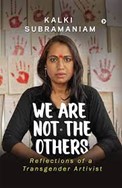
Championing an Identity sans Signifiers:

A Review of Kalki Subramaniam's We are Not the Others: Reflections of a Transgender Artivist

By Basudhara Roy*


Kalki Subramaniam

We are Not the Others: Reflections of a Transgender Artivist

Notion Press, 2021
ISBN (Paperback) 978-1-63940-487-2
Pp 166 | Price 
http://www.museindia.com/images/rup.png 350


“I too stand

in the thick of the battle field

destroying stupidity

and defeating

the emasculated,

let us celebrate life,

come.”

(Kalki Subramaniam, ‘Arise, My Precious’)


Kalki Subramaniam’s latest collection We are Not the Others: Reflections of a Transgender Artivist published by Notion Press this June, is a book that will leave your heart open for ever. An honest, unapologetic, and fiery narrative of a transgender’s lived experience presented through poetry, prose and through deeply figurative and unsettling illustrations by the talented writer herself, here is writing that takes the heart by storm, wreaks havoc on our complacencies, upsets the neat and futile categories of definitions that have been drilled into us through a prolonged process of socialization, and liberates us by the overwhelming strength of its optimism.


Artist, activist, poet, actor, and writer, Kalki powerfully places her transgender identity at the centre of her rich and multifarious work. Founder of Sahodari Foundation, an organization that works for the social, political, and economic empowerment of transgender people in India through various creative projects, Kalki combines art and activism with a commitment that is not just intellectual or social but defiantly humanist. One of the most prominent voices in the LGBTQI+ community of India, she is well-known for championing the recognition of the legal rights of transgender people which resulted in the historic 2014 verdict of the Supreme Court of India whereby the rights of the transgender community as the third gender were recognized not merely as “a social or medical issue but a human rights issue”. Widely awarded for her social work, art, film performance, and literary contributions, Kalki continues to be an inspiration both within the transgender community and beyond it. Her poems, as N. Elango writes in his Foreword to the collection, are “clarion calls, not only to the LGBT community, but for those whosoever seek to break themselves free from the shackles and fetters snapped around them by the hegemonic conspiracy.”


Comprising sixteen poems, some of which have been translated from the original Tamil by N. Elango, four personal essays, and magnificent quotations and artwork, including the actual handwritten scripts of her Tamil poems, the book takes us into an autobiographical journey of growth, strength and faith through the trauma, angst and painful discrimination that transgenders undergo every day in this country. In her Author’s Notes to the collection, Kalki writes:


This book is a bundle of so many of my emotions – joy, pain, anger, fury, distress and hope. Through this book, I tell some parts of my story and that of the others like me. You will hear their voices through me.


Poetry and art give a richness to my life. They give beauty, strength and hope. They heal. I couldn’t have survived my tormenting teenage years without them.


Signification, one realizes, is a complex process and often, self-defeating. The complexity of signification stems from the fact that the signified, rather than being an objective presence in the real world, constitutes an abstracted idea of it in our minds. Our ideas, often being entrenched by particularities such as history, society, religion, culture and conditioning, the looming possibilities are that a wrong, erroneous and unwarranted idea may root itself over time into a vindictive stereotype. Around us and across the world, the negative effects of such stereotyping are rampantly visible. Stripped of distinctive individual virtues, identity becomes an allotted story of signification that may have no correspondence to fact. Every human and non-human Other is the victim of just such a process of signification whereby the assumed has offset the actual, and ushered in practices of prejudice, discrimination, hatred and violence. When it comes to people who identify themselves as LGBTQI+, the trauma and suffering that pernicious narratives of signification can produce, is heightened by the fact that there is no appeal to a common truth. The only truth about sex and gender is that which also challenges their greatest fallacy viz. they are binary. Nothing can be farther from biological fact. In From Transgender to Transhuman, Martine Rothblatt writes:

… sex in humans is a continuous variable, a complex of phenotypic and genotypic factors as unique as one’s fingerprints. While male and female categories are useful to group biological characteristics for medical purposes, these same categories have socially detrimental effects when used outside the field of medicine. Sex should really be the sum of behaviors we call gender—an adjective, not a noun. People should explore genders. When they settle on a set of gender behaviors, the name for that set describes their sex.

Rothblatt insists that the resting point for gender “depends upon the same complex of mental propensities and chance socialization that leads people to adopt one or another career, hobby, or religion.” However, in a country like India where sex is, in most quarters, destiny and where patriarchal thought largely reigns, transgenders are routinely judged by society for their bodies, voices, physical appearance, sexual choices and morality, so much so, that the ordinary prerogatives of ordinary people everywhere in the world become for them, exclusive privileges they must fight to earn.


In ‘If You Don’t Mind’, the poet describes how the claim of transwomen like her to womanhood, is continually contested by mainstream society that reserves the right to judge her body as an anomaly, and in a blatant invasion of her privacy, to ceaselessly question her about  it. ‘Don’t Tell That to Me’ documents, in the same testing spirit of the irritable receiver, what transgenders receive most from the world – curiosity, sympathy, stares, whispers, questions and requests for blessings as if they were divine in their departure from normative humanity. Kalki writes:


To you and to

the million others

I want to shout

I am made of

flesh and blood,

of fear and hope,

of joy and pain.


I am like you

I am human too.


On the terrain of gender identity, gender affirmation for transwomen is no less traumatic. As far as the socio-cultural binary thinking about gender goes, it is not sufficient for a person to identify as a woman. One must also offer evidence of ‘being’ one as per mainstream norms of body-type and behaviour. Such socio-cultural determination of questions of ontology does grave injustice to real life by refuting the immense variety of embodied gender experience and imposing a blanket uniformity on the internalization and articulation of womanhood. ‘Piece by Piece’ that examines gender identity as a process of becoming rather than de facto being, is a poem that talks of the poet’s struggle to painstakingly establish her claim as a woman:


I am not a woman by birth

I was born as a shattered

Rubik’s cube,

all my life I worked

step by step

to reclaim my honour.


To correct the wrongs,

I collected all of me,

my body, mind and soul

and put together in patience,

vouching with perseverance.

I endured shame and guilt,

yet I stood strong with grit.


In the heart-wrenching poem ‘Nirvaanam’, the multi-layered issues surrounding gender – biology, culture, policing and performance – poignantly coalesce. The transwoman’s joy in her anklet and her ecstatic dance invite ridicule from the moral police, “those/ who have their manhoods/ hanging about them”. The only way for the woman here to “stand my ground/ to prove my womanhood”, is through biology:


with tears rolling down

I remove my saree.


In this moment,

I do not want any Krishna

to save or rescue me


The act of disrobing is transformed here into an act of agency and defiant transgression. Its complex and potent symbolism is heightened by the mythological subtexts that it skilfully builds, both evoking and rejecting the need of a male God to protect the sham cultural notion of ‘honour’. The female body which has historically borne the brunt of violence against women in society now becomes a vital site for the empowered assertion of female identity, beyond the need of patriarchal intervention or safeguard. This is not to say that the element of victimization is absent here but the conscious attempt is to wrest power for the woman against all odds.


‘Truth and Lie’ documents another painful moment of rejection, this time, in love. In a potential bond of marriage, the poet-speaker’s revelation of her real identity as a transwoman, spoils all her conjugal hopes:


“I told you not to out

yourself as a Transwoman.

My parents rejected you,

I need them and

can’t reject them,

so I reject you”

you spoke.


This is a culture that, as the poem points out, punishes honesty and will forgive and even welcome inauthenticity at the cost of maintaining its illusions intact. In her prose pieces ‘My Perfectly Imperfect Vagina’ and ‘Will an Indian Man Ever Bring a Trans Woman Home and Say ‘Ma, I Love Her’?, Kalki evocatively describes the transwomen’s existential necessity to acquire the biological gift of womanhood through sex-reassignment surgeries and society’s prejudiced rejection of them as women despite their fierce identification as members of the female sex.  In the former essay, she writes:


Women who are ‘born women’ are gifted with a perfect vagina, they don’t have to spend a dime or a rupee to have a perfect one. But our stories, the transwomen’s stories are entirely different. Before we did our sex reassignment surgeries, those days whenever we looked down naked, we were ashamed and wanted to pluck it off whatever was hanging there. We loathed it.


The essay throws light on the various experiences of gender dysphoria and the non-seriousness of the government in dealing with it. In poems like ‘She’ and ‘Clap Aloud’, Kalki deconstructs the stereotyping of transgenders by establishing their clapping as an act of empowerment and liberation from the misplaced and hypocritical values of society – “Clap aloud/ Thirunangai/ clap aloud!/ Like a crack of thunder/ that shocks the world/ during a great rain,/ clap your hands aloud!” The ability to have both hands free for oneself and for service to humanity becomes a higher form of ethic than the selfish engagements of the workaday world. The act of clapping, thus, becomes an assertion of humanity and of the superior knowledge of identification of the self with the world.


Rothblatt states that the “apartheid of sex” by which we are cast, from the time of our birth, into a sex-type based on our genitals and socialized into a “sex-type-appropriate culture called gender” is extremely detrimental to society. “Freedom of gender is,” in her opinion, “therefore, the gateway to a freedom of form and to an explosion of human potential. First comes the realization that we are not limited by our gross sexual anatomy. Then comes the awakening that we are not limited by our anatomy at all. The mind is the substance of humanity. Mind is deeper than matter.”


Kalki, in her writing, also strongly argues for the evaluation of humans as humans, irrespective of gender. In her prose piece ‘A Letter to a Transgender Kid’, she attempts to put forward a narrative of androgyny that is gloriously human:


Do remember that there is no complete man or complete woman in this world. If anyone as such existed ever, they can never understand the emotions of the opposite gender. In every man, there is a woman and, in every woman, there is a man. How much of a man is a woman, and how much of a woman is a man is what makes them. Makes us all.


Each piece of writing in We are Not the Others: Reflections of a Transgender Artivist deconstructs the idea of transgenders as Others by deconstructing cultural signification and offering an insider’s account of their dreams, desires, hopes, pain and suffering that are all too universal and all too human. Challenging the stereotyping of signifiers, these are pieces that vehemently bring home to us the fact that boy/girl/man/woman/first gender/second gender/third gender are hierarchical categories that we forcefully impose upon human experience with severe injustice and irreparable damage. It is important to acknowledge the diversity of life, of living and of performing humanity across bodies, genders, cultures and sexual orientations. “This book,” writes Laura Sherwood, “is essential for all academic institutions and programs working to dismantle dominant narratives or facilitate dialogue around gender beyond the binary.” I would like to affirm that this is a work that must be read by everyone who wishes to know, first-hand, of human grit,  perseverance, and the human ability to, both, fuel and transcend them through art. Also that, once read, this is a book no reader will be able to permanently disentangle her memory and consciousness from.

___________________________________________________________________________


*Basudhara Roy teaches English at Karim City College affiliated to Kolhan University, Chaibasa. Drawn to diaspora, gender, and ecological studies, she is the author of three books - Migrations of Hope (criticism) and two collections of poems, Moon in my Teacup (Writer’s Workshop, 2019) and Stitching a Home (Red River, 2021). She loves, rebels, writes and reviews from Jamshedpur, Jharkhand, India.


Poetry: Translation from Hindi

Poet: Naresh Saxena 
Translator: Sanjeev Kaushal


Rain on the Sea

What can the sea do
What can it do with so much salt

Countless rivers arrived and disappeared 
No one knows- where
It has no account of 
How many it turned into vapour
Yet all the rivers of the world
Carrying all the salt of the earth 
Rush towards it
What can it do

How can it summon 
The sweet water fish
How can it face the thirsty
Where can it drown itself
The sea cries shame on the self
It rains on the sea

Who doesn’t need salt
Why must the sea alone 
Carry all of it

Is it a punishment
For its leap over gravity
Or a reaction against its size

No one knows
If there is salt in its primitive memory

There is no salt in its dreams, I know 
Since childhood
I have been aware
Of its longing for a spoonful of sugar

The sea laments
Within the three fourths of my body-
Now cloud
Now ice
Now ice
Now cloud.
***

 
Hunger

First it eats the brain
Then the eyes 
Then the remains of the body

It spares nothing
It eats relationships,
Be it mother, sister or children

It relishes children particularly,
And devours them 
First and foremost

What remains once the children are finished.
***


Termites

Termites don’t know 
How to read

They devour
The whole book.
***


Metals

With its separation from the Sun
The Earth began to rotate 
And with this began
Magnetism and the role of metals 

There was a metal age even before the Metal Age
There is a metal age even after the Metal Age
Who says metals don’t flower
These days, 
After water
They are most often found 
In fruits and flowers

Through fish and birds
They fuse sky with ocean 

When we leave for office or market
Or return home
They surround us in smoke 
And start dissolving in our blood

Metallurgists are worried over
Their unequal deposits on Earth,
They are depositing in hearts
Kidneys, nails, skin, and roots of hair

Right now they are spreading in our thoughts 
But one day
We will find them resting in our souls
What will happen then?
Hot in summer and cold in winter
Our souls will stretch when pulled
And flatten when hammered

It’s not that people are completely oblivious of it 
Many a time my friends ask me 
Dear Naresh
What metal is it that you are made of?
***
 

Table

The criminal was sharp as a poet
Who looked at a swaying tree
And said, look a table is swaying 

It was the table where he noticed
Fruits, flowers and chirping birds 

Finally, he spread a tablecloth
Over the swaying tree

I hate tablecloths 
Let my back be bare 
There are stripes there
Where my age is preserved 
Each stripe represents a year 

When seasons change
Stripes still pulsate with sensation 
During the rain every nerve is wrenched
Let my back be bare

Maybe one day 
A different kind of poet 
Will recognise me
Pull me out of the poem and
Carry me to the stairs of a court even if dragging
And appeal to the judge 
To count the stripes on my back
And the nails thrust in it

Will any judge see the lashing whips
And the marks emerging among the stripes 
On bowed backs

Because His Honour 
Will also have a table
With a tablecloth spread over it.
***  


Poetry: Ananda Sen

Ananda Sen

On My Triptych*


Some days I roll up

My fingers in a fist

And throw it towards the sky

As if to touch it

As if to break a part of it

and put in my pocket.


Some days I listen

And listen

And listen

To all you have to say

And hold your hand

Knowing fully well

Those hands have bloodied me

Time and again.


Some days I am happy

I play with words

flirt with tunes

Soak in the rain

And surrender to my desire

I create my own story.


And another day

I am a mound of clay

And let you make

Your favorite sculpture

Of me.


Some days I am manly

--whatever that means--

To the world

I can rule and dictate

Like men do

Have done so for thousands of years.


Some days I live

The life of a woman

As it is written in the scriptures 

You Love it

As does the world

And I know what it feels like

To be the Second Sex.


Some days I clothe myself in 

Fancy dresses

Put on jewelry

That shines and sparkles

And your hands rip open

My shame

You leave me naked

Often by authority vested upon you.


And yet some day

when I take my clothes off

On my own accord

You cannot stare at my nudity

You cry of sacrilege.  


Some days I am in a dream

I see no color, no creed

And I play fearlessly

Like a child

With all that are fragile


Some days I wake up

I am the Methuselah

I see black and white

And I see shades of gray

And I tread watchfully

On a rope.


I am all of these

Some scattered left

And some to the right

And in the middle panel

Of the triptych in my attic

It is I

In search of the role

I am to play today!!


*Author’s Note: Triptych is a three paneled mirror

***


Victory


The firecrackers light up the night sky

smiles move from a face to another

she is happy

in India it is Deepavali, the festival of lights

twelve thousand miles away that celebration

mixes with another

``We won’’

somebody shouted –`` let’s get 2024’’!

tireless efforts paid off,

the countless nights she did not tuck in her children

the concerts of her son she missed

the numerous rainbows she did not look at

the many episodes of her favorite show she skipped

the poems she did not read, or write

all vindicated, at this moment

the light, the sound, the action

all feel like a happy ending of a movie. 


It was not an easy campaign, never meant to be

mud was slung, stones hurled

a daughter of immigrants

she had to prove her worth

to her family, to the world

and to herself. 


Now she is drowned in congratulations

for a job well done

she passed the test

with flying colors.


Meanwhile many miles away in a bar

a different type of light spits out of the barrel of a gun

a different type of sound fills the room

there is scream and stampede

bodies strewn all across the floor

bodies that now only have names

lips that will not feel the touch of its lover

eyes that will not witness 2020.


Now there is silence

deafening, vicious, choking silence

waiting to be shattered by the next round of bullets. 


The guests left the living room in a mess

she does not want to clean it now

she wants to rest, to cuddle with her family

she wants to be home tonight.


Tomorrow she will wake up early

to prepare herself

for the next battle

for the next journey ahead. 


After all, victory is but a moment!!

***


A Graduation Poem


The silence is deafening

The clock ticks menacingly

Walls of the hallway, the lockers, the floor,

The beautiful glass cabinet with trophies

                        All painted with anticipation

They are waiting

Oblivious to the outside world

               Waiting for something to happen


And then the bell rings

Doors open

Gushes out bodies

Like water out of a floodgate

Like a tsunami hitting the shores

The silence breaks

                       One last time 


He empties the locker into his backpack

His treasures, a pack of cigarette, an autographed baseball,

A headphone

A two dollar bill

And a crumpled picture

Does her locker have one too?

                    Perhaps with a different boy


Behind the soccer field, there is a tree

that witnessed many first kisses

bore on its trunk signs of many unions

Sometimes the same name appears more than once

In different pairs…..

He sits at the foot of the tree

                         One last time


He watches his friends talking animatedly

Perhaps looking for him

Principal talking to some students

giving them some final advice

A few boys started playing touch soccer at one end of the filed

He watches from a distance

                      like one watches a movie


He walks back into the building

Into the empty classrooms

Picks up the chalk

Draws a ship on the board

A ship sailing away


He walks to the crossing outside the school building

A waft of cool breeze caressing his face

A homebound school bus stops at the light

Dream and ambition exchange glances

For a few seconds

And then ambition crosses the street, walks away

                               as dream looks on.