Showing posts with label Ram Krishna Singh. Show all posts

Ten Haiku: Ram Krishna Singh

Ram Krishna Singh
yellow  lemons
still hanging after the storm
sunny backyard

dusty leaves
break days of silence
spring’s first rain

making lemon tea
and warm buttery toast-
birds singing outside

inviting
sandal attar from the wrist-
summer evening

evening walk
near the woodlands path:
spiny friend

inhales sun
through the foggy morning
a leaping frog

a quick brush
with snake in the fence:
plucking flowers

fingers push
roots into loamed earth
touch-me-not

warblers fly back
seeing the soft-stepping cats
in the grassy yard

seeking shelter
a leaf falls into
the puddle
***

Bio: Ram Krishna Singh is a widely published, anthologized, and translated Indian English poet, who has published in many journals including Poetcrit, Spillwords, The World Poets Quarterly, Kelaino, Magnapoets, Saraswati, Setu, Sybil Journal, Mainichi Daily, Asahi Haiku Network, etc.  His latest poetry collections include Covid-19 And Surge of Silence/K ovid-19 Hem Sess├нzl├нk Tolk╚Лn╚Л (English/Tatar, 2021), чЩ╜ц┐Б: SILENCE: A WHITE DISTRUST (English/Japanese, Kindle Edition/Paperback, 2022), Poems and Micropoems (Southern Arizona Press, 2023), and Knocking Vistas And Other Poems (Authors Press,2024). Find him on Twitter @profrksingh and on Facebook www.facebook.com/profrksingh . More at https://pennyspoetry.fandom.com/wiki/R.K._Singh

Book Review: Knocking Vistas and Other Poems

Review by: Bill Waters

Knocking Vistas and Other Poems
Ram Krishna Singh.
Authorspress, New Delhi, 2024
$25.00 Pb; 94pp
ISBN 978-93-6095-669-1


R. K. Singh’s latest volume of poetry is not easy to categorize because this widely published, award-winning poet has magically squeezed the entire world into it.

Visually, the poems in Knocking Vistas are bare-bones, relying on line breaks and expanded spacing between certain words and phrases to frame the structure. Punctuation marks and capitalization are used only as absolutely necessary, which has the effect of inviting — even requiring — the mind to linger on lines and the mental images they create.

Bill Waters
And there is a lot to linger over! This thought-provoking collection portrays life primarily as an overlapping collage of battlefields. Gaza is the obvious one; less overt are the arenas of politics, religion, technology, psychology, sociology, the media, sexuality, and the aging human body. At the heart of the majority of these poems is the ongoing struggle to cope with (and make sense of) the blunt truths and sharp pangs encountered over a long life.

The first 34 poems of this book require only a page each to communicate their messages, while poems 35 through 38 break the single-page barrier to create a different kind of reading experience. “Melting Elements”, called “an experimental long poem”, fills 14 pages with alternating stanzas of five and three lines each. “Love Hides” is a haiku sequence of 3 pages. And “Knocking Vistas” is divided into two separate poems: the first a grouping of five-liners spread over 13 pages, and the second a grouping of three-liners, spread over 16 more.

The book concludes with a laudatory essay entitled “The Narrow Road: R. K. Singh’s Haiku, Tanka and Beyond” by Kevin Marshall Chopson, poet laureate of Gallatin, Tennessee. “The melding of the literal and metaphorical into a space that is beyond language that grounds us in the now but is simultaneously transcendent,” says Chopson, “is quite the trick. Ram Krishna Singh is able to do this in this poetry, particularly in his own species of haiku. In this regard, Singh has become a master magician, an alchemist — taking base metals and turning them into gold.”

Knocking Vistas offers a penetrating perspective on life through the eyes of one who has seen it all.
***
 
Bio: Bill Waters is a broadly published poet/writer, perpetual reader,  talented editor, and renowned haikuist. He lives in Pennington, New Jersey, USA.


Ram Krishna Singh

Ram Krishna Singh

Ram Krishna Singh, born, brought up and educated in Varanasi, is a retired professor and Indian English poet, writing for over four decades. He is widely published, anthologized and translated into several languages.   He has published 56 books, including the recent poetry collections, Against the Waves: Selected Poems (2021), Silencio: Blanca desconfianza/ Silence: White distrust (Spanish/English, 2021), Changing Seasons: Selected Tanka and Haiku (English/Arabic, 2021), Covid-19 And Surge of Silence/Kovid-19 Hem Sess├нzl├нk Tolk╚Лn╚Л (English/Tatar, 2021), чЩ╜ц┐Б: SILENCE: A WHITE DISTRUST (English/Japanese, 2022), and Poems and Micropoems (2023). Find him on Twitter @profrksingh and on Facebook www.facebook.com/profrksingh.

More at https://pennyspoetry.fandom.com/wiki/R.K._Singh


Poetry: Ram Krishna Singh

Ram Krishna Singh
MYSTERY

I’m still on nodding terms with days I hardly relish
except for memories of sex and poetry books
that’s me in stuckness in bits and pieces
howsoever dwarfed or doomed today

I grope the mystery that couldn’t be living:

autumn with songs of unbloomed spring
restive stillness mocking on the curtains
naked beings lying with blinder on the eyes
the lost moon in curse of tears never shed

the short grace period is no breather
to manoeuvre the words shelled in the skin
or turn oracular to light the vale
***


IF I COULD PAY

Luck awaits me
if I could buy it from
her miracle store

she gives me three dates
for her call to reach
the higher cosmic forces

she dreams me stand
in the middle of a
tree-lined park

against saffron flowers
flashes of light focus
on my serene face

the shower of gold tempts
a being of light descends
I’m offered a new life

divine abundance
defeat of enemies
and stream of love

if I could pay
for her rituals of
angelic magic
***


SEARCH FOR LIBERTY

Why do they ignore the clitoris when half the world has it?
the lovers don’t care, the doctors don’t talk

it’s no leaf that falls on the wave’s crest
and rots on the shore before they prescribe
a chocolate remedy or testosterone cream
to revive in dapple light:

denial is the way of life
be it desire, emotion, or frailty
for conformity, unity and control

the redness of the setting or rising sun
is too much to the drab colors of the priests
who accuse of heresy, witchcraft or immorality
to shut the so-called hot beds of sedition

when all they seek is stoppage
of the show of teeth, blood and skull
on the spinning wheel
condemned to nursing home
***


THE HELL IS REAL

They lure me with wealth in heaven
as if plucking hair would reduce
the weight of the dead body

they don’t see the bruises abandoned
on the fading skin of apple
that rolls metaphors in the basket

sleeplessly I watch her drift in dreams
on the horizon float to descend
for a share in the horrors of earth

they blindly conceal to hoodwink
god’s will for poets cultured in the past
now glittering as the sun’s wreckage

I can’t clean nor rebuild around them
the hell is real I can’t run away
with sweet nothings I can’t die in bluffs
***

Four Books of Children's Poetry by Rajiv Khandelwal

Ram Krishna Singh

Book Review: R. K. Singh


1.    CRAZY CLASS. Rajiv Khandelwal. Gurugram: The Poetry Society of India.  ISBN: 978-93-91091-14-9. $20, pp. 50; July 2021, HB

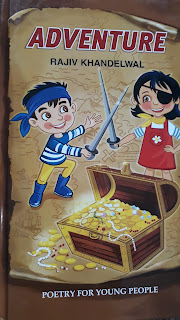
2.    ADVENTURE. Rajiv Khandelwal. Gurugram: The Poetry Society of India.  ISBN: 978-93-91091-13-2. $ 20, pp. 50; July 2021, HB
 
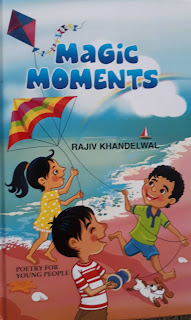
3.    MAGIC MOMENTS. Rajiv Khandelwal. Gurugram: The Poetry Society of India.  ISBN:  978-93-91091-19-4,  $ 20, pp. 50; July 2021, HB
 
4.    LET’S CRAWL. Rajiv Khandelwal. Gurugram: The Poetry Society of India.  ISBN: 978-81-949206-8-7, $ 30, pp.84, July 2021, HB


The nicely packed and attractively designed gift book set contains three books of poetry for children and one book on learning to write poetry. The set is imaginatively conceived and skillfully executed to promote verbal creativity among the present generation of children who have a wide variety of cultural exposure via TV, beginning with the cartoon channels to infotainment channels. Each book is also available separately.

Rajiv Khandelwal, an established Indian English poet, Electrical Engineer by education, and businessman by profession, seeks to arouse among children of all ages an interest in poetry reading and writing. He especially composes 50 poems for each of the three books and tries to make poetry accessible, as it appears to me, to post-primary and high school level students in the Second Language contexts where the medium of teaching/learning is English.

He and his poet and academic readers who offered their feedback about the suitability of the poems or their selections to him presume that the readers/learners have already acquired the basic knowledge of English language and grammar, are interested in poetry, and can be motivated to learn to write it, too.
So, Rajiv  Khandelwal presents an “exotic collection of poems” with diverse themes and verbal music, to quote Julia Devardhi, who assisted him in making his choices. No doubt, most of the poems are good to read, engage the mind, and are entertaining, but for my 7-year old reader, Jahnavi, certain words and expressions were not understandable: “pot of gold” (Rainbow), “pneumonia” (Alarm), “legit” (Business), “fiscal”, “referral”, “corporate office”, “ego” etc. Nevertheless, she said that in the book Magic Moments, “poems such as A Wise Box, True Tale, Battle With Corona, My Favourite Season, and Alarm are very good. I like them very much.”

I would like to quote a couple of examples that bespeak the relevance and appeal of the poems Rajiv Khandelwal has composed:
“Peter had a petrol pump/ But now a days there was a slump/ Due complete clampdown in town/ Citizens were in lockdown/ For in air virus did not fade/ So, there existed no trade./ Could not even go to bank/ Money in house shrank and shrank/ Till no money left, even for rice/ Now all paid, for not heeding advice.” (Covid and its Price, Adventure, p. 28); and  “If I were God, I would instruct mom/ To make this food plan for her son Tom./ No, to green vegetables,/ Allowed daily eatables/ Will be ice-cream for breakfast.// For lunch, pastry will be must/ Dinner will be doughnut/ Each day, get six glassfuls of Pepsi/ I as God, declare such foods healthy” (If I Were God, Crazy Class, p. 1).
The poems are, no doubt, readable and successful. Yet, the poet should have possibly graded the 150 poems for different levels of readership, and made his selections accordingly, instead of ‘mixing’ them in the four-volume set for ‘universal’ use, from pre-primary to secondary level students/learners.

The fourth book, Let’s Crawl, is aimed at teaching how to write a poem.  It particularly seeks to develop the skill for writing Acrostic poems, Syllabic poems, and using vocabulary.  The book is good in that it develops ‘word sense’ via different examples that are motivating and promoting one’s feel for the English language, it’s rhythm, rhyme, and other nuances.  The poems, prompts, and exercises in it are effectively designed to help, understand, and encourage young learners to produce their own verses in English.

Additionally, Rajiv Khandelwal, as a poet, and now, as a producers of children’s literature,  makes a strong plea for using poetry both as input and output in the language learning process, which is appreciable. His new books make a significant contribution to children’s literature and Indian poetry in English. Kudos to him for his fresh venture.


***
--Dr. Ram Krishna Singh (Formerly Professor of English, IIT-ISM, Dhanbad, India)

Pandemic Poems: Ram Krishna Singh

Ram Krishna Singh
TEST

Lonely December
aren’t I immune?

antibody test
before boarding

uncertainty continues
no silence helps

virus more mighty
than gods in politics

don’t know if I can meet
children before the year-end

to celebrate birthday
or continue journey

in flurry living
each day a grace
***


NEW GODS

Meditation --
future uncertainties
beyond crisis

new strains, new virus
villains of the  new order
peeking from windows

create new mantras
for life to continue
envision new gods 
***


Bio-note: Ram Krishna Singh, an Indian English poet, has been writing  for about four decades. A retired   Professor of English  at IIT-ISM in Dhanbad, he has published 46 books, including poetry collections God Too Awaits Light (2017), Growing Within/Des─Гv├вr┼Яire l─Гuntric─Г  (English/Romanian, 2017), There's No Paradise and Other Selected Poems Tanka & Haiku (2019), Tainted With Prayers/Contaminado con oraciones (English/Spanish, 2019), Silencio: Blanca desconfianza: Silence: White distrust (Spanish/English, 2021), and A Lone Sparrow (English/Arabic, 2021).  More details on https://pennyspoetry.fandom.com/wiki/R.K._Singh

Short Poems: Ram Krishna Singh

Ram Krishna Singh

UNTITLED - I

1
The mask of man they paint
with so many fingers as brushes
man’s only colour now

2
They take away the day’s flower
husk I retain for tomorrow
nobody knows what the robbers may look for

3
Unable to rise beyond themselves
they worry about their colleagues’ peace
and die of selfless jealousy

4
Apple, snake and three-fifth of me
in bed manipulates man
inside selfish rubbles

5
The painted paper-god and Christ on the cross
stand on the dawn-coloured wall of my bedroom
watch sex, prayers and restlessness each night

6
The colour of night is the same everywhere
what if my identity is not known
let’s f**k the moment and forget the place

7
If passion breeds beads of sweat 
in winter night the plateau is reached
too much love can run one out

8
Crushed heads of serpents coil along the road
green glitter of stream strikes my vision
I walk and fear the growing ripples in urinal

9
It needs less than a drop to procreate
but months and years of readiness to enjoy
sex sustains both life and art

10
Once your body was the sitar waiting for my touch
the sweet fragrance of your hair still lingers
but the cigarette that was mine is now ash

11
Locked in the giant Chandragupta
I fly over snow stacked stones
and defy clouds in unseen sun

12
Civilization hasn’t spared the caves
man suffers in the hands of parasites
here too who work often go without food

13
The smile you weave splits the sun
I lose my direction in clouds darkening
the white of the lake moon kissed


UNTITLED - II


1
Here she goes in the long light
and swiftly a shadow moves with her

2
What if my nights are poisoned by evil spirits
they can’t corrupt my bare truth in one life

3
The fire broke out to retaliate
they fight with lightning

4
Where will I reach running with gluey feet on gashed earth
a relentless sun licks leftover of a dying day

5
Not to kiss my feet they rush 
waves vie with waves to reach the shore

6
The dance of rain is good for a short 
but the fall of sky is too much

7
Keep my cracked tongue tightly closed
lest the diseased mind is known

Bio note: Ram Krishna Singh, an Indian English poet, has been writing for about four decades. Professionally, till December 31, 2015, Professor of English at IIT-ISM in Dhanbad, he has published more than 160 research articles, 175 book reviews and 46 books, including Sense and Silence: Collected Poems (2010), New and Selected Poems Tanka and Haiku (2012), You Can’t Scent Me and Other Selected Poems (2016), God Too Awaits Light (2017), Growing Within/Des─Гv├вr┼Яire l─Гuntric─Г (English/Romanian, 2017), There's No Paradise and Other Selected Poems Tanka & Haiku (2019), and Tainted With Prayers/Contaminado con oraciones (English/Spanish, 2019).  His haiku and tanka have been internationally read and appreciated. web: https://profrksingh.wordpress.com  ; email: profrksingh@gmail.com

Tainted with Prayers—Exposing Life’s Various Layers!

Authors: Ram Krishna Singh, Joseph Berolo
Country Published: India.
Copyright: 2019
Date Published: December 22, 2019
Languages: English by Ram Krishna Singh, India
Languages: Spanish by Joseph Berolo, Columbia
Sold by: Amazon.com Services LLC.
Publisher:  Editorial Ave Viajera SAS
ISBN 13: 978-1650109237
Pages:  78
Paper Back: $19.00                                            
Kindle Version: $0.00


Joseph S. Spence, Sr.

Reviewer: - Joseph S. Spence, Sr.

Introduction

Professor Ram Krishna Singh is a brilliant poet and an eminent scholar. He begins this excellent book with a great comment regarding Diwali, the most representative festival in India. Such an awesome celebration filling the night with glorious lights of illumination never seen before. This continues for five days, where Hindus celebrate victory of good over evil at the “Festival of Lights.” An eloquent event which is needed, and resonating goodness in the hearts of everyone. In correlation, this book indicates, “Now is the time for poetry to be a therapeutic tool with a taste of goodness to humanity.” Such a taste, which does not have any negative effect, but only nourishment, redeeming values, and saving grace. This is an inspirational healing of the spirit, through poetry by driving out evil existing in the soul and body of individuals, where goodness is reminiscent of Diwali, and its principles regarding life’s goodness and victory over evil.

This excellent book is written in English by Professor Ram Krishna Singh, and translated into Spanish by Joseph Berolo. Based on my knowledge of Spanish, and reading of such, an exceptional translation was done on each of the poems. Berolo, like myself, was also moved by the sensual and spiritual essence of the poems. The fluidity of the poetic verses, proliferates personification of the poems flowing with much grace like healing water, with realistic idiomatic sinuosity and imagination. The brevity, and vastness of interpretation of the words scribed by our illustrious author, stimulate growth for the existence of humanity in special ways.

The first poem, “New Dawn,” expresses his love for the night, when sleeplessness yield to passion of the body. This results in the melting of ageing fears, for the beauty of a new dawn. Such excellent thoughts of love and affection, occurring before the sparkling orange and red rays of an eloquent sun crests the morn, of blue sky with white billowing clouds, with its inspirational beauty, uplifts numerous souls with pleasurable endearingness.
He continues with the poem “Blasphemy,” which begins by stating, “We have lived many deaths, and are now afraid to live.” This is a result of the terrible ruins in and around us, where raging fire of voices grows stronger and spreads. This result in the lack of dreaming and visualizing a new picture of the world. Such reflection of thoughts, sends a vivid image of, “It’s no use flying high because the sky seems shattered, and the city is haloed with blasphemy from saints.” His words and images in this poem, remind us of the book, “Things Fall Apart” by Chinua Achebe, Nigerian professor and poet. It’s translated into 45 languages, with over 10-million copies sold. Some of the themes are: changes in the status quo, stereotype challenges, experiences of cultures, and uplifting life’s imaginations—"Such Striking Sights!”

The next poem, “Ritual” is very illuminating, and speaks to the essence of many supposed leaders. Excerpts follow:

            Hiding helplessly in the luxury of prayers
            He raises a wall a babel of deception
            Through cocktail of drugs and desires
            Wakes up to unheard alarms
            Repeating rituals of shame ageing time

Here we see our distinguished author in deep contemplation dealing with images and perceptions of, “It’s not to be, and should not take place.”  He would rather see life without such rituals involving drugs and desires. His expectation, is not of one meandering through life like in a bad dream; thus, winding up as lost sheep walking aimlessly around.

The pages move to the next poem “Death of Desire.” Here one is able to see clearly how evening walks within the lanes and byways of body harmony, which is supposed to bring a sense of calmness, does not materialized. It’s eventually disturbed and turned into debates from television, and serial news, regarding temporal things of distorted wholesomeness. Such disturbing events eventually require swallowing of pills, as a quest to mitigate rising hackles, which involves walking through death’s desire to be in bed—"Such Sickening Situations!”

The next poem “Debris of Dreams” speaks to the importance of not allowing others to corrupt one’s mind with their antics. Excerpts follow:

            It’s near but
            Everyplace has a distance
            And people too
            They flee to see
            Me in their vicinity
            Sense of anger
            Down to smallness
            They hate only themselves
            The debris of dreams they leave
            I must erase and be at peace

These are the kind of events one sees evolving in our common era. Where we find people distancing themselves and not wanting to belong. Their actions of negatively toward others display self-made misery. Such wanton rage has brought them down to the smallness of hate, reflecting only from themselves. When facing a situation of this nature, the mind, body and soul now have the quest of positively to erase such lunacy, and remnants of debris from ones’ dreams to abide in ultimate peace and accord.

Sticking with the subject of dreams, the next poem “Dreams of Clay,” raise questions regarding existence of things that should not be.  Excerpts are as follow:

            They make my face
            Ugly in my own sight
            There is not beauty, nor holiness left
            The hinges of doors moan
            Politics of corruption
            I weep for names and faces defaced
            With clay dreams.

Here our eminent author, states his mind on what he does not like that’s existing in his sight. He questions the desire to even look in the mirror. He is afraid of what he may see of himself caused by others. He does not feel there is any beauty or holiness left and the nation is naked. He sees streams flowing in darkness. Political corruption resulting in moaning, even with the motion of opening a door. There exists weeping for defaced faces like rigid shattering of clay in a dream. Naturally, there are visions to change this situation of life. He realizes, one is able to do so with creativity and ability, while molding the situation making it better.

On the next page we find the poem, “Gourmet Journey.” This poem addresses the kind of events we see daily in political situations. It started by illustrating, how others win elections, with the practice of sponsoring chaos chanting. The objective is to kill tongues uttering dissent in the form of righteousness, opposing such foolishness. As a result, many closed their windows, allowing the essence of dysfunctionalism to be the holy constitution. Allowing, such displeasing situations to be the norm. These actions foster into small deities of tango with collaborations invading newer territories; thus, becoming the status quo. The ensuing reality, allows a variety of dreams to rise and sell, as political posturing and pleasing, feet moving forward and minds backward, as they relish lies of gourmet journey with their passion of discontent— “Flagrantly Transforming Fear Festering.”

The next poem “Aftermath” shows another phase of disruptiveness to humanity. Selected Excerpts follow:

            Between mossy and thronged pathways shadows slant
            Wisdom splashes in gonzo arguments, as a rooster walk
            Others feel the sting but prefer silence
            Like caged parrot’s free to shame from decades groomed
            Hey know how weak they are to stop the burning
            Aberrations clot in their minds
            The wounded converts
            Counting cries form lashes and piercing

Here our illustrious author, tells the truth of situations others find themselves residing with in their daily lives. Their voices are silent and afraid to speak, like their tongues taken out and now dumb. They are forced to accept the existing conditions. These individuals are not like the poets arriving with a therapeutic tool for humans to taste goodness, knowing it does not hurt, and is not flattering. In actuality, they fail to realize poetic essence only incorporates nourishment of the spirit, redeems lives, and saves the body and soul from being controlled by evil. Unfortunately, their sight does not allow them to see, how poetic words fill lives with melodious echoes of peace and spiritual harmony as body therapy. They experienced such negative conditions daily in life, without any thoughts of eventual poetic essence and liberation.

The next poem “Intellectuals” reflects the emerging era. One must be cognizant of the environment, and who is teaching ethics, integrity, and related subjects of progress. It begins by addressing the issue of being stranded in the past. Actually, governed by supposed intellectuals, with glasses in hands, preaching ancient wisdom to a modern generation. Some diving nude into dried pools, while corralling others along. Many now sit by the fence, polishing their reduced and diffused visions, reflecting on minimal value, and buffing such distorted knowledge for the next day’s session—"Such Sunrise Slaughtered Sheep!”

The final poem to review in the awesome book of Tainted with Prayers is “Liberation.” Selected excerpts follow:

            Away from home in academics, sex, philosophy and religion
            I’ve been skeptical about these years, hell reveals in lost memories
            Couldn’t be new dialect for spring
            Fears are not bread from heaven
            Yet the eagles fly with wide eyes
            Nose opened to stinking patches
            Mandates for dream wrapped in nightmares
            Praying for liberation and decay with divinity

Here our recognized author paints a clear picture of reality on several university and college campuses, while away from home. He sees his dreams as nightmares still wondering in his mind as fires, with no heat or light. They only exist as sterile emotions, making their presence dark and absent. The resonating mud and ghost bewilderment, leave him preying for liberation and decay with divinity—"Supreme Spiritual Insight!”

Conclusion

This dynamic book reflecting realistic essence of life ends with a collection of notes and opinions regarding the inspiration, skill, knowledge, and ability of our prestigious author. Some are as follows: “[This] is not only existential, but metaphysics and sensual denouncement of exile from a world that has been stolen from poets, and worldwide humanity” (Christina Montero, Argentina). “A true poet is a poet without boarder as he echoes the innate sensibility, desires and angst of human being that often transcend time, race, and medium…poetry resonate at a universal wavelength and can connect with the sensitive souls the world over” (Dr. C. L. Khatri, TPS College, Patna, Bihar, India).  “Ram Krishna Singh is a true poet. Not one to rest in the knowledge, him being a lyrical poet like none, he also has a work ethic like few….” (Spiros Zafiris). “[This is such] a unique collection of poetry which implicitly assists the reader to find the right path through the enigmatic maze between life and reality” (Munia Khan, Author of, To Evince the Belu). “[Starting] from the first line of every poem, the poet’s wit, unfailingly, unleashes the reader into a different plane of existence and fluid flow…having tasted the gentlest expressions of the rising star in rebellion against the mundanity till the last drop of dying desire….” (Varsha Vijay, Suecia).

There exists various use of English literary principles outlined in this wonderful book of realism. Some include: metaphor and simile for distinctive comparison, couplet poetry form of two lines, narrative forms of continuous lines without stanza breaks, analogy which shows similarity between two things, imagery which allows readers to see and feel the meaning of the poetic words, haiku styles of poetry as stanzas, and other variations.

Waiting to get this eloquently expressed poetry book after reading this review, is an injustice to one’s self. Now is the time to act, by obtaining a copy and expand the power of the mind, body and soul, through reading the stimulating essence of reality unleashed in this book, through poetry by our esteemed author, Ram Krishna Singh, and translated into Spanish by Joseph Borolo!


About The Author

Our valiant author, Dr. Ram Christina Singha (December 31, 1950-), Varanasi, India, earned his B. A. in 1970, and M.A. in English literature, Banaras University, 1972, and a Ph.D., Kashi Vidyapith, Varanasi, 1981. Additionally, he obtained a diploma in Russian during 1972.

He started his career in journalism, as a compilation officer with the District Gazetteers Department, Lucknow, 1973, and as a journalist with Press Trust of India, New Delhi, 1973-1974. Thereafter, he became a lecturer at the Royal Bhutan Polytechnic, Deothang, Bhutan, 1974-1976. He joined the Indian School of Mines in Dhanbad as a lecturer from 1976-1983, and subsequently was promoted to assistant professor in 1983. He served as professor of English with the Department of Humanities and Social Science, Dhanbad, beginning in 1993, and retired as a professor in December 2015. He is highly recognized in English for Specific Purposes, from India, and has evaluated over forty Ph.D. theses from a variety of universities.

Some of his literary activities include the following authorship:  writing of over 160 researched articles, 170 book reviews, 40 books, and published in over 150 anthologies. His editorial activities in guest editing include: language forums during 1986, 1995, and creative forums in 1991, 1997, and 1998. He served as the general editor for Creative Forum New Post Series, editorial board for Canopy, Indian Book Chronicles, Indian Journal of Applied Linguistics, Reflections, Titiksha, International Journal of Translation, Poetcrit, Impression of Eternity, and SlugFest. His poems have been translated in: French, Spanish, Romanian, Chinese, Serbian, Croatian, Slovene, Japanese, Bulgarian, German, Italian, Portuguese, Greek, Crimean Tatar, Arabic, Farsi, Esperanto, Kannada, Tamil, Hindi, Punjabi, Telugu, and Bangla.

Dr. Singh is also known as R. K. Singh, a prominent Indian English haiku genre poet. Some of his known publications are: Every Stone Drop Pebbles (1999), Pending Dreams, part of a trilogy collection in English and Italian, Pacem in Terris, written jointly with Myriam Pierri and Giovanni Campisi (2003), The River Returns (2006),  Sense and Silence: Collected Poems (2010), New and Selected Poems: Tanka and Haiku (2012), I Am No Jesus: and others selected poems in Tanka and Haiku (English/Crimean/Tatar 2014), God Too Awaits Light (Cholla Neddles, September 2017), and Growing Within: A Bilingual English and Romanian Collection (Constanta: Anticus Press).  He uses mystical elements, involving emergent social and political consciousness, to validate and exemplify his haiku practice in India. Additionally, he developed his own Indian kigo, images, and experiences in haiku practice, and does not differentiate between the practice and writing of haiku and senryu poems.