![]() |
| Gayatri Majumdar |
** ISSN 2475-1359 **
* Bilingual monthly journal published from Pittsburgh, USA :: рдкिрдЯ्рд╕рдмрд░्рдЧ рдЕрдоेрд░िрдХा рд╕े рдк्рд░рдХाрд╢िрдд рдж्рд╡ैрднाрд╖िрдХ рдоाрд╕िрдХ *
Gayatri Majumdar (Colours of Love and Barriers)
Molly Joseph (Colours of Love and Barriers)
![]() |
| Molly Joseph |
Contents, July 2022
SetuVolume 7; Issue 2; July 2022Setu PDF Archives EditorialPoetry
ExclusiveEssay: An ExcerptAuthor of the MonthConversations LiteraryTranslationShort FictionAudio VisualCultural Roundup
ArtPhoto EssaySpecialSpecial Feature: The Telugu Tableau through Translation – 2 Presenter’s Preface: Atreya Sarma UPoetry
Short Fiction
Setu Initiative: Setu Series of Virtual Readings
Special Edition: Colours of Love and Barriers Guest Editor: Candice Louisa Daquin
|
Guest Editorial: Candice Louisa Daquin
![]() |
| Candice Louisa Daquin |
Special Edition: Colours of Love and Barriers
Featured Authors
Poetry: John Maurer
| John Maurer |
On “Murmurs of Silence”
Pradipta Mukherjee, is a Film
Critic and Associate Professor in the Department of English, Vidyasagar College
for Women, University of Calcutta. Her published books include – Fluid Frame in Cinema: Collected Essays,
published by Cambridge Scholars Publishing, UK, Studies in John Fowles’s The French Lieutenant’s Woman and Shakespeare on the Celluloid: Global
Perspectives. She has co-authored a
book titled Tragic Survivals: From the
Hellenic to the Postmodern. She has three co-edited anthologies, Dodging Dystopia: Literary Routes: Global
Circuits; The Diasporic Dilemma:
Exile, Alienation and Belonging
and Women’s Education in India: Past
Predicaments and Future Possibilities. Mukherjee has presented her research at some
of the most prestigious academic forums across the world at University of Paris
13, University of Amsterdam, University of London and Universit├й of Grenoble
Alpes. She is a regular columnist in The
Statesman, one of India’s leading dailies.
Pradipta Mukherjee
***
Ashoke Viswanathan, is a multiple national and international award
winning filmmaker who is currently Professor and Dean at Satyajit Ray Film
& Television Institute, Kolkata. 
Ashoke Viswanathan
He has directed more than 150 film projects including feature films, documentaries,
shorts and television shows. He has been the Chairman of the jury, National
Film Awards on two occasions. Viswanathan has been a Visiting Professor at
Tufts University, Boston and Monmouth University, New Jersey.
An active director, playwright and drama translator. His recent writings
include Ikattar Ki Ladai and Shakespeare in Venice (both 2021).
Viswanathan writes regularly in mainstream media as well as in academic and literary journals (like LENSIGHT, LONDON MISCELLANY and TAKE ONE) on Film and Theatre. Murmurs of Silence (2022) is his first book of poems.
Poetry: Robert Maddox-Harle
![]() |
| Robert Maddox-Harle |
Cast Shadows
The
abandoned building beckons
a
bleak bridge to the past,
paint
flakes the wall
falling
like downcast eyes,
an
eerie dull light seep insipidly
from
a crescent moon,
a
flickering dull-bright from
the
cracks beneath the antique doors.
Damp
musty scents waft over me
the
presence of coal gas menacing,
somewhere
a clock ticks loudly
reinforcing
the curse of mortality,
Plath’s
ghost sighs deeply
trying to recite Sheep In Fog,
impossible
this side of the bleak bridge.
The
one-armed cook smirking
stirs
the blood-filled stew
and the broken stove creaks,
dinner
for the Laid Off
half
warm - soon.
the
boy’s clock chimes his return
his
broken lamp lifeless
casting shadows on nothing!
(Inspired by “The
Club of the Laid Off” (1989) is a short 25-minute stop-frame animation movie
masterpiece by Czech filmmaker Jiri Barta)
***
Shrouded Coffin
The
intrapsychic coffin is shrouded
a
sickly white-grey mist obscures its plaque,
the
coffin’s presence a mystery,
it
suddenly materialising remains unanswered.
Throwing
the Tarot yields The Moon,
four
golden Yods fall from her body
two
towers are the gateway to Resurrection
the
dark flux of night dominates ….
this
coffin is deceptive,
search
past the falsity of the obvious
is
the wisdom of this Luna card.
The
mist lifts and reveals an inscribed plaque
“Within this tomb
lies the answer,
the answer to the
illusion of space-time reality”,
to
open the coffin an esoteric key is needed ….
a
ventriloquist’s phantom chant
echoing
an incantation harmoniously,
an
incantation from the heart of the Golden Yantra.
The
chanting slows and softens
the
dark flux of night
is
drawn apart by slivers of moonlight,
in
the yellow gloom the coffin lid opens,
an
effigy of Salvador Dali grins,
a
golden clock balances on his chest
the
time …. one minute to midnight.
***
The Hospital
An eyelash clears a cinder trapped beneath its rim,
the chained slave is a never-ending burden
in different shades of bruised blackness,
then consumable luxuries send intimate messages
extremely crass,
56432-1
so the goose kills the loquacious and inaccessible
whores
and everlasting vows are abandoned.
La Saltp├кtri├иre – Explosive!
gunpowder blasts transmute to deranged screams
Enter Edvard Munch!
The plough rejects the earth
shrill birds mocking,
this ultimately floats into infinity
all ignoring an oboe's desolate plea.
Next we find the pawnshop of numeric tourism,
this well-considered defence strategy opens the
technological almanac
raising the hospital's permit
and the hysterics are silenced,
SILENCE .. SILENCE .. SILENCE
The soft-hearted and worn-down procurements float
as doubt settles into the abysmal lace,
the best-seller an abomination of retrospective lies
answers as the phone rings abruptly.
Hallo!
47 Boulevard de L’hopital.
A mysterious painting hangs abandoned in the hall
its piety risks exposure
functioning as a mirror for psychosis
all creatures disintegrate before its reactive
tendrils.
(From:
The Blazing Furnace.)
Jael Varma (Colours of Love and Barriers)
![]() |
| Jael Varma |
Emily Thomas (Colours of Love and Barriers)
![]() |
| Emily Thomas |
Paresh Tiwari (Colours of Love and Barriers)
![]() |
| Paresh Tiwari |
Jaime Speed (Colours of Love and Barriers)
| Jaime Speed |
Ermelinda Makkimane (Colours of Love and Barriers)
![]() |
| Ermelinda Makkimane |
Bekezela Mguni Offers Poignant Exhibit in Light of Ukraine War
| John Maurer |
-John Maurer
Timing is everything. And while artist Bekezela Mguni began creating her latest exhibit – entitled I come from a holy place – in 2018, the now completed collection of art provides an even greater cultural context today given the 2022 Russian conflict with the Ukraine. Mguni’s exhibit was discussed Saturday morning, July 23rd at the Mattress Factory’s Boxspring Cafe in the Mexican War Streets of North Pittsburgh. Mguni, a queer artist and an immigrant from Trinidad and Tobago has lived in Pittsburgh’s Hill District for the past two decades. Her current installation, I come from a holy place, is a part of a larger artistic project, a collection of works from both Russian and American artists entitled Pop-Aganda: Revolution & Iconography, where the art provides commentary of the moral ideology that underlies propaganda as we know it, while simultaneously the pop-art sensibilities in the works put those commentaries within a cultural context from which to view them. All of which are timely and compelling themes in today’s current events in Europe.
![]() |
| Bekezela Mguni |
Mguni’s exhibit is a four-wall collection on the
fourth floor. As soon as the elevator doors open, one is immediately greeted
with Mguni’s piece, Affirmation, a circular mirror wreathed in
hand-assembled dried flowers with the phrase and title of the exhibit, “I come
from a holy place” printed in capital letters along the bottom curve of the
mirror. Within the viewer’s own reflection, this piece serves as a portal into
which one enters the installation understanding that the artist isn’t just
trying to communicate where they come from but asks the viewer to consider
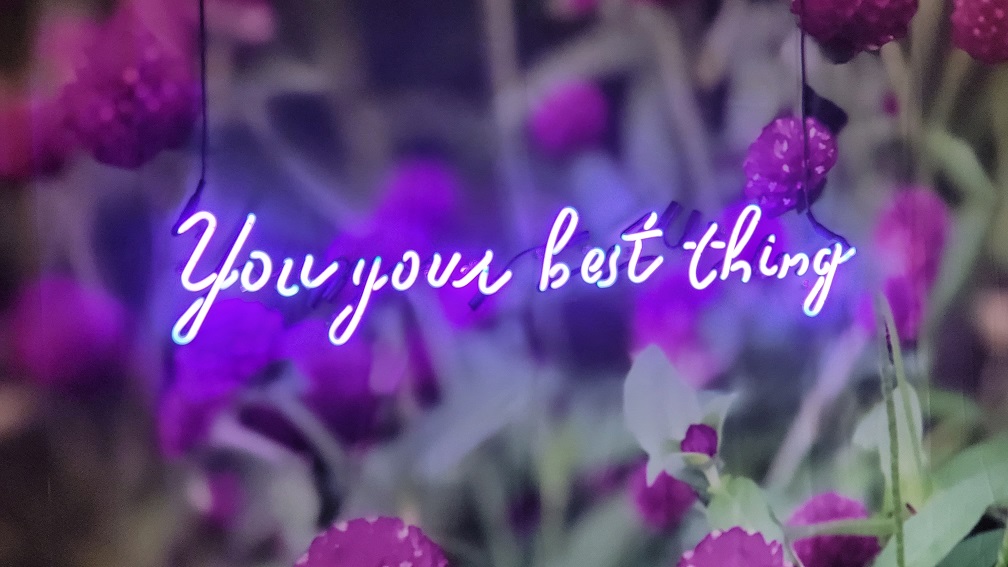
their own origins. Upon further exploring the violet painted sub-room, one is
greeted by an enlarged photo of Gomphrena flowers captioned by a purple neon
sign that reads, “You your best thing.” This is a quote from Toni Morrison, the
Nobel and Pulitzer Prize winning novelist that Mguni refers to as her “ancestor.”
![]() |
| Foundation / Altar |
This flowed into the next piece, Foundations/Altar,
an assemblage piece built from salvaged tin, steel, and a black marble
fireplace mantle and ornamented with small statues, shells, flowers. These
materials provide the “foundation” to two photos of Mguni’s parents holding her
as an infant. According to Mguni, she mused while creating the piece “How do I
affirm black people in a world that tries to erase and destroy us?” Perhaps her
hypothetical answer is offered in a photo of graffiti Mguni currently has as
her Facebook banner which reads ”More Black Self-Care.” Ultimately, the piece places
the artist and her parents in a context which empowers and uplifts her and
asserts that when looking for truth, we shouldn’t look outside but inside, a
message that could also be taken from the previous piece, Affirmation.
Beside this collection of images, vertically
arranged and constructed from more salvaged metal were three Adinkra Symbols,
one of which was Gye Nyame (which means “the omnipotence of the creator,”)
could also be seen in the earrings being worn by Mguni.
The fourth wall was comprised of a myriad of
different pieces. The first piece the viewer is drawn to is the television
screen playing footage of Toni McClendon, a peace activist, speaking at the
1987 World Congress of Women in Moscow. Alongside this piece is a dozen books
in stacks of four, each stack sitting upon a metal L-bracket fastened to the
wall. Among these books were Beloved by Toni Morrison, Feminist
Theory by Bell Hooks, and Dawn by Octavia E. Butler. These pieces are
arranged among a few more printworks including images of icons such as Audre
Lorde, Gladys Bentley and Zora Neale Hurston
that were composed in a distinctively different style than the printworks on
the opposite wall, and a collection of family heirlooms including a cocoyea
broom, an antique clothes iron, and a mortar and pestle.
Beyond the artwork itself, it’s important to
understand Mguni’s process for this installation. At points, there are other
less obvious connections to her social activity. For example, the wall-sized
photo of Gomphrena wasn’t just taken by the artist, but she grew the flower
itself, and other flowers used in her prints, in East Liberty Garden. This was
part of a program Mgnuni sponsors called “Flowers for Black Girls.” As part of
this initiative, Mguni and a group of others gathered at the Wood Street “T”
station on October 24, 2014 with over 500 flowers with messages attached such
as “You are valuable,” to hand out to Black
trans/women and girls. Mguni chose October 24th
because it was the birthday of Teaira Whitehead, a Homewood teenager whose body
was found nude and doused in bleach on a trail in Riverview Park a few weeks
earlier. No arrest has ever been made for the crime.
In total, Mguni’s creativity, artwork and
messages are poignant and moving in any decade or generation. But viewed
juxtaposed the headlines of today’s Ukraine conflict, they were especially
impactful and worth the trip to the fourth floor.
Kripi Malviya (Colours of Love and Barriers)
![]() |
| Kripi Malviya |