Showing posts with label Mahua Sen. Show all posts

Poignant poetry

Book Review by Subhash Chandra


Nostalgia Crafting a Home Within
Author: Mahua Sen
Year 2024
Pages: 122
ISBN 978-93-92494-52-9
Price ₹ 349 | USD 9.99  

Quite some time ago I posted on my FB page that all poets share the same address: RAINBOW. 
It was an impulsive act. Impulses, we have been told by psychoanalysts, spring from the Id (the Unconscious), and therefore, are chaotic and irrational. However, they have a subterranean logic that is not graspable … at least immediately. If reflected on after a lapse of time, often you begin to understand the rationale. 

Thinking back, I realise, why the Rainbow is Poets’ habitat. They are empathetic, blessed people who have been assigned the responsibility to create beauty through their poems (songs, even the sad ones) that make the world beautiful and create peace and harmony which the world has always needed … and does now more than ever.  It is not for nothing that the planets move in harmony and the process creates the music of the universe.   

That my impulsive statement was not a meaningless effusion is borne out by my encounter with Mahua Sen’s poetry collection, Nostalgia Crafting a Home Within.  The title is multilayered. It has depth and universality and is delicately suggestive. It indicates that the idea animating the poems is YEARNING – yearning for Home and all that goes with it: love, understanding, warmth, security, freedom from responsibilities, and the comfort of the lap of the grandmother and her stories to boot.

All of us irreversibly lose home through a shift in place/space or through the process of growing up, but the longing for home becomes more intense with time and we attempt to retrieve it by crafting it through memories (nostalgia).
                                                        #
Life is full of vicissitudes; we are vulnerable to crises that cause worry and stress. Each day seems an arduous climb and, at times a harrowing task. One can either find ways of dealing with the situation or go under and slide into depression.

In the poem “Red,” the poet is overwhelmed by the exhaustion caused by confronting nettling issues during the day, and sleep eludes her like a mirage in the ‘desert of the night.’ She wraps herself “in the warm, crimson hues of nostalgia … A comforting cocoon [home] that shelters” her “from the harsh winds of the present.” (!3). 

Trudging the cratered road of life is exhausting, and the drained sojourner looks for the evergreen ‘Live Oak’ under which s/he can rest in the dense shade, replenish her energy, and resume the journey. The ‘evergreen tree’ is the grandmother in the poem, “Grandmother,” which I find is one of the most heart-touching and beautiful verses in the collection.
To wit: “I still hear the faint chime of my grandma’s bangles, 
…. …
In the labyrinth of days … 
Her lap, a sanctuary from life’s tempestuous climb.” (15)

Craving for love and romance is universal. Each individual cutting across gender, class or caste, and marital status, is struck by Cupid once in a lifetime, even though it is well-known that unrequited love causes anguish.  This pain is captured in the poem, “Charulata,” who carries within her more of her ‘lover’ than she does of herself. 
“The epicentre of/my being now bears the weight of memories, suffused with the scent of 
bloodstains, amplifying the tumultuous chaos within” (16). 

There are other poems like, “Echoes of Childhood Fragrance,” in which
“Nostalgia seeps through the cracks of my heart, crafting a home
within.” 
And on “Certain evenings, in particular, carry a profound aroma, a scent
that resonates with ‘home.’ (23). 

In “Desiring Simplicity, 
“My heart longs for a voyage back in time, 
To days of innocent bliss and lavish twilight affairs, 
I muse upon the shade of nostalgia’s hue …” 
Even if the poem is not demonstrably about the yearning, the imagery unmistakably conveys dwelling in childhood: “They attempted to strangle my Hope
But my Hope is an infant
Unacquainted with the art of silence….” (‘Hope is a Thing with Feathers.’ (19).

To conclude, there are poems in the collection that may be outside the pale of the defining framework I set out with. But you will find memory, that is nostalgia, at work to create a comfortable, protective niche for the poet. 

If you enjoy poetry with poignancy, sparkling imagery, mesmerizing rhythm, and poetry with a purpose, then plunge into Nostalgia … Mahua Sen’s book!

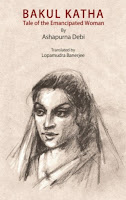
Bakul Katha: Tale of the Emancipated Woman. Original novel: Ashapurna Debi. Translation: Lopamudra Banerjee

Review by: Mahua Sen


Book: Bakul Katha: Tale of the Emancipated Woman 
Original Novel: Ashapurna Debi 
Translation: Lopamudra Banerjee 
Publisher: Avenel Press, India (2021) 
Pp 335. ₹ 500.00

“Each time a woman stands up for herself, without knowing it possibly, without claiming it, she stands up for all women.”

Eminent poet Maya Angelou’s pulsating words reverberated with every word I read in Lopamudra Banerjee’s translated work Bakul Katha – Tale of the emancipated woman, originally written by Ashapurna Debi.

When you hear the name ‘Ashapurna Debi’, do you think about a resilient and promising woman? I do, and her name warms my soul! The primary reason is that I cherish the sincerity in her thoughts and her unrestrained voice to inspire woman to unabashedly occupy their ultimate sovereignty. Besides, I also cherish her relentless efforts to awaken the subjugated women from their stupor, encouraging them to break the shackles of servitude and oppression and unfetter themselves. She offers a thought-provoking insight into the psyche of a woman and throws light on the oppressive societal milieu.

Lopamudra Bannerjee
Ashapurna Debi is a household name in Bengal. She is popular for her Sui Generis nature of challenging hegemony. Her nonconformist ideology reflects in her writings as she wanted to create a haven for woman where they can voice their opinions, where they are not treated with disrespect and derision.

It was her powerful trilogy which catapulted her to fame and glory. The three novels ‘Pratham Protisruti’, ‘Subarnalata’, and ‘Bakul Katha’ depicts women’s emancipation in three unique ways, encompassing the stories of three generations of women. In Bakul Katha, the last novel of the famed trilogy, we are impressed by the personality of an educated and economically independent feminist writer. She appears contemporary to readers of today since she unveiled the toxic masculine world where women are taught from a tender age to relinquish their voices.

Mahua Sen
I’ve read many bowdlerized versions of translations before, but Lopa di’s works of translation have changed my notion! Not to mention that ‘Bakul Katha: Tale of the Emancipated Woman’ is her best translated work so far (in my opinion). Each chapter of these 37 chapters of the book has a story to tell. Some will make you nostalgic, happy, cheerful, while some others will make you utterly crestfallen! Lopamudra Banerjee has translated the masterpiece with marvellous eloquence and intricate precision. In the process of translating one of the finest works of Ashapurna Debi, she has paved the way to an international readership for Bakul Kotha and has opened door to a cross-cultural discourse on the book, which is a fantastic tribute to Ashapurna Debi.

In Bakul Katha, we are taking a dip into the fjord of a plethora of emotions. I stifled a giggle while reading Shampa’s chronicle of love-affairs, her encounter with men, and fought back tears reading parts such as this:
“… after a few days, there were no significant memory of Shovan’s mother’s stay in the house. The unfinished sweater which she was weaving for Shovan lay over the trunk for many days, and then disappeared eventually…” as I read these lines, my eyes were fogged with uncontrollable tears and my heart ached for Parul, Bakul’s Sej di.
 
Many a times, I found the woman in me mumble beneath my breath while reading lines:
“You know saris with red borders carry that strong smell of being a pati brata , reeking with unquestioned obeisance to our husbands. I can’t seem to stand that smell…I would be carrying that fake advertisement along with those sarees if I ever wore any of them’’.

Some of the passages had me introspecting –
“…in this same house women still care to cover their heads in veils in the presence of their elders…in this same house, there is still the traditional ritual of ‘itu puja’ in a corner of the kitchen…women of the household still read the thin book, invoking Goddess Lakshmi. And then in this same house there is Shampa! Which one of it is true?”

I read and re-read and savored each word that I could relate to, with a lump in my throat, a smirk on my brow! The agony and ecstasy tucked beneath the duvet of each chapter; the paradoxical setting blew away my mind! More so, because all these are still very relevant to us.

This is a story that evokes all kind of emotions and throws a light on the muffled voices of women lying submerged just under the surface of society’s male-dominated gaze. At the same time, it talks about the rebellious blood that screams for liberation.

The story puts into perspective many things- it talks to us about that lonely desolate place that we all have experienced at some point, because of the way our culture is set up. The intimidating Do’s and Don’ts that muffle our voices since childhood until we break free!

Bakul Katha is also a way of seeing and comprehending beyond traditional values and instigates us to reclaim our true power! A reminder that once we emerge from the depths of darkness, we can turn our faces to the light with renewed courage.

The book is full of points and counterpoints and pinpoints a lot of questions that would make you introspect more about yourself and the society around you.

I must mention that I am in constant awe of Lopamudra Banerjee’s choice of words and diction. She is gifted with superlative grip on the English language; thus, her translated works retain the flavor of the original book. This book has no additional redactions and has been engineered with utmost ingenuity. I bow my head to the translator for having the courage and passion to execute such a mammoth task with such brilliance!

I believe, translation is the most challenging task to achieve excellence in, But Lopa Banerjee has proved me wrong, time and again, and yet again! With her smooth flow of words and a nuanced understanding of the human psyche, she has swept the reader and the woman in me and carried me along with the flow. I could visualize the story, feel, sob, smile as I merged into the story and found a part of me that I didn’t even know existed as I experienced diverse perspectives on situations that life throws at us.

The book has been published by Avenel Press, India and is available both in Amazon India and worldwide.
***

BIO: Mahua Sen is a multiple award-winning Poet based out of Hyderabad. She has authored a poetry anthology named ‘Insights’ under the flagship of Authorspress and has also edited and compiled a book named ‘Flock, the Journey’ that found place in Amazon Best-Seller list. Her poems and stories find place in more than 70 International and National anthologies, journals, and newspapers. 

She is a recipient of Grand Queen’s Leadership Award 2021. She is the recipient of Reuel International Poetry Prize -2021.She is the recipient of the ‘Distinguished Poet’ Award in the 10th Rabindranath Tagore International Poetry Award-2021.A recipient of the ‘Poesis Award for Excellence in Literature’ in 7th Bharat Award-2021.The ‘Wordsmith Award’ by Asian Literary Society -2020.

Mahua was also among the Top 3 winners at the Women Power and Summit Award 2021 at Bombay Stock Exchange. Mahua is the winner of ‘Nari Samman Award’ by Literoma. 
She is the winner of Literature Excellence Award-2020 curated by Lions club of Kolkata magnates.Mahua is the winner of ‘Rising Star Award’ by Asian Literary Society.
She is the winner of ‘ Bangalir Gourab’ Award -2021 apart from many other awards and accolades.

Mahua is presently working with BEO (Bull’s Eye Outsourcing) as the Regional Director, South.