|
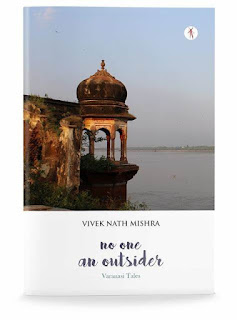
| Vivek Nath Mishra |
- Vivek Nath Mishra
“If you are willing to meet me, come over to Assi Ghat this Saturday. It is the last Saturday I’ll be walking along the river.” He saw this message by Krish around five in the morning. He heard a faint sound of a group of pilgrims singing psalm in unison. But that too stopped after a while. It had been long since he woke up this early. It sounded divine in the utter silence all around. It reminded him of the school time when his mother would wake him early before the sunrise to revise for the exams. He couldn’t sleep thereafter. He slithered out of bed and splashed some water on his face. It was after a long time that he saw his face carefully. A long time had elapsed since the school days. A lot had changed around him but the fact that he didn’t have many friends remained the same. Krish was one among a very few friends he had.
Krish had been living here in Varanasi for about fifteen years now. He was a lean and tall French man aged around sixty-two to sixty-five with thin, silky, golden hair streaming down to the nape of his neck which had now begun to turn silver due to ageing. Once when he had seen a Japanese man at Prabhu Ghat with long matted hair falling down almost to the ground, he had asked Krish, “why don’t you grow your hair this long?”
“Everything has its own potential and limit, Sarad. This wouldn’t grow longer,” he had said with a gentle smile. Limitation. Of course it is our limitations that we fight against all our life and the scepticism towards it, perhaps, gives a purpose to our life. In Varanasi this is an assumption that everyone is a Guru and perhaps he had turned into one.
“Of course I am Banarasi. Don’t you see me preaching all the time for free?” he had said bursting into laughter.
Krish always wore the same golden coloured long khaadi Kurta which came down to his knees and a long white pyjama, folded at the end. He sometimes wondered if it was the same kurta he had first seen him in, many years ago. As it always looked brand new and well ironed or perhaps he had had a few sets of the same clothes. He didn’t grow fat or thin and nothing in him changed with the passing years not even his ochre coloured Jhola which he had bought from Tibet. He wasn’t on any social media platform. All he believed was in real things but quite contrary to it all the real things didn’t matter to him much. After he insisted Krish too many times for a phone he had bought one. A simple set with buttons and radio. Krish detested western music and Bollywood music too. He had his radio set in his room on which he listened to Indian classical music on All India radio Raagam channel.
Krish had asked him to come over around half past four in the evening but he was late. The time he got ready to leave, his father asked him to take him to a hospital to see a relative who had broken his waist by falling off a ladder. He couldn’t refuse his father, and Krish had to wait for half an hour.
“I’m sorry I am late. Sorry I kept you waiting,” he said as he sprinted down the numerous steps at Assi ghat.
“Oh! No problem, I was here with a cup of tea and Ganga, my best friends you see,” Krish said jubilantly. He looked happier that day. He had never seen Krish this much happy before. He didn’t show Krish but he even felt hurt that Krish was so happy to leave him, and ghat and chai and everything that kept him company for such a long time.
Krish was a divorcee. He and his wife had decided to separate long ago when their three children were small. They sold the house as his wife needed money to shift with her new boyfriend. They divided the money, and with his share of money Krish took a small apartment on rent in Nice. When his children grew up and were independent, he came straight to Varanasi. He always wanted to come to India. He felt disconnected to Western life. His children and neighbours thought he was crazy. He had bought a book of Nisargdatta, a famous Indian spiritual preacher, from an individual bookstore and he always remained engrossed in it. There was a huge photograph of Nisargdatta in his room, hung on the wall. He wore a Rudraksh mala which he had managed to find in France.
“India is too much, father,” his eldest son, Matt had suggested. Matt had seen the videos of Varanasi on YouTube. He had seen the cows and stray dogs on the street, the scattered filth, and the mad traffic always honking horns. The videos gave him shivers. His friend had once gone to India but even the short trip had taken its toll on his health. His friend had got a dreadful chest infection within two days of the trip which turned into an ear infection after another two days. Nothing worked to get him cured, not even Allopathy or Ayurveda. It lasted with him until he left the country and came back to Europe. He had decided not to go back to India again. “Nothing can take me back there, even if the whole world is on fire. It almost got me killed,” he had said.
Matt couldn’t think of his father passing through the streets of Varanasi without being knocked down by a mad cow or an old model motorbike. He had watched the videos of bulls, high on the hormones, fighting in the labyrinth of narrow lanes. Bulls chasing cows in a narrow pathway and people passing by them not much affected by the whole scenario made his hair stand on the end. The cremation Ghat where corpses burned in public while people ate and laughed seemed utter insanity to him. He tried many times to talk him out of this trip. They had no idea that it was not just a trip, in fact, Krish had decided to spend the rest of his life in a small apartment near Assi, eating Khichdi, learning Indian classical music and painting babies of beautiful animals, chimpanzee, orangutan, pandas, elephants, sloths for the rest of his life. He had enough savings to spend the remaining days of his life without doing any work, and so he didn’t paint to sell. He wasn’t ever bothered about making some money. Krish had refused to sell those to him. He always thought that Krish had some money problems considering his same attire over the years and the simplest food he ate but he hadn’t, as when he had asked him to teach French to a few students for money he had refused straightaway.
He had met Krish in a music class twelve years back. Krish would come on a giant size second hand bicycle which he had bought from a peasant. He had made acquaintance with Krish only to improve his English but he disappointed him with his. So later it was he who helped Krish with his English. He sang very poorly and practice over the years didn’t help him much. His accent always took him astray from the perfect notes, but he sang passionately. He practiced daily in the morning on his old harmonium.
They moved ahead on the Ghat. There were Nagas all around us, gathered there for Kumbh, an auspicious month in the Hindu calendar. There were small orange tents everywhere. Some Nagas were down with Ganja they’d been smoking all the time. All looked terribly thin and dark with their tiniest of waists. Nagas beckoned them to come near, but they passed without paying them much attention. He knew now it was all a sham. He wasn’t naïve and credulous anymore. The place had changed him. A few monks were playing badminton. It had caught the attraction of many tourists who were busy in capturing them with their huge cameras. A scent of Ganja was lingering in the air that suffocated him. Smoke was rising from almost all the tents, as the monks had begun their cooking.
They passed through Harishchandra Ghat, known to be the second cremation Ghat. A thick smoke was rising from a funeral pyre. On the other funeral pyre a dead body was surrounded by infernal flames that erupted furiously. The hungry flames devoured the flesh and seemed to be dancing with joy. They could smell the burning flesh and bubbling and crackling of bones could be heard clearly. There were many people sitting on the steps to watch the whole process. Some were relatives of the dead body and many were foreigners, their nose and mouth properly covered with a mask. The sight could have attracted anyone’s attention or perhaps disturbed a sensitive person, but Krish was in some other world that day. Each time before, they passed through this cremation Ghat he would stop by and look at the burning corpses and utter a word or two about futility of all the things but today he passed by as if it wasn’t there. Krish was walking briskly now. He had a prodigious energy that day. There was a strange happiness on his face. His face shone with frequent smiles. They reached Pandey ghat where they had been drinking tea for several years. Many Koreans were around them smoking cigarettes and sipping their lemon ginger tea. Krish unzipped his jhola and took out a few plastic bags and began to roll a cigarette. He never bought readymade cigarettes; he always rolled one for himself. “It is cheaper and shorter in length and you smoke less,” he would say.
They saw Prakash coming. Prakash was from Israel. He came to the same tea shop at the same time daily. They never had to call him up. He came there regularly. He had long matted hair, and his clothes were ragged and torn from places. One could not tell how much money he had as his clothes were falling apart like a beggar’s but he always paid for their tea. They talked about Indian classical music and the concerts they had been recently to. Prakash brought out his small notebook from his bag which he had bought from Ladakh, and began to sketch as he blew rings of smoke in the air. Krish's eyes had drifted over the river and had taken its placidity. He looked calm, deep and flowing like the river in front. The sun got down and they rose up to walk back to Assi ghat leaving Prakash who went back to his place.
This was their last meeting as Krish had texted him. He was feeling heavy with emotions. Krish was the only friend he had in Varanasi. He was more than three decades younger than Krish, but still he liked his company more than the guys of his own age.
“So are you going back to France?” he asked to break the silence that had dawned upon them and had taken them in trance.
“One cannot say before one gets to it. I have no idea where a man goes when he doesn’t find a home. But I feel like going somewhere far. Life is unpredictable. Who knew I would be spending this much time here, miles and miles away from my homeland looking for emancipation,” said Krish in a low voice.
“I shall miss you. You’re the only friend I have here. You already know my marriage isn’t a happy one. It has everything but chemistry.”
He burst into laughter. “Chemistry! Are you really looking for it? My marriage had chemistry. In fact, all the marriages in West have chemistry but what is the result? Divorce, divorce and divorce all you get. Accept life as it is, Sarad. You’re wise.”
He changed the topic immediately. He knew Krish was in a different mood. Nothing could perturb his happy state of mind in that moment.
“Can we take a photo together? For a memory after you go,” he said hesitantly. He knew Krish didn’t believe in photos. He had no photos of his childhood with him. But this was the last time and he didn’t want to regret later.
Krish laughed sarcastically. “Do you really believe in photos, Sarad? It’s a western thing. Do you not even scatter the ashes of your loved ones into the river after they die, instead of keeping them in a pot as a décor? There’s no memory Sarad. World is a shadow. It has no shape. Nothing. It looks like a real thing; but has anything ever come into your hands? Stay free from it, untouched like you truly you are. We are only smoke rising from the pyre. I have lost a lot of time in finding something that was not there and now I seem I do not have a purpose.”
He hugged Krish and Krish hugged him back tightly. His eyes felt watery and there were tears in Krish's eyes too.
“Wish you good luck with your journey friend,” he said as they went their own ways. He turned back and looked at Krish once again but he was walking briskly as if he was getting late for somewhere. He felt as if it was a shadow he had met. Krish didn’t seem to be real that day. And within a few seconds he disappeared in the dark.
Next morning there was a strange calmness all around. An eerily silence was hung in the air. He had slept tightly all night and there was a stinging pain in his left shoulder. He was feeling like he was still in a dream. Birds which used to chirp early in the morning were uncannily silent. It took him sometime to get off his bed. Krish was still in his mind. He went over to the table to check his phone. He wanted to see Krish’s painting once again. He knew he was going to be friendless again. He thought of asking Krish to send at least one of his paintings. But he noticed there were three missed calls from Prakash and a text message.
He thought of calling Prakash but he first opened the text message.
“Krish passed away yesterday night. He didn’t wake up in the morning,” it said. He kept staring at the screen for long. It got him numb. Krish was perfectly fine yesterday night. Who could have thought that!
When he called Prakash he told him that Krish had not booked a ticket for France or to anywhere. He had no plans to go anywhere, as his stuffs were not packed. There was a new painting in his room and the paint was still wet on the cardboard. It seemed he had painted last night. The painting looks indecipherable. They cannot tell whether it is a suicide before the forensic team sends in the report.”
The phone trembled in his hand as he heard the word suicide. Could it be a suicide? Krish could not do that. He knew Kirsh for so long. He wasn’t the one who could suicide but a lot of time had passed since he had met Krish for the first time and a lot might have changed in and around him with that passing time. The time he remained excited about Varanasi was lost in past. The city which looked like a mystery to him had completely opened itself to him in its ugliness. The narrow lanes and bylanes were now totally consumed by modernity. Temples which embodied Gods of his imaginations had now a ruinous look. He went about the temples as if there was God sitting there right in front of him and who could change his life completely. Sadhus seemed to him a man sent by God. But later he seemed to be the bitterest critique of Varanasi. The indiscipline, the impenetrable traffic, the chaos, the lack of social conscience, the cows running on the road, the madness of common people, their adherence to superstition all earned disrespect towards the place of his dreams.
Time had changed a lot for him. He began seeking for the reasons that could force Krish to commit suicide. It was true that he expected too much from the city. After leaving the place he was brought up in because he felt disconnected, he had thought he would have himself completely changed but there was not much change in his life. The mysticism he felt looking at the fog in the photographs of the place was not there in reality. There was cunningness, treachery and looting everywhere in the guise of mystic power. But can a city be a reason enough for someone to kill himself? There were many reasons which could justify his suicide but none seemed too intense for a person to kill himself.
And he remembers Krish had asked him once about what a man does when he doesn’t find the home of his dreams. He had no answer. He didn’t know anything about that but he knew there was a time when he used to think like that about himself. The burdens he couldn’t carry on and felt like ending up. The impulse which seems indecipherable to him now, like the painting of Krish, felt so much more then to convince him to end his life.