Showing posts with label Gunnar Wennerberg. Show all posts

Gunnar Wennerberg: Translations by Jerome Berglund


Gunnar Wennerberg was an acclaimed Swedish poet, composer of music, educator and statesman who lived from 1817 to 1901.  A statue of him was presented to the city of Minneapolis in 1915 by an association dedicated to preserving the memory of his accomplishments.


Jerome Berglund, recently nominated for the Touchstone awards and Pushcart Prize, has published translations in Setu Bilingual Journal, the Pinecone Review, Brown Bag Online, and Ekphrastic Review.  The first full-length collection of his own poetry Bathtub Poems was just released by Setu Press.


 War and Peace.

Gunnar Wennerberg

translated by Jerome Berglund


    Not only those who be victors of war

Deserve their reputations proudly scored

And venerated in posterity;

Mediators too produce stunning triumphs

Whose splendors we should place just as high up

Are worth celebrating merrily.


You’ve had enough glory of war,

Than you could bear in fact much more,

    Noble Swedish people!

Start now and do not cease,

To always exalt peace,  

    Make your hearts its steeple!


 It’s one thing, however, to hear some advice,

 Another applying in ways which suffice;

               Listening does not mean understanding.

Not long silent remained the corps:

“If you want peace, then ride to war!”

               Do it, urgency is demanding!


Gunnar Wennerberg: Translations by Jerome Berglund


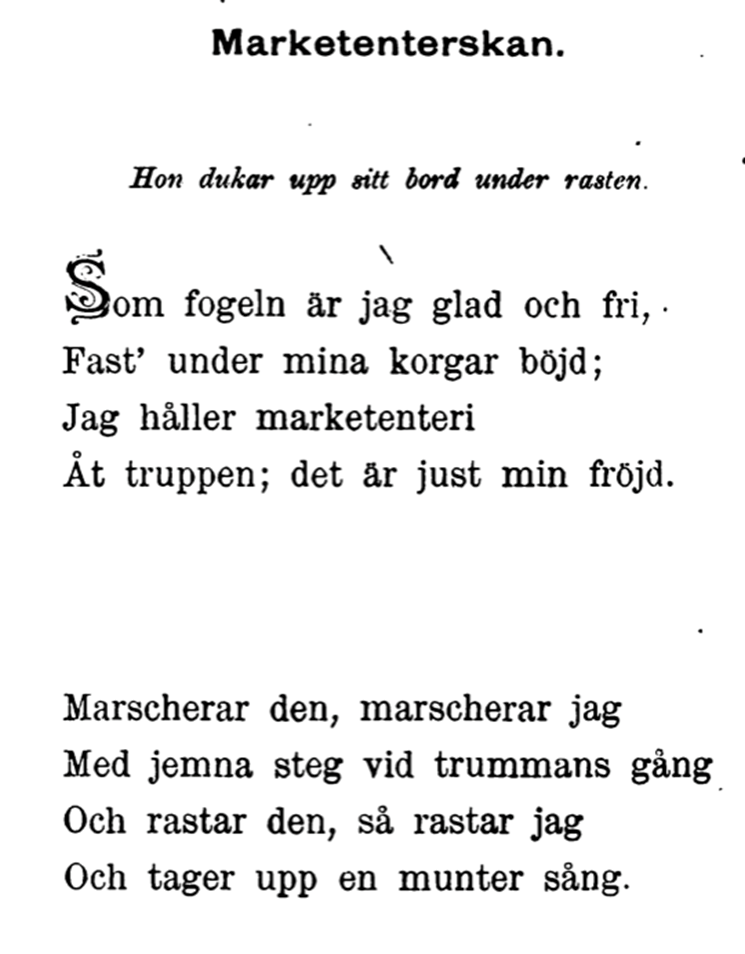
The camp follower.[i]

              She sets up her table during the break.

 Like the bird I am merry and free,

Though bent over my baskets which annoy;

Keep the canteen running properly

For the troupe; that is my only great joy.


If it marches, I shall be marching too,

With steady steps to the beat of the drum.

And when it does pause, I also rest, whew!

And take up a cheerful song, will I hum.


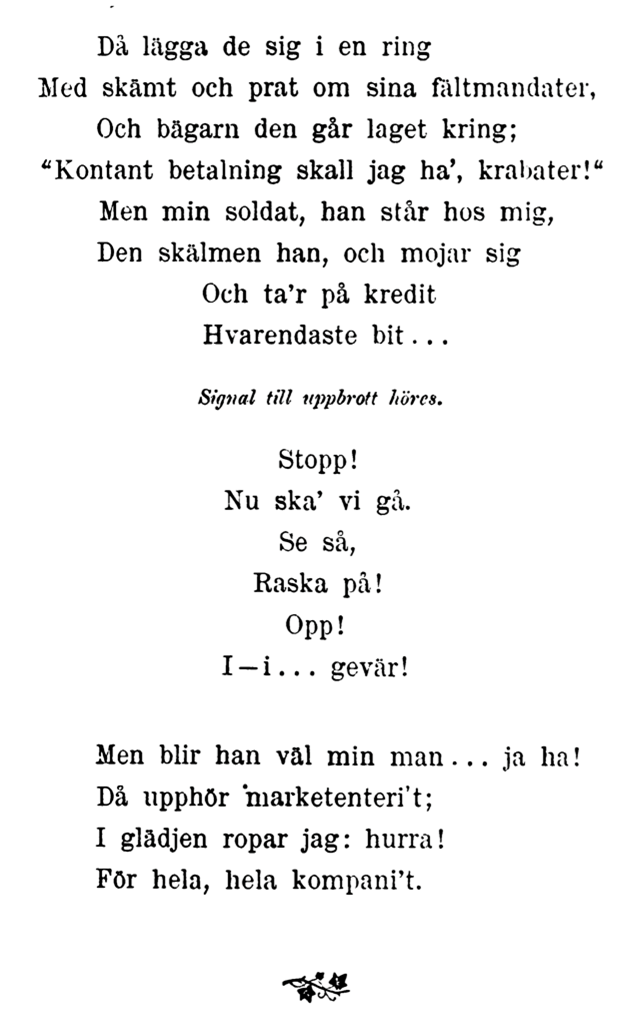
Then they will sit down in a circle with glee

Jokes and gab about their marching orders bellow,

The goblet is passed around the assembly;

“Cash reimbursement I shall have, my good fellows!”  

But my soldier, who stands by me grizzled,

Reprobate that he is, wets his whistle

And every bit

Takes on credit. . .

                         Signal to break camp is heard.

                                Wrap it up!

                                Now jump to it.

Hustle you gits,

Look alive private!

Hurry up!

Artillery. . . into formation, split!


But he’ll probably be my husband . . . ja ha!

Then the market center ceases to be;

With elation I then do shout: hoorah!

For the whole, the entire company.

***


Gondoliers.

On a palace[ii] balcony in Venice on the Grand Canal at twilight, Enrico and Anna are waiting for their gondola.


Enrico.


Behold, signora, look at the singular way

Past the skerries moon is upward running;

The wind is dormant, the waves silent on the bay . . .

Will the gondolier not be coming?


Anna.


The hour at which he was to be expected,

Has passed; however, we will still allow

Another, until tonight's fog is projected

Slowly lowers, around Brenta,[iii] its shroud.


              Enrico impatient.


Are there not crowded at docks round the moat

Surfeit of gondolas for your subpoena?

Why must you then wait for specific boat,

Manned by that oarsman who is from Fusina?[iv]


Anna.


Because I remember, in Santa Clara[v]

In our youthful days so carefree

How we would sing sacred songs by Caldara[vi] . . .

Therefore, his rowing pleases me.


Enrico.


Cara Anna,[vii] that average gondolier

Does ill deserve so excessive an appraising:

Is not, for coxswain who can merely steer

Through the lagoons, a fickle disposition king?


Anna.


But, Enrico, I must remind you as graceful

As can you yourself once said, agreeing:

“Few gondoliers today are near as faithful

As he, and are contented so being”.


Enrico.


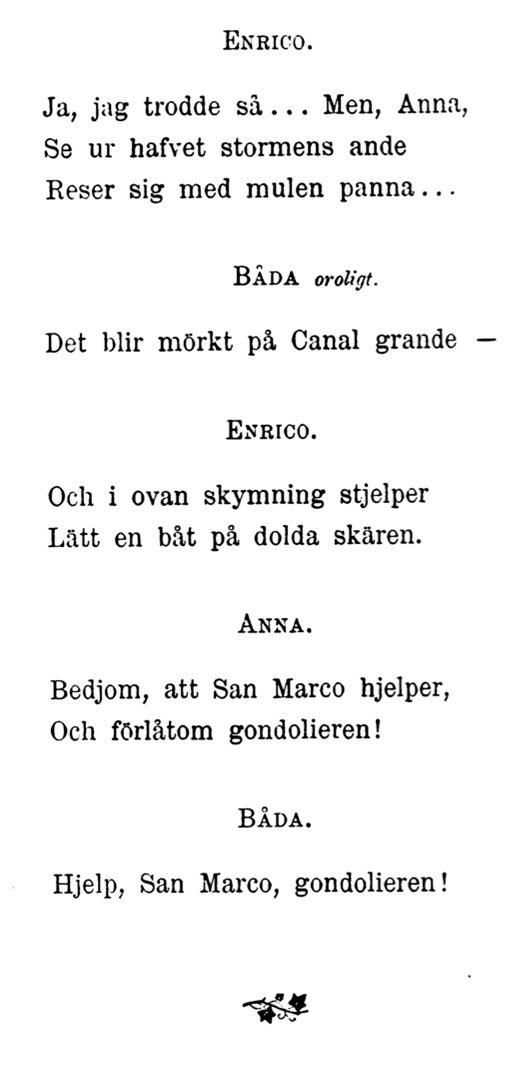
Yes, I thought so then . . . But, now Anna please,

Look out at the sea, a storm brews in this locale

Clouds move in from Fusina on a breeze . . .


            Both anxiously.


It is getting dark on Venice’s Grand Canal –


Enrico.


And a boat, as this murky dusk envelopes,

Easily capsizes on unseen rocks I fear.


Anna.


Say prayer with me then, that San Marco[viii] helps,

And can forgive trespasses of the gondolier![ix]


Both.


San Marco, please help the gondolier!

***


The shepherd girl.

                    On the road leading up to the woodland’s entrance.


These hardships cause me much distress![x]

These hardships!

Far away within the forest,

Everything is in bloom, verdant grass to you can be blessed.

Such hardships!


But a wolf thereabouts rests

So horrible, whose size does impress,

   “With teeth he gnaws best,”

 Mother does attest,

    “And stares at guests,” 

   Continues her address,

 “And has such long claws to invest.”

“So, so long!” mother expressed.


These hardships cause me much distress!

These hardships!

Far away within the forest

Likely lives one who, with longer claws, could us protect.

Such hardships!

***


***

[i] According to Av Christer Johansson, ‘markententerskor’ were women who ‘in various ways lived and worked close to the staff of the armed forces, both in peacetime and in wartime. This group of people consisted of the wives of officers and soldiers and their servants, who cobbled shoes, laundered clothing, and orchestrated the mess hall.’
 
[ii] One of the central landmarks in Northern Italy, built in the Gothic style, where Republic's highest authority the Doge once resided.
 
[iii] A river that runs to the Adriatic sea, immediately south of the lagoon in Venice, from Trentino. 
 
[iv] Neighborhood in the Veneto region.  The etymology of its name translates roughly to 'workshop of slipping', referencing its role as a liminal place of transition – where a machine allowed marine crafts to migrate between the Lagoon and the river Brenta, which the borough resides at the ancient mouth of.
 
[v] The Basilica di Santa Chiara is a church in the town of Assisi in central Italy, which contains the remains of Saint Clare, celebrated disciple of Saint Francis who founded the Order of Poor Ladies.
 
[vi] Antonio Caldara is a Venetian composer in the baroque style, who began as a chorister at St Mark's Basilica and rose to many illustrious positions.  He wrote many operas, including ‘Faithfulness in love conquers treachery’, whose aria 'Sebben, crudele' ('Although cruel') – in which a noble waxes poetically upon his wife's infidelity – remains popular and is still performed in concerts, and has been recorded by the likes of Baker, Gigli, and Bartoli.
 
[vii] Italian for:                        ‘Dear Anna.’
 
[viii] One of the six areas (subdivisions termed ‘sestieri’) the historic city of Venice is divided into.  This region is highly frequented by tourists due to its containing many famous landmarks, including Saint Mark's Basillica and Square, numerous important churches and Palazzos.  Contemporarily, it has figured as a colorful backdrop into numerous video games, such as the second Assassin's Creed and the classic arcade brawler Tekken.
 
Mark the evangelist and saint is the author to which the eponymous gospel is ascribed authorship traditionally.  Purportedly, he was the founder of the Alexandrian church in Egypt, a stronghold which proved of critical strategic import to the growth of Christianity at its advent.  A winged lion is used to represent him symbolically, and he has a feast day celebrated in late April.  It's worth noting another of the four evangelists, Luke, is shrewdly referenced in the first poem in this section.
 
[ix] Figuratively, the overdue boatmen they await is presumably Charon, who ferries newly arrived souls over the river Styx to Hades.
 
[x] ‘Kovalle mina kor!’ and ‘Kovall!’ are Finnish, and translate more simply to ‘Hard for me’ and ‘Hard!’ 

Gunnar Wennerberg: Translations (The fisherman on Kinnekulle, The statuary hawker, Swedish redemption)


The fisherman on Kinnekulle[i]


he sun shining clearly over tops of the hills 
Looks upon the valley, where mist settles closely; 
The weather shall be gorgeous today – if God wills! - 
Lukas[ii]  is blue and Leck├╢ Castle[iii]  seems ghostly. 
There within the Key, 
Which sparkles so green,
Reward awaits me,
If I cross the stream.[iv] 
Alas, care I to reach it, unable for long!
It’s a great distance there across the bay’s blue prong.

My mind raring with eagerness I set out from the shore, 
Vessel of woven reeds rocking gently in surf so harsh;
The fishermen shout when out a duck does proceed to soar,
Comes hissing like a feathered arrow from inside the marsh; 
But o’er waves’ springs
Through their flapping
The loons’ gray wings
Are foretelling 
Contents of sea’s depths, thus where my quarry dithers!
Therefore, my boat flies across crashing waves thither!

Aye, and so it goes on my clear lake’s breadth, 
With foam so high it splashes over the gunwale, 
The mists disperse… There I see K├еllands-├╢![v] 
Where truffles are hiding! . . . Bearing south, find a trail 
To a town where the sun down showers 
Upon the terraces and towers. 
That on many days at odd hours 
Join father Jan[vi], exert my powers, 
By selling both my pikes and perches in the square, 
So can buy wedding gown for my lass over there. 

Soon high tide for sailing will be over, and perceive
I’ll need be departing . . . no, I want to pause by her window,
Listening, to hear if she sleeps, and then – as I leave!  –
Steal a kiss to carry with me. Oh, dearest Anna, I owe
More affection
Than to anyone;     
Pledge in clouds we’ve done 
Each other’s hearts won; 
But if to sleep for a while longer must you decree, 
I’ll forever remain your most faithful devotee.


The statuary hawker.


He is standing on a street corner with his plaster bust of a head.

Out in the hustle and bustle of the world,
Far from Parma[vii]  which is my home 
Year after year 
Fleet as a deer 
With shabby icons do I roam. 

However, to heavens of Italy’s twirl 
I can transport from glacial maroon, 
Those who have a yearning strong 
To once again hear its songs  
And exult in their familiar tune. 
Turns to a passing gentleman.
Ah! 
Caro signore![viii]  
Buy un amore[ix]  . . . 
Buy Garibaldi . . . King Charles . . . Tegn├йr[x] . . .  
O un cavallo . . . 
Un papagallo[xi] . . .  
Ben, mille grazie![xii]  - Buy a little more here!


Swedish redemption

Freedom lives in the north,
   Free was Svithjod’s[xiii]  land,
Free, as long as saga remembers;
   And in the mountains
   Svea is still free,
Free, long as iron’s forged in embers.

Once from east[xiv]  trolls in dragonships[xv]  did roam
To bequeath our lives and lend us our home -
   “Manly courage to the last breath!
   Give us freedom or give us death!”
May our Swedish redemption be.


Svensk l├╢sen

Frihet bor i norden,
   Fritt var Svithjods land,
Fritt, s├е l├дnge saga minnes;
   Och p├е bergen sitter
   Svea fri ├дnnu,
Fri, s├е l├дnge j├дrn der finnes.

Komma en g├еng troll i drakskepp ├╢stanfr├еn
F├╢r att gifva oss v├еrt land och lif i l├еn —
   “Mannamod i n├╢d!
   Frihet eller d├╢d!“
Blifva skall v├еr svenska l├╢sen.


***

i. A flat-topped mountain, on lake V├дnern's eastern shore, in V├дsterg├╢tland county.

ii.  Greek for: ‘Light.’

iii.  A medieval castle in this vicinity, originally fortified and later ornately furnished and decorated with baroque frescos and paintings on the walls and ceilings; presently a national monument.  The location where Wennerberg would later perish at the age of eighty-four. 

iv.  The largest lake in Sweden and the EU; in all of Europe only two Russian lakes are bigger.

v.  An island in lake V├дnern.

vi.  Janus is the Roman deity who presides over time, transitions, gates, frames, beginnings as well as endings.  Attends conflicts' entrances and terminations.

vii.  A city in Northern Italy renowned for its art, architecture, music and cuisine.  

viii.  Italian for: ‘Dear sir!’ 

ix.  Italian for: ‘Someone you love.’

x.  Writer, teacher, and Greek language scholar, Esaias Tegn├йr was considered by many to be the father of contemporary Swedish poetry.  He penned the epic romance Frithjof's Saga, which is referenced in many of Wennerberg’s poems.  Charles Ludvig Eugen, Carl in Swedish, was King of Sweden and Norway.  Interestingly, in actuality he was the ninth king of Sweden; the popular accorded numeral is derived from the the nation's popular folklore.  Giuseppe Maria Garibaldi was a revolutionary Italian general who helped unify Italy and contributed significantly to the kingdom's formation.  He is considered among the most prominent 'fathers of the fatherland', and is furthermore termed the 'hero of two worlds' for meritorious martial accomplishments in both Europe and South America.  He was admired by Lincoln, Hugo, Dumas, Dickens, Engels and Guevara, among others.
 
xi.  Italian for: ‘Or a horse . . . A parrot . . .’

While small plaster statues of horses and parrots both existed, it is possible these lines describe busts of men with parrots on their shoulders, or the famous equestrian depictions of the king which were popular during this time, a predilection which extended into all mediums of portraiture - it's conceivable this may specifically reference a miniature of the well-known statue in Stockholm of Charles XV on horseback, in the manner Americans purchase scaled down statues of liberty as keepsakes.
  
xii.  Italian for: ‘Okay, thank you so much!’

xiii.  An obsolete name for Sweden, or more specifically the old territory which today is named Svealand. It meant literally “the Swedish people”.

xiv.  Between 793 and 1066 AD (the “Viking Age”) throughout the middle ages Vikings expanded their empire and settlements migrating westward across Europe, ultimately venturing as far as North America.

xv.  Viking vessels.  According to avaldsnes.info: “Dragonships were large longships that had carved heads of dragons and other magical beings mounted on their stem. They were ships for chieftains and kings. The ship’s dragonhead was a visual message about the owner’s status.”  

202209E,English, Poetry, Fiction, Article, Book, Review, Essay, Research Paper,