Showing posts with label 202209E. Show all posts
Showing posts with label 202209E. Show all posts


Translating realities into words and visuals
 |
| Sunil Sharma |
Welcome back!
Texts.
Translations.
Audio-visual.
Visuals.
Imagery.
This package contains these defining elements in a single canvas.
This month’s special edition is on the broad theme of freedom and explores the power of the visual medium in its full spectrum and entirety.
Ably supported by high-profile visual artists, guest-edited by the eminent artist-poet Jerome Berglund, the gallery of the works of the featured 10 creatives is sheer delight for the eyes and mind of the viewer.
We are thankful to them and the guest-editor for such an imaginative presentation and an exposition of each work and its author that almost borders on the lyrical and picturesque that only Jerome with a photographic gaze and memory could do.
It adds to the value of the monthly journal in terms of artistry and its sensuous appeal.
Visual arts get their due exposure on this global platform.
Another highlight: It is translation heavy.
Representing languages and cultural experiences made familiar through the art of translation, a tough discipline, demanding but satisfying pursuit.
A great service in creating conversations across multiple cultures.
Texts in Swedish, Hindi and Albanian rendered in fluent English by the experts, poets by heart that reveal realms glimpsed by their creators in prose and poetry forms.
Translation has, of late, emerged as a major area of literary studies and academic discourse.
And deserves respect and attention as a separate field.
And a vital link between languages and literary writings rooted in different geographies and landscapes for consumers looking for new experiences.
Setu’s focus is to act as a bridge and translation helps erect such bridges of understanding between nations and peoples through arts.
We will be investing in this area in coming months as well.
Senior editor Rob Maddox-Harle recently published his much-anticipated collection of experimental poetry with images, called: The Blazing Furnace. Congratulations to Rob for this spectacular milestone. Over a decade, he has built a dedicated fan following and a loyal base in India and Australia for his unifying people’s projects and allied collaborations.
Setu is proud to carry some interesting poems selected by the reputed poet himself for our readers.
Cool stuff there!
J.D.Nelson, another important name, sends us his famous haikus and Paul Brookes, a poet-editor-blogger of repute, writes poems in three different poetic traditions: an Acrostic, a villanelle, and a Sestina. In an accompanying video, Paul recites these for the Setu audiences.
Kushal Poddar is Author of the Month, a well-earned spot for the poet and journalist liked for his distinct voice.
Young and established poets, authors and critics bring in their distinct flavours, along with reviews of books making waves.
And much more.
Please enjoy the selection of the best.
Thanks all.
Keep reading!


Touch as Metaphor: Reading “Ahalya’s Waiting” by Nandini Sahu
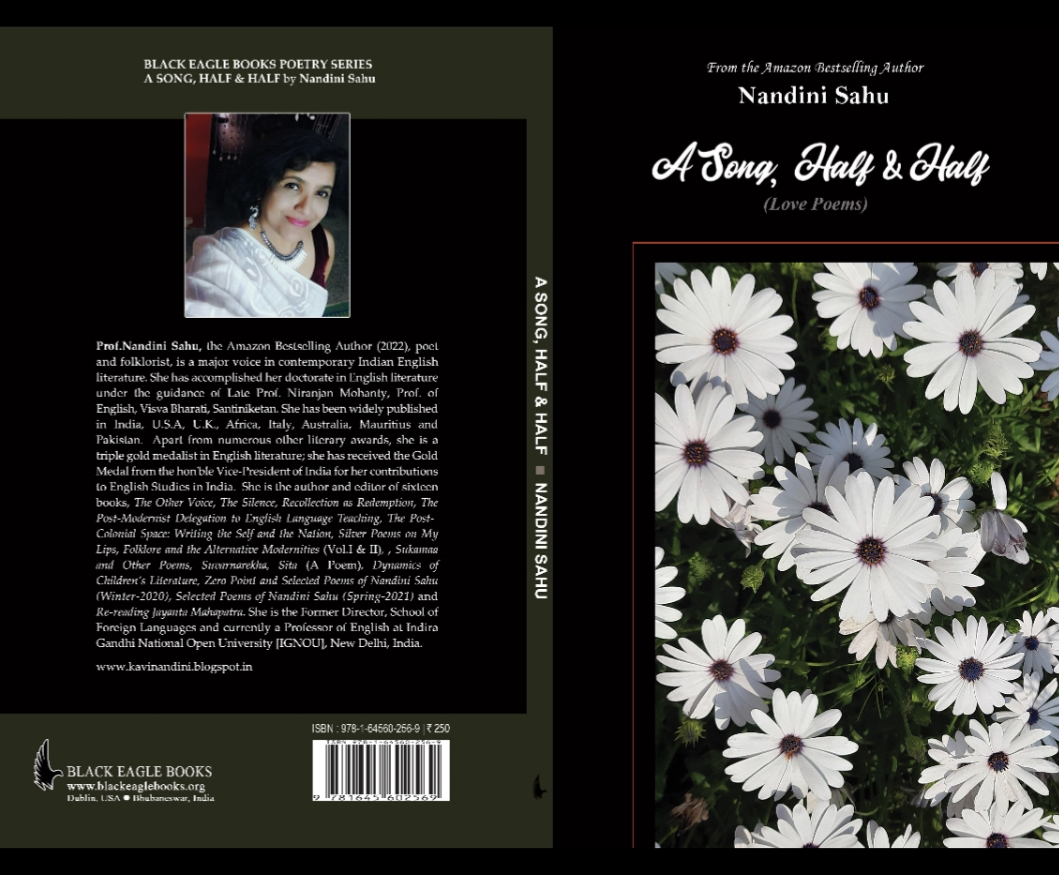
To me, Nandini Sahu’s pivotal poem, “Ahalya’s Waiting” is the supreme example of protest literature. The Ramayana has been written by men from men’s perspective since time immemorial. Here Nandini takes up the responsibility of protesting against patriarchy in one of the world’s most powerful myths through her poem, “Ahalya’s Waiting” from her Amazon’s Bestselling poetry collection(2022), A Song, Half & Half. A first reading of the poem would apprise one with the question, ‘Was Ahalya actually waiting for a touch, in the first place?’. Because, the fundamental question of the poem is, ‘Was Ahalya waiting for the benevolent God to come someday, touch her, and redeem her of a sin that she actually never committed?’
With these tensions in my mind as a content reader of Nandini’s poetry, in this research, it would be pertinent for me narrowly to deal with:
ü The
anomalies of defining realism, modernism and postmodernism in the poem
“Ahalya’s Waiting” by Nandini Sahu
ü Realism
as content or realism as an effect on the reader vis-à-vis “Ahalya’s Waiting”
ü Modernism
and postmodernism as a continuum and as typical classifiers vis-à-vis “Ahalya’s
Waiting”
ü Post-Modernism
and the inner self of Nandini as a creative writer
ü Division
of ‘realities’ in modernism and postmodernism, vis-à-vis “Ahalya’s Waiting”
ü The use
of creative writing to explore extreme experiences in myth
ü A
comparative analysis of Nandini’s Ahalya with that of the character from Ramacharita Manas
ü The apt
use of the metaphor ‘touch’ in “Ahalya’s Waiting”
Nandini
Continues to write social mobility literature here in her recent poetry
collection, A Song, Half & Half, as elsewhere, through a poem like
“Ahalya’s Waiting” where the personae Ahalya waits for a benevolent touch from
her lord/lover, but not to redeem her of any sin that she never committed! This
is the basic argument of the poem, while the persona is open for ‘touch’, both
physical and metaphorical, by her archetypal Lord/lover to come and touch her
as an elemental man would touch an elemental woman and both would complete each
other in the process.
Nandini Sahu is a progressive poetess. Her Ahalya is entirely
different from Tulsidas's Ahalya. Because in this context , I can safely
say that Tulsi Das advocated patriarchy.
Tulsidas says in The Balkand (210/11, 12) of Ramacharita Manas:
आश्रम एक दीख मग माहीं,खग मृग जीव जन्तु तंह नहीं।
पूछा पुनिही सिला प्रभु देखि,सकल कथा मुनि काही विसेषी॥ (मानस,बाल210/11-12)
(On the way, Ram saw an Ashram in which there were no birds and
animals. Seeing a rock there, Shri
Ramchandra asked Muni and he told the whole story in detail.) The essence of the story is,
गौतम नारी श्राप बस उपल देह धरि धीर
चरण कमल रज चाहति कृपा करहु रघुबीर। (मानस,बालकांड-210)
(O Raghuveer! Gautama's woman has patiently turned into a
stone due to the curse, she wants the dust of your lotus feet, please be kind
to her.)
The detailed story is that Indra and Moon together duped
both Gautam Rishi and his wife. She had cohabited with Indra only after
thinking him to be Gautam Rishi. Later, on the arrival of Gautam Rishi, when
Indra was asked, she came to know that she had been cheated. When Ahalya told
lie in such dire situation, the sage cursed her that she would become a stone
immediately.
According to the Ramacharita Manas, Ahalya was
guilty of two crimes, the first, sex with another man and the second, of lying.
She had done the sexual crime as she
was deprived and the crime of lying was
done due to fear. These both crimes made her to remain stone for ages. Is there
a single instance or example in all Indian mythological literature, where any Rishi
had turned into stone because of someone's curse for such a crime? After being a stone for ages, when Ahalya became
alive by the touch of Ramchandra's feet, she prays,
“मैं नारि अपावन प्रभु जगपावन रावनरिपु जन सुखदाई” -मानस,बाल 211/छंद2
(I am an impure woman and you are Ravanaripu who
purifies the world and gives happiness to the devotees)
Now it is a matter of discussion that due to this crime,
the moon did not become impure, he remained the Lunar God. Indra did not become
impure, Indra remained a deity as yet, Gautama did not become impure, he
remained Gautam Rishi forever. Then how did only Ahalya become impure? Apart
from this, what other reason can be given that she was a polluted woman?
Ram Laxman's visit to Janakpuri, breaking the bow, Parshuram dialogue
etc. are the most focused events of 'Ramcharit Manas'. When Shri
Ramchandra went Janakpuri, one of Sita's friend expressed her confidence about
Ramchandra’s virility and said,
परसि जासु पदपंकज धूरि,तरी अहिल्या कृत अधभूरी।
सो कि रहिहि बिनु सिव धनु चरें,यह प्रतित परिहरिअ न भोरें। -मानस,बाल 223/5-6
(The Ahalya,the
sinner, got salvation by touching the dust of lotus feet of Ramchandra, then How will he
remain without breaking Shiva's bow! )
After Sita Swayamvar was over, the king and queen were hypnotically washing the holy feet of
Ramchandra. How those feet are
जेपरसि मुनिबनिता लही गति रही जो पातकमई (-मानस,बाल324/छंद2)
(By touching the Muni wife Ahalya, who was a great
sinner, also got salvation, whether she was saved or not, it can also be the curiosity of
a skeptical atheist.) But that is not the question here. The question is, why
has the poor Ahalya been remembered here as Pataki so quickly? Are both Chandra and Indra, who deceived her,
being worshiped as Gods? The Muni who was duped by these two Gods also did not
become the object of negation. Then why was Vanchita Abla forced to
become the only stone?
To me, there is only one answer--she was the woman of
Tulsi Das's imagination, not the radical ecofeminist Nandini’s.
Different texts have various stories about Ahalya’s salvation,
I would like to draw a parallel of this poem with multiple mythical and
literary texts. Commentators of Vedic literature have considered it a metaphor.
'Ahalya Bhoomi' means that the land in which the plough has not been carried
out, it seems natural as the land is related to Indra, the deity of rain. In
later literature, Ahalya’s story developed substantially and the relationship
of her salvation was linked to Rama. In the Mahabharata, Gautama is
considered to be Ahalya’s husband. In fact, it is written in Vedic literature
that Indra used to call himself as Gautama.
There is a story in the book, Shadbish Brahmin ,in
which both the Gods and the Asuras were fighting, Gautama was doing penance
between the two armies. Indra requested him to become his detective, but
Gautama rejected him. Then Indra took the form of Gautama and proposed to
become a detective, which he accepted. Perhaps on the basis of this story, it
was believed that Ahalya’s husband's name was Gautama and Indra was called Ahalya-Jar.
Valmiki Uttarakanda has presented another aspect in this context. According to it, Brahma took
the best parts of other beings and created a woman who completely lacked 'hala'
(ugliness). It is equally highlighted by the poetess Nandini in her poem in
following lines,
‘Ahalya’
connotes the ‘one with no ugliness’.
The
woman beautiful turned into a stone there and then.
Reek
of patriarchy with
the
social game of victim-blaming began.
(Sahu, 28)
Sans all ugliness, she was named as Ahalya. Indra used to
desire Ahalya, but Brahma kept her in custody of Gautam Rishi. After many
years, Gautama returned her to Brahma and Brahma, seeing the accomplishment of
the ascetic Gautam Rishi, presented her as his wife.
According to Harivansh Purana, Vaghyasva and
Menaka had two children, Dividas and Ahalya. Ahalya became Gautam's wife and
gave birth to Shatanand. The Brahma Purana says something else in this context.
According to it, to get Ahalya as wife, there was a condition that the God who
came to Brahma first after circumambulating the earth, would be given Ahalya.
All the Gods went out to circumambulate the earth, but Gautama circumambulated
the arddha-prasuta cow Surabhi and Shiva-Linga and got Ahalya as the
reward.
In the post-modernist context, Nandini problematizes this
‘trophy-wife’ concept—of awarding/rewarding a woman of flesh-and-blood to
someone without taking her will into consideration, and then redeeming her even
without her appeal. To quote the poetess,
Father presented me, the puppet, to husband on
his free will.
Husband couldn’t fulfil me as a woman.
Indra tricked me to satiate his desire, not
mine.
Inept, impotent husband cursed me
with what right, oh, with what right,
to become a stone exactly at a moment
when I was satiated as a woman!
And now why do I need yet another man, you, oh
Ram,
to touch me and cleanse me of my uncommitted
sin?
(Sahu, 29)
According to the Paumchariyam, Ahalya is the
daughter of Jawalan Singh and Vedvati, who rejected King Indra on the occasion
of her swayamvar and chose King Nandimali (or Anandmalakar). Later,
Nandimali became disinterested in worldly pleasures and took initiation.
Someday Indra had tied that meditating Nandimali, which resulted Indra to
defeat by Ravana. In the Western
account, Ahalya is mistakenly considered as
Vishwamitra's wife. In the Skanda Purana and Mahabharata, the example of
Gautama's son is Chirkari, who rejects his father Gautama's order to kill Ahalya
for being an adulterer. In Chirkari's eyes, his mother was innocent, because
Indra changed his form before Ahalya in Gautama's absence. According to the
Assamese Balkand, Ranganatha Ramayana, this act was carried out with the
aim of obstructing Gautama's penance. Brahmavaibrata Purana considers
Indra a misdemeanor and Ahalya as innocent. According to Kirtivas Ramayana,
Indra was the beloved disciple of Gautama. Similarly, there are many forms of
Gautama's curse.
According to Mahabharata, Indra's beard was yellow,
according to Valmiki Uttarkand, Meghnad defeated Indra and he got half the
fault of human sins, Indra being a snake etc. as per Valmiki’s Balkand, Balram Das, Kamban
Ramayana, Indra became Sahasranayan, According to Padam Purana, Ahalya got no
curse in the myth.
Pashanbhuta Ahalya is mentioned for the first time in Raghuvansh
and later in Narasimha Purana, Skandha Purana, Mahanatak, Sarla Daskrit
Mahabharata, Ganesh Purana. In Valmiki's Balkand, Gautama said that
after welcoming Rama, Ahalya would come to him in her human body as before,
that is, Vapurdhariyishasi. Perhaps this is story, from where the notion
of Ahalya becoming a rock arises. According to Ramkien, Gautama cursed her so
that at the time of Ramavatar, she would be used to build the bridge and should
be buried in the ocean forever. A curse of Gautama according to which Ahalya became
a dry river, is less prevalent. According to a legend, Ahalya’s daughter Anjana
is mentioned here and there. When Gautama learned about Ahalya’s adultery from
his divine vision, he asked Ahalya about the reality of the daughter. Ahalya replied
that the man was Marjar, which had two meanings--Indra taking two forms or her
adultery. On this, he cursed Ahalya to become the rock and Indra to become
Sahasrayoni. Anyway, according to legend, Ahalya and Gautama had two sons Bali
and Sugriva.
In the story of Pashanbhuta Ahalya, the author of Adhyatma
Ramayana connected Ahalya with
standing on the rock and doing penance. In this way, a famous mythological
story of Ahalya from Brahmin texts and merged
into the devotion of Ahalya to Ram, taking many forms. The playwrights
have had no hesitation in changing the narrative of Rama. In Janaki Parinay,
the story of Ahalya salvation comes in such a way that when Rama wants to
kill himself by jumping off the rock after seeing the life of the elusive Sita
in danger, Ahalya appears from the rock with the touch of lotus feet of Rama
and told him the secret of demonic Maya.
European scholars compare Indra to the Greek myth Zeus.
Both are Gods of the sky and are famous for their love affairs with women. Zeus
mongoose, impersonating the sun's rays or their husbands, rapes many princesses
and nymphs, and gives birth to great heroes such as Porseus and Hercules. Some
critics conclude men with the sky
culture and women with earth culture, while some see this story as a
symbol of the relationship between Dev culture and Aryan culture. Narendra Kohli, in
his novel 'Ramkatha', attempted to keep the narrative of Ahalya and Gautam in
modern perspective.
Hindi poet
Udbhrant speaks about Ahalya in his poetry collection ‘Treta’ that there was a great bonding of love between Gautama and Ahalya.
But once he set fire to his family life by inviting neighbor King Indra to stay
at his place. Indra was the king of the nearby Surpur kingdom. He was
fascinated to see Ahalya. In the absence of Gautam Rishi, to fulfill the evil
wish of his mind, he tried to go to Ahalya in the guise of Gautam on the night
of Amavasya. But Ahalya’s sixth sense caught Indra's intentions and signaled him to get
out, but then the entry of Gautam Rishi made her a victim of wrath. Gautam
Rishi became suspicious of his wife and left her alone to live life in a
solitude like a rock. The condition of innocent women in the then conservative
society was not good. They were expelled from society. When Ram came in contact
with Ahilya, who did not go outside from her place, Ahalya again got social
acceptance.
Narendra Kohli took this fact of Udbhrant with a
different angle. At that time, the Ashrams were equivalent to modern schools or
universities, and the sages were the heads of departments of those institutions
like vice-chancellors. As per the contents of Narendra kohli's novel, Gautama
gave shelter to Indra as he was the king
of the neighboring country. Ahalya was sleeping with her fever-stricken son
Shat, but Indra, seeing the very beautiful woman, considered her futile to
suffer association with a poor sage. Indra accepted hospitality at Gautam's
place and while drinking alcohol, Gautam wanted to see Ahalya alone in the
absence of Rishi. Ahalya was asleep, but could experience that unknown touch
well. When Ahalya’s mouth sneezed and her son started crying loudly. The people
of the neighborhood gathered, at that time Gautam Rishi returned to his hut,
Indra threw a sentence towards the crowd with shameless wickedness, "First
she called me and now she is pretending" --claiming this, he sat in his
plane and went to his country. The reason behind Vishwamitra telling this story
to Ram-Laxman was to present the background of revolution, not only the role of
struggle in life. but also to provoke anger against injustice in the public
mind. If a woman calls a man and the man accepts it and comes to
her, then the society will blame the woman only, Indra has done such a trick.
By stigmatizing Ahalya, he wants to hide
serious crimes and sins of raping a Rishi's wife. Gautam Rishi put the matter
of insulting Ahalya in front of the society and called upon them to remove Indra,
the devotee of Dev culture and the guardian of the sages, but even though a
section considered Ahalya innocent, but her chastity had been tarnished. Ahalya
could not be saved by punishing Indra or not. Due to the devaluation of social status,
various questions were raised about Gautam Rishi, being the Head of the Ashram.
The question arises that if a sinful man tortures a weak woman, will his Ashram
also be considered as corrupt? Not only this, wherever Gautama will go, every
person raise a finger towards him as he
is husband of Indra's Bhogya Ahalya and even when his son will grow up, the
society will not refrain from sledging him. Such accidents do not unite the
people to stand against the ruling class in the general, holding the power of
office, the power of money, the power of paramount. The pioneer in the field of
knowledge, fame and honor endangered the existence of citizens like Gautam
Rishi, who not only fed on their development, but also for future generation.
These ideas made Ahalya to go underground for living a lonely life and forced
Gautam Rishi to go another place for his future. When a great man like Rama
saved Ahalya by finding that abandoned Ashram at the behest of Vishwamitra, she
regained social dignity and was freed from living an unaimable, lonely life. On
getting the protection of Ram, thinkers, sages, priests, Brahmins stopped
considering Ahalya as criminal at the social and moral level. Nandini
problematizes this ‘victim-blaming’ syndrome of our society and exposes its
hypocrisy:
Touch
sensitive, touch deprived,
touch-craving,
I would rather wait till eternity.
I
prefer to reject your offer of touching me
on
the condition of taking me
into
the snares of purity-pollution.
I
am my own possessor, proprietor, I am my woman.
Let
me remain ethically upright on my own terms—
this
is my ultimate liberation.
(Sahu, 29)
Here I am reminded about Hindi Dalit Critic Kanwal Bharti. He considers this story as a relationship between Aryan and Dev culture. Ahalya of Ramayana was not innocent. According to the Ramayana, when Maharishi Gautam was not at the Ashram, Shachipati Indra went there in disguise of Gautam Muni and said to Ahalya, "Always be careful, Sundari! The lover do not wait for time. I want to have sex with you. ” Ahalya also recognized Indra in the guise of Muni. 'Hey! Devraj Indra wants me' – Out of curiosity, she accepted the offer to have sex with him. After sex, Ahalya said- "I am grateful to have sex with you, now you leave soon before Gautama comes and protect me."
Then Indra also said to Ahilya, "Sundari! I was
satisfied too. As I came, I'll go the same way immediately. At that time, Gautam came and saw both of
them. Immediately cursed Indra that his testicles should fall and he became
testicleless. He then cursed Ahilya, “You will lie here for many thousands of
years only by inhaling air or fasting and will live in the ashes of this Ashram by remaining invisible from all beings.” The
poem of Nandini’s Sahu started with
these lines quoted from Splitting the Difference: Gender and Myth in Ancient
Greece and India (Wendy Doniger, Mircea Eliade)
(Sahu, 28)
Later, on Indra's request, the seniors Gods saved Indra
by putting sheep testicles, but Ahalya was saved by Ram by touching his
feet. The following questions emerge
from this narration:
1) Why did Indra say that men who want sex do not wait
for an appropriate time ?
2) Did Ahalya recognize Indra even in Munivesh?
3) After recognizing Indra, did Ahalya say that Aho,
Devraj wants me?
4) Did Ahalya accept Indra's proposal?
5) Did Ahalya say after sexual intercourse that I was
grateful for your intercourse?
6) Did Ahalya ask Indra to run away immediately after
sexual intercourse ?
7) Bhadet Anand Kausalyan thinks differently, If the touch
had to be done, what could not be done by hand ? why by legs ?
“मुनि तिय तरी लगत पग धुरी, किरति रही भुवन भरी पूरी”
The only answer to these questions is that Ahalya and
Devraj Indra had a physical relationship with mutual consent. Indra was recognized
by Ahalya because she was already aware of his coming in Munivesh. Ahalya herself was willing
to have sexual intercourse with Indra. So she accepted Indra's proposal and
both of them got complete satisfaction after intercourse.
All the above questions of critic Kanwal Bharati are, in
a way,replied in this poem by Nandini, using ‘touch’ as a powerful metaphor. As
per her, Ahalya did not want touch by hand or legs, but by sentiments,language
and reverential behaviors, which can be seen in the following lines of poem,
Your touch should be your creative language,
your behaviour, your basic attitude.
With my touch, stars ought to dance across your skin.
Your touch must take away my fears of
all Goutamas and Indras.
Love, soothe my anxiety and
fill my senses with your compassion.
Touch my cognizance and you can redeem the stone.
Make me your Muse.
You know, touch is where miracles arise
And exchange of the light and dark begin.
The curse of Rishi Goutama may be immobilized
with your touch, with this assertion.
(Sahu, 28)
All the Indian litterateurs, whether Hindi poet Udbhrant was writing his poem on Ahalya
in his collection 'Treta', whether novelist Narendra Kohli was writing 'Ramkatha', no matter how much mythological
literature, all men were supremacists and believed in man’s dominance in
society. No writer has shown the courage to read Ahalya’s inner voice. It is
not only right for the writer to raise questions of any character, but also to
find the psychological reasons behind it. Nandini has dared to discover these
reasons in her poem in these lines:-
Father
presented me, the puppet, to husband on his free will.
Husband
couldn’t fulfil me as a woman.
Indra
tricked me to satiate his desire, not mine.
Inept,
impotent husband cursed me
with
what right, oh, with what right,
to
become a stone exactly at a moment
when
I was satiated as a woman!
And
now why do I need yet another man, you,oh Ram,
to
touch me and cleanse me of my uncommitted sin?
(Sahu, 29)
Nandini
problematizes the situation when woman has been considered as an attractive figurine
and nothing more than that. In moments of rest, she is the beloved, otherwise
she is an the object. The deep abyss of inequality between the male and female
has been questioned by the poetess. Our country is debauched even today,
despite we talk so much about sexual parity,
but our ideas about marriage and sex are
hypocritical. It is true that throughout the globe, only men have framed
protocols about the ideals of chastity, purity, specifically about women. Regretfully
these ideals are limited to woman’s body. Before marriage, It is prohibited.
Later on, touch is permissible only by husband. Once she is married, then no
person other than her husband should not come into picture in any condition. By
religion, by formula, by social organization and finally by body systems, it is
engrossed in our mind that marriage is only solution to transform the girl into
a pure woman. Unless the girl is sanctified by marriage, she has to spend her
life in infinite loneliness—or become a stone!
For thousands of years in Indian history or mythological works, poets
have created strange inequalities between man and woman, while the poetess
Nandini’s “Ahalya’s Waiting” gives the message about fundamental right of
womanhood. Nandini's 'Ahalya' is a symbol of the woman who understands her body
and mind, who respects herself, with conviction. According to her, unless the lost souls
of women do not awaken in our country,
no matter how hard you try, human civilization cannot be revived. She writes,
My
redemption lies not just in your touch
but
in zero tolerance of
any
marginalization.
I
need a rejoinder from the society
and
from you, oh the most knowledgeable one,
for
my quintuple patriarchal relegation.
(Sahu, 29)
I
read “Ahalya’s Waiting” as an epic poem;
a heroic character like Ahalya creates this estimation. Ahalya is a
woman of strange distinctions, she disrupts our very sense of equilibrium and commands
respect. She is the victim as well as the eradicator. She is virtuous, yet she
has a much-questioned moral and social status. She is dutiful, and yet she commands
dignity in her own terms. She is sovereign, yet she is the slave, the puppet in
the hands of time. The metaphor ‘touch’ defines both the physical and the
metaphysical woman, Ahalya, in the powerful poem “Ahalya’s Waiting” by Nandini.
Such poems are the need of the hour where a woman looks in the eye of
patriarchy, speaks clearly and openly about her body and her sovereignty, the
multi-layered dignity thereof.
Works Cited:
Sahu,
Nandini. A Song, Half & Half, Black Eagle Publications, Dublin, USA,
2022.
https://udbhranttreta.blogspot.com/2017/07/blog-post_45.html
https://www.ramcharit.in/ram-charit-manas.in
………………………………………………………………………………………..
https://udbhranttreta.blogspot.com/2017/07/blog-post_45.html
https://www.ramcharit.in/ram-charit-manas.in
………………………………………………………………………………………..
About the Researcher:
Dinesh Kumar Mali is a researcher, writer and translator of repute. He has translated more than 25 seminal books which are published worldwide. He has academically contributed to the MA in Folklore and Culture Studies programme of IGNOU, New Delhi, India.
Review: RE-READING JAYANTA MAHAPATRA THROUGH NANDINI SAHU'S LENS

Jayanta Mahapatra
(1928- ) is the first Indian English poet to have won the Sahitya Akademi Award
in 1971. He considered as one of the founding fathers of Indian English poetry
alongside Nissim Ezekiel and A.K Ramanujan. A prolific writer, he has published
more than ten collections of poetry and a few prose pieces and continues to
write till date. Also a bilingual poet, he has written several poems in his
mother tongue Odia. His poetry offers a wide canvass of themes ranging from his
familial relationships to the depravity of the society to representations of
cultural landscapes of Odisha. Some of his notable works are A Rain of Rites
(1976), Relationship (1980), Bare Face (2000), and Hesitant
Light (2016).
Prof. Nandini Sahu, Amazon’s best-selling author
2022, Professor of English and Former Director, School of Foreign Languages,
IGNOU, New Delhi, India, is an established Indian English poet, creative writer
and folklorist. She is the author/editor of seventeen books. She is the
recipient of the Literary Award/Gold Medal from the Hon’ble Vice President of
India for her contribution to English Studies. Her areas of research interest
cover New Literatures, Critical Theory, Folklore and Culture Studies,
Children’s Literature and American Literature.
Through this book aptly titled: Re-Reading
Jayanta Mahapatra (Selected Poems), Sahu has shed new light on Mahapatra’s
poetic oeuvre. The critical introduction covers the
poet's entire career, starting with his early poems to his most recent
publications. Several scholars like John Oliver Perry, M.K Naik,
Bruce King, and Madhusudan Prasad have critically looked at Mahapatra vis-à-vis
post-colonialism, modernism and symbolism. However, Sahu’s re-reading of the
poet in question is unique because of the way she has successfully connected
the poet’s personal life with his poetry. By doing so, she is encouraging the
readers to read the poet in conjunction with his life. Her psychoanalytical
approach sheds light on aspects of Mahapatra’s poetry which were hitherto
invisible to his readers. Referring to his autobiography, Sahu has interwoven
the details of his personal life with their varied representations in his
poetry. This is a novel way of reinterpreting some of his poems. For instance,
Sahu points out that Mahapatra had a loving relationship with his father which
is reflected in the poetry collection Whiteness of Bone (1979) where he
talks about his dying father or remembers the daily rituals his father used to practice
when he was home.
Mahapatra’s
complex relationship with his past is said to have affected him in ways that he
himself did not fathom. She says, "His mind lurks in the past in quest of
something that he himself is not aware of" (p. 16). Sahu has tried to
unveil the complex relationship that the poet shares with his past by probing
deep into his psyche. Looking into his past is like re-reading his poems in a
different context. She focuses her attention on the recollective mode of
Jayanta Mahapatra. In a poem titled “Grandfather”, the poet remembers reading
the old, yellow stained diary of his grandfather. According to Sahu, “Mahapatra holds his grandfather accountable for the pessimism
in the family because of his absence…the reawakening of the memories of his
grandfather through the yellow diary becomes both a mien of joy and
sorrow…(p.20)”. By citing several examples from
Mahapatra’s works, Sahu highlights his past relationships starting with his
grandfather, then moving to his father and mother.
The poet is seen negotiating, not
only with people, but also with some of the past spaces he has occupied. Sahu
observes and tries to decipher the ways in which remnants of his childhood home
along with the people who used to reside in it continue to perturb him. Quoting these lines from Mahapatra’s poem “The
Dispossessed”:
There is a photograph still
hanging
on the wall in my father’s house.
It is quite old,
and against an elaborate
backdrop the photographer used
are my parents, my younger brother
and I.
I want to shut it from my mind
because
it reminds one of a useless monument.
Sahu
portrays the gripping effect that the space still has on the poet. He seems to
seek solace in his past. The poet is seen
continually negotiating with the notion of home, what it means to him after so
many years, and why he feels lost. Continuously probing into his actions, his
failures, Sahu has enriched our critical understanding of the psychological
underpinning of the poet’s poems by searching for connection between his home
and family members who are now deceased.
The transformation of the poet in terms of his
transition from writing love poems to writing poems on larger issues of life is
also traced in the critical introduction by Sahu. In the early part of his
career, Mahapatra used to write extensively on the themes of love. According to
Sahu, Mahapatra views love as the “seminal needs of the mortals” (p. 18). His
maturity as a poet reflects in his poetry subsequently when he started writing
about the history of India and his locale. The preoccupation with the past
stays the same. Only now, he is reflecting on the past by focusing on
historical incidents. According to Sahu, "The
present which seldom comforts him, seems to be a sheer support system to reach
back to the past"(p. 32). This past that Sahu is referring to is his
cultural past. In doing so, she is able to clearly show us the progression that
Mahapatra has undergone from being a personal poet to being a poet writing
about the collective history of a shared tradition.
Sahu shows the
readers how acutely aware Mahapatra is of the traditional Odia customs and the
binding power of Lord Jagannath. His familiarity with the rich cultural past of
Odisha stems from the strained relationship he shares with his Christian
identity in a land dominated by the Hindu tradition. The whirlwind of emotions
that the poet experiences in connection with his position in the Odia society
is linked to his fractured religious identity by Sahu. His grandfather had
forcibly converted to Christianity during the devastating famine of 1866. Sahu
says, "The one aspect of the cultural heritageof his native land is that
he is never tired of portraying the religious rituals and worship in these
temples" (p. 38). Mahapatra also feels burdened and is affected by the
legend of King Ashoka and the Kalinga war that killed thousands. She cites
poems like “Dawn at Puri” and “Relationship” to depict the multifaceted
representations of his traditional past.
Moving from the past to the contemporary society occupied by the poet, Sahu has also depicted the effects the “contemporary Indian degenerative situation” (p. 51) has on Mahapatra. Quoting his lines from poems like Japan II, Sometimes, “The Lost Children of America", “The twenty-fifth Anniversary of a Republic", she comments on his highly sensitive treatment of these issues. They are naked truths of life that disturb him. Sahu also makes interesting observation on the nature of time in Mahapatra’s poetry. She remarks, “Even if the poet has a sense of belongingness to the present, he is agonized because of the fleeting nature of time..” (p 77). Mahapatra is seen to be taking huge leaps across centuries, perhaps in search of steady ground, feeling “remote” in the present, but not comfortable in the past either, according to Sahu.
The poems in this collection shed
light on the various modes of interaction through which Mahapatra reflects and
dwells on the past. His personal relationships, his friendships, the Odia
society, historical past of the state, all collide to form a huge backdrop for
his poems. The poems that have found a place in this collection have been
carefully curated by Sahu. She has meticulously selected some of Mahapatra’s best
poems that depict the diverse range of themes he has written about till date.
This book not only serves as an excellent entry point for readers who have
never read Mahapatra but it will also be helpful for academics looking for a
comprehensive critical introduction to the poet. Sahu has successfully reaffirmed the importance
of re-reading Jayanta Mahapatra as his poems are evergreen and the more one
reads him, the more there is to discover.
Through her re-reading
of Mahapatra’s poetry, she has proved his poems are able to withstand the test
of time. In doing so, she has successfully reiterated the crucial role that
Mahapatra has played in shaping the legacy of Indian English Poetry.
Reviewer’s Bio: Dikshya Samantarai is a PhD Research Scholar from the Department of English, School of Humanities, IGNOU. Working on Mahapatra’s poetry, her research contributes in the ambit of Indian English Poetry. She completed her Masters in English from Hindu College, University of Delhi in 2018. Currently, she is engaged as a Guest Faculty in Department of English, Miranda House, University of Delhi. Her other areas of interest include science fiction, magic realism and theories on body politics. She has also published a paper titled ‘Question of Authenticity in the Man in the High Castle’ in Journal of Arts, IIS University.
Subscribe to:
Posts
(
Atom
)