Showing posts with label Basudhara Roy. Show all posts

An Ensemble of Uniformities: A Poetic Cartography of Contemporary Indian Voices

Review by Matralina Pati

A Book Review of Mapping the Mind, Minding the Map: Twenty Contemporary Indian English Poets, Edited by Basudhara Roy and Jaydeep Sarangi, Published from the Sahitya Akademi, India with ISBN: 978-93-5548-513-7; 2022, pp. 369.  Priced ₹ 400 INR

A pulsating rhapsody of culturo-linguistic harmonies wells out of Mapping the Mind, Minding the Map: Twenty Contemporary Indian English Poets, designed by Basudhara Roy and Jaydeep Sarangi. Amidst its pages a wondrous kaleidoscope of spatio-temporal-thematic pluralities lingers. As readers navigate through its rich mosaic of voices and vistas, they are initiated into the literary odysseys of twenty eminent Indian poets. This anthology resonates with the polyphonic literary esse of the nation. The poets' engagement with notions of identity, resistance, and belonging have refracted through the intersecting slants of postcolonialism, eco-criticism, feminism and transnationalism. This anthology encompasses the evolving contours of the postmodern Indian poetics.

Matralina Pati

The collection unfolds a captivating introduction with multilayered discourses, eliciting from the editors’ commitment to epistemic promises of poetry. The traditional Indian ethos of inclusivity in diversity is echoed through the thematic-stylistic breath of the anthology.

Across generations and geographies poetic voices are embraced. A veritable melting pot is forged wherein luminaries of yore such as Jayanta Mahapatra converge with burgeoning voices such as Sudeep Sen and Arundhathi Subramaniam. Thus, the dynamic evolutions and continuities of Indian English poetry are crystallised.

          The thematic concerns of the poets are as varied as their backgrounds. Obscure narratives of antiquity, staples of mythology, socio-political issues, personal experiences, and existential musings coalesce into pluripotent narratives. For instance, Mahapatra's poetry, steeped in his native land in Odisha, contrasts with the diasporic sensibility of Bashabi Fraser. This juxtaposition creates a dynamic interplay of local and global perspectives. Usha Akella’s poetry engages with realities of violence and displacement wrought by the socio-political turmoil of contemporary framework. Thereby, poetry wields its subversive and reflective potentials.

The anthology does not shy away from exploring complex and contentious issues. Anita Nahal's poignant exploration of race and identity in poems like "How easy it is for a Black life to be taken" resonates with relevance and urgency. The architectural finesse of the anthology, with each bard adorned with a constellation of ten meticulously chosen poems, permits an exhaustive exploration of their thematic preoccupations and stylistic idiosyncrasies.

The editorial decision to allow poets to select their own poems for inclusion is a unique and commendable aspect of this anthology. This approach ensures that the poems are not only representative of the poets' best work but also reflective of their personal and artistic priorities. The inclusion thereof imbues the compilation with an aura of authenticity and reverence for poetic agency.

Innovation pulses through the book as the poets explore a plethora of forms—from prose poems to experimental structures and traditional verse. K. Satchidanandan's masterful blend of form and content in "Burnt Poems" and "Gandhi and Poetry," or Mamang Dai's lyrical ode "The Voice of the Mountain," echoes the anthology's commitment to pushing the boundaries of poetic expression.

Visually stunning, the anthology’s cover painting by Geeta Dass sets the aesthetic tone for the collection. The scrupulous typesetting and printing further enhance the reading experience. Beyond its aesthetic and thematic allure, the anthology serves as a bridge between tradition and modernity. Poets like Ranjit Hoskote emerge as temporal cartographers. They traverse the corridors of time to unveil the continuity of cultural narratives.

The intricate symbiosis between topography and poetic sensibility are poignantly elucidated. Whether it be Yuyutsu Sharma's evocative delineations of the Himalayan expanse or Jayanta Mahapatra's palpable coastal imagery, the geographical anchorage serves as both a backdrop and a thematic nucleus. Identity, in its myriad facets, finds resonance within the verses. The poets grapple with the complexities of gender, race, ethnicity, and nationality.

Poets such as Keki N. Daruwalla, Adil Jussawalla and Tabish Khair have twirled their crafts to scrutinize societal concerns and historical chronicles, replete with a sense of immediacy and pertinence. The ruminant pens of Ashwath Kumar and Sanjukta Dasgupta seek to unveil the angst of the marginalised.

Intimate narratives are entwined with the evocative verses of Bibhu Padhi, K. Srilata and Smita Agarwal. Meditations on nature, encased in the poetry of Jayanta Mahapatra, lend palliative cadence to the collection. Arundhathi Subramaniam and Lakshmi Kannan defy orthodox perceptions as they plumb the depths of female consciousness. Likewise, Yogesh Patel and Bashabi Fraser engage with nostalgia and the disquiet of liminality. Their lyrical explorations of memory, home, and identity have added layers to the anthology’s examinations of human conditions.

Linguistic hybridity weaves through the fabric of the compilation. Incorporation of vernacular elements into English verses endows the poems rich textures. It not only reflects the multilingual reality of India but enhances the expressive potential of the poems. Thereby, the poets authentically capture the nuances of their cultural realities.

The most compelling feature of the compendium, perhaps, is its ability to evoke emotional resonance. The poems are instilled with a depth of feeling that transcends the pages of the book. Readers are invited into the emotional spheres of the poets. Be it the melancholic reflections on loss and longing, the fervent expressions of love and desires or the contemplative musings on life and death _ they congeal into a ubiquitous tenor of humane affairs. The anthology succeeds in crystallising the essence of human conditions.

The accessibility of the anthology renders it a precious resource for both the erudite and the uninitiated. By bridging the chasm between scholarly discourse and popular appeal, it fosters a broader understanding and appreciation of Indian English poetry.

In truth, this anthology intricately maps the expansive poetic landscape of the Indian Subcontinent. Titled ‘Mapping the Mind, Minding the Map,’ it aptly embodies a dual exploration: delving into literary-philosophical visions with ‘Mapping the Mind’ and unwinding geographical diversity through ‘Minding the Map.’ Thus, Mapping the Mind, Minding the Map stands out as a testament to the transformative power of poetry. Its rich tapestry of voices and motifs invites readers on a profound journey of self-discovery and introspection. The book transcends the limits of a conventional anthology. The yearnings of the enlightened and the obscure alike are corralled in its pages. The book shines forth as a beacon of future poetic innovations and ambitions.

***

Bio: Matralina Pati, a Ph.D. scholar at Bankura University, specializes in marginal Bhasha literature in English translations. As a UGC-NET-JRF awardee, she holds an MA in English Literature, graduating First Class First in 2020. Her has presented her research articles and creative writings at various literary and academic forums. She is a budding bilingual poet and translator, based in Bankura, West Bengal, India.


'Write to Me: Essays on Indian Poetry in English' by Basudhara Roy

Write to Me: Essays on Indian Poetry in English
Basudhara Roy
ISBN- 978-1-64560-543-0
Black Eagle Books, Dublin/Bhubaneswar, 2024, Pp 228

Reviewed by Jaydeep Sarangi

Thirty-five well researched reviews of Write to Me: Essays on Indian Poetry in English take us to the work(s) of the poets reviewed, faithfully and along with this they do something amazing. Collectively, they justify the strength and richness  that lie at the heart of the current  corpus of Indian Poetry in English. Write to Me is powerful responses to some important volumes of verse, but taken together the reviews serve as a brilliant introduction to the rich diversity of today’s Indian Poetry in English written from different backgrounds. Noted Wollongong (New South Wales) based    critic Paul Sharrad asserts, “I would want Roy as my reviewer.” A curator of Hearth Within, an important online poetry platform, the reviewer is a committed artist who thinks poetry constitutes a record, a document, a witness, a thread of happenings and a timeless corpus. Her introduction to the book is a rare gift for the readers where she earnestly says, “Poetry in India and Indian Poetry in English is, currently, going through one of its healthiest and happiest phases.” Indian poetry in English is globally visible and intrepid for all spheres of social/ literary appropriation. Indigenous resources of multicultural India are the vital energy for the uniqueness of IPE. IPE has that strength that can never bore readers from different backgrounds. The reviewer explores all possible parameters of Indian knowledge banks taking texts from different perspectives and analyzing them critically and contextually.

The review anthology begins with Bhanu Kapil’s wonderful collection How to Wash a Heart. Bhanu Kapil is a British American poet of Indian heritage.  The review is an attempt to find out an interface among cultures and contexts. The speaker in this collection, it is highlighted, is a champion artist, who brings out the fabrics of traditions and modernity at multiple levels. The reviewer examines the question of identity of an immigrant poet through a set of tropes. The immigrant experience is more layered in this collection as the interaction of three personal racial histories of the three women. Like all diaspora critics the reviewer tries to figure out “What is a home?” Her arguments are sharp and intense. Not all poetry collections have an axe to grind, to hypnotize the readers.

A prominent Bengali poet Shyamal Kumar Pramanik’s The Untouchable & Other Poems is a translation from his Bengali poems. Pramanik speaks for the Dalits characterized by subversions, protest, defiance, resilience and emancipation. The fifty poems that comprise The Untouchable & Other Poems are seminal markers for social change. The sensitive reviewer probes deep into the poems and highlights the poet’s strong self-awareness to his social and personal dignity and commitment towards a casteless society. The readers are startled in these poems by a language that resists both aesthetically and functionally. The maestro is at her critical best when she quotes and examines, “Awake, awake O world’s primitive man.” Only a sensitive reviewer can do it with ease.

         One of the champion poets from the North East Robin Ngangom’s My Invented Land is a collection of poems which is a faithful exploration of desires and the heart’s multi-layered longings for peace, hope, justice, cultural/political understanding and human credence. The review shows how the seasoned poet crafts an entourage of life’s daily resilience to fight back from every upset. For him poetry is therapeutic. Self, land and poetry constitute a thematic confluence:

“It is never too late to come home.

But I must first find a homeland

where I can find myself(.)” (p. 218)


Allahabad based Smita Agarwal’s Speak, Woman! is a treat to read and long for more. In some of the poems the past leans out silently. At times, the poet’s thoughts go beyond the world of facts where things are non- negotiable with human wit and routine grammar of living. The reviewer captures most of these impressions poignantly and convincingly. Agarwal reminds:

“Recall, how Kunti had to

dispossess herself

of a son,

Sita, walk into fire,

despite all the wrists

adorned with sacred thread.” (p. 128)

Here is a gyre of poems in which life is portrayed firmly and vividly. Usha Akella’s I Will Not Bear You Sons is an urgent, demanding tone. The book is divided into two sections, I and We. The reviewer goes deep into a planetary history of women’s victimization, dispossession and suffering, and the transcultural and strategic disempowerment of women’s self hoods by the stereotypes. Basudhara claims the collections as, “an anthem of intersectional

feminist solidarity.” (p.134)

Noted poet-diplomat Abhay K’s Monsoon: A Poem of Love and Longing is a confluence of two dominant passions – his love for landscape and his quest for tracing kinships across cultures and traditions. The poet-reviewer cortically examines how a single poem of 150 quatrains, Monsoon describes the journey of the south-west Monsoon from the island of Madagascar across the Indian Ocean and the Indian subcontinent to the Himalayas. Kashiana Singh’s Woman by the Door  is about women at the door. The woman, throughout these amazing poems, remains the nerve centre of the collection and a vital node of consciousness through whom ideas, ideologies, images and intuitions flow, circulate and sediment into knowledge. The reviewer considers, “Kashiana’s woman, as the reader will note, is not one.” (p.163). Her woman represents, for the poet, an ontological  collage for the experience of plural identities; the poet lived in two different lands; India and US. A perfect soul-maker Sukrita Paul Kumar’s Vanishing Words fluidly transacts between poetry and painting, cross-borrowing ideas. Sukrita’s images are pictorial:

“Numbers don’t matter

Till they become razors

The edges rubbing into the heart

Sending shards of pain

And the tunnel to death widening

for the rising numbers to enter.” (p. 186)

 
All reviews and the individual collections demand our careful attention. Many poets are professors. Among many myriad reviews we may mention, Anita Nahal’s What’s Wrong With Us Kali Women? GJV Prasad’s This World of Mine: Selected Poems, Kavita Ezekiel Mendonca’s Light of The Sabbath: Poems about Memories and the Sacredness of Light, Sanjukta Dasgupta’s Unbound: New and Selected Poems (1996-2021), Vinita Agrawal’s The Natural Language of Grief, Sanket Mhatre’s A City Full of Sirens,  Malashri Lal’s Mandalas of Time. Each of these reviews is a call from within. These individual poetry collections are amazingly   remarkable for their obsession with Indian mythical knowledge systems, the authentic emotional inflections, the loaded metaphors/idioms, and the oscillations across a wide thematic range of living and longing, existence, estrangement, erosion, redemption, hopelessness, pain and forms of beauty and lust.

Let us speak of hands--Black Eagle Books has produced the book elegantly. The book is a face that bears the footprints of India and the world. No doubt that  Write to Me will leave us both satiated and wistful for a long time to come. Happy reading!
------------------------

Jaydeep Sarangi is an Indian poet with ten poetry collections in English latest being Memories of Words,  poetry activist and scholar on postcolonial studies and Indian Writings  with forty one books  anchored in Kolkata/Jhargram,.. With Rob Harle he has edited six anthologies of poems from Australia and India which are a wealthy literary link between the nations. With Amelia Walker, he has guest edited a special issue for TEXT, Adelaide (Australia). His recent books include, Mapping the Mind , Minding The Map:Twenty Contemporary Indian English Poets , Sahitya Akademi, 2023 and A Life Uprooted: A Bengali Dalit Refugee Remembers, Sahitya Akademi, 2023.  Mapping the Mind, Minding the Map ( 2023, Sahitya Akademi) is his latest book.  Sarangi is currently the   President of Guild of Indian English Writers, Editors and Critics (GIEWEC) and Vice  President, EC, Intercultural Poetry and Performance Library, Kolkata. Living with poets and poetry, Sarangi is principal of New Alipore College, KolkataHe may be reached at: jaydeepsarangi1@gmail.com 

Basudhara Roy (Towards Visibility)

Basudhara Roy
IN ABSENTIA

You are both here and not
in the way the story is here and not
and a possibility sleeps supine between us
contented that between luck and fate
its awakening never came.

In better seasons
there would have been things to say
but you never trusted words enough
and I never could bring the knife to desire
or proof to intention to convince you
that not all words had claws to scar 
or pins to prick faith unawares.

Had you permitted letters
you would have affirmed
they were at best caresses in the breeze
at worst pencil shavings over your desk
fluttering into defeat.
***


THESE DAYS I THINK LAVENDER

It could be the gold of the heat
that so flames all it touches 
that the eye needs some respite
from this orgy of light.

It could be the distant hill
that under a definite slant of the sun
turns from green to slate to blue, 
its head tucked in nimbus peace.

It could also be the chiffon
of your dream draping my limbs,
the confidences between fabric and skin
an enigma I wouldn't tear apart.

Blossoms line these eyelids
from all of yesterdays
and the grass is, for once, willing
to hold us between earth and sky.

I think lavender these days,
steadfastly holding to purple 
even as it loses its heart to white -- 
tomorrow's dream for each bereft tonight.
***

Basudhara Roy teaches English at Karim City College affiliated to Kolhan University, Chaibasa. Drawn to themes of gender and ecology, her four published books include a monograph and three poetry collections, the latest being Inhabiting. She loves, rebels, writes and reviews from Jamshedpur, Jharkhand, India.


The soul is forever in equinox: A review of Inhabiting by Basudhara Roy

- Jindagi Kumari


Basudhara Roy’s book of poems, Inhabiting, recounts “moments” lived inside and beyond spaces and self; life and art. The collection not only promises “words plentiful”, “a handful of soul” and “salt” of “thoughts” (‘Circle’ p. 23) but also the “whole dark being” of the artist.
 Needless to say that the title “Inhabiting” is a metaphor where inhabiting is not limited to known and identifiable places. However, the sundry implications and possibilities with which the term appears make it more than a metaphor. A poem by Indira Sant ’Kanav’ quoted in the beginning of the collection states: 
In a room 
twelve feet by twelve feet
I count thousands of miles;
a window two feet wide 
shows me the whole sky; (ll.1-5)

“heart’s piggy-bank”
The lines hint at a “chasmophilic” vision of the poet, an outlook enabled by her love for small spaces. Poetry carves newer routes for the poet for diving deeper into the self and revealing newer facets of the immediate personal and socio-political surroundings. Imaginativeness is the space where poetry and poet inhabit each other. The short poem ‘Nativity’ inducts readers to the genesis and a mysterious, mother-like, bond between the art and the artist. In the poem ‘Reckoning’ the speaker calls poems her “heart’s piggy-bank”:
my pleasure only comes
at my long day’s end,
from recounting them to you. (ll.19-21)

In her lyrical piggy bank, the poet hoards “raw and rude” experiences; of love, pain, relationships, and questions about womanhood. The poem ‘Names’ offers an approach to relationships where it might help to leave “things cozily scattered” (l.20). A quest for perfection, and attempt to achieve clarity by naming and branding, may play spoilsport mitigating the purity and possibility of the unexpressed emotions. 
‘Years’ stresses that acknowledging the non-negotiables in relationship is as vital as negotiating gaps. The poem speaks through elemental imagery. Time makes the “Sun-born”, “heat-bred” persona with a “tropical bosom” journey from “what would I know of ice” to “I know ice now”. Evocation of climate, continents, and territories underline range of Roy’s imagery widening from “home” to the universe. 
 Roy’s selection of central imagery in poems fascinates for its novelty, aptness, and intuitiveness. ‘Reflections’, for example, recreates both the magic and the shock of love through the picture of kantha embroidery: “…The magic lining ripped / off love’s kantha work, you’re left fingering / its rude …underside. (ll. 13-15). ‘To love you’ illustrates the role of empathy in relationship:
I must travel to your long -lost
innocence, to the wondrous suns
of your youth, to its deciduous rains,
to your tops, kites, marbles, books (‘To Love You’, ll.9-12)

The persona’s live imagination of the trajectory of her partner’s bodily and mental evolution; his physical environs, aspirations and fears, shows the poet’s innate understanding of human psychology. Marked by a tender and broody mood, the poem hides a quiet irony in the refrain “I must”. The persona reminds us of the archetypes of Parvati and Sati; the epitomes of unquestioned giving and penance. 
 “love for liberty”
A group of Roy’s poems in the collection voice a determined love for emancipation of women. These poems interrogate and expose the unfairness of patriarchy. The following verses attack the patriarchal appropriation of iconic Hindu deities Durga and Kali as representatives of women:
It’s their tools you always wield, unmindful
of why all your hands should serve them
or why tools were never yours to begin with (‘Advice for Durga’ ll.33-35)

Structured as a series of questions, the verse coalesces Durga’s image with Ishtar, Inana, Astarte, Cybele – mythical figures of similar stature; powers and symbolism, from other part of the world – to convey how history, stories, and iconography have manipulated and failed women. After her earful to Durga, the poet moves on to sing a lullaby to Kali, whose fierce persona appears to be a camouflage for her troubled self: 
suspended between your witnessing teeth, is an ageless battle
between silence and speech. Your tale, Kali, remains untold
  …Only your body
 is a crusading ship, determined to reach meaning’s shore.
 Rest this vigil for a moment, Kali. Lie down in dust with me, (‘For Kali’ ll.31-35)

The visualization of Kali as a woman conflicted between speech and silence and extension of camaraderie to her render her a symbol of aggression against societal oppression: 
“Rest from being a warrior, Kali. Let me calm your commitment,
caress you into a sleep. You must be so weary of being a scream.” (ll.39-40)

‘Letter to an Unborn Mother’ captures women’s sufferings as mothers which is, normally, concealed by the generic and dreamy portrayals of childbearing and childbirth. It is imperative to be mindful of the mothers who are “resented, unwanted, (and) loathed. There are mothers who are scared and insecure of: “knives, syringes, need of heirs”, “…nutrition /forbidden, unafforded”, “… food-poisoning, … ragging”. The poem petitions that all mothers be set free from prejudices of various kinds:

 … And what nation 
 tell me mother, can safeguard
 us from such persecution? What
 flag, what colour, what anthem
 mother, can finally set us free? (ll. 61-65)

‘Memories of my Grandmother as a Clock’ narrates the intriguing life-story of grandmother whose recall and conversations tear through patriarchy and admonish women in family to make their minds “invincible” “fortress”. The poem ‘Woman-to-Woman’ exhorts women to gather their inner strength; “sing of what rushes in your veins”: 

 …only when you draw sap
from earth’s breast, home the
earthworm in your soil; only when the

sky stretches above you free, … (‘Woman-to-Woman’, ll. 61-64)

The poet uses myths, memories, and observations, and continues to sing inspiring anthems for women’s liberation.

 ‘A Story of Water’ and ‘Graffiti’ are poems that fit dozens of contexts and exude numerous meanings in the short reading moment. Reflecting upon the havoc causes by the pandemic, ‘Graffiti’ creates a somber atmosphere that envelops the soul of the reader. Some of the haunting analogies are; “vagrant wind” as “widower bereft of faith”, death as “receding of form into space”, the effect of epidemic as “sprouting unbeing like flowers”, and the need to “catalogue all lasts”. Suggestiveness has been a strong feature of Roy’s poems in her previous collections, in Inhabiting it is achieved with a simpler and more curated diction marking a greater self-assurance in the artist. Besides, poems in the volume seem more organized in terms of emotions, language and the appearance on the pages— barring a few where the argument seems slightly overdrawn. One of her reviewers, Anisur Rahman, rightly observes that “Inhabiting is a way of putting both the poem and the home in order.”
 The collection, Inhabiting, appears to be what “Diary” had been to Anne Frank— a treasure of intimate and essential interactions with self. But many of these interactions are also passionate pleas and steely conviction for societal reforms. It is Roy’s poetic combo offer of the flavours of “caprice magnanimity turbulence” obtained from a deeper plunge into the singularity of her voice.

Basudhara Roy (Colours of Love and Barriers)

Basundhara Roy
Basudhara Roy teaches English at Karim City College affiliated to Kolhan University, Chaibasa. She is the author of three collections of poems, her latest work being featured in EPW, Pine Cone Review, EKL Review, The Woman Inc., Live Wire, Madras Courier, Berfrois and Yearbook of Indian English Poetry 2020-21, among others. Shortlisted for the Deepankar Khiwani Memorial Prize 2022, Basudhara loves, rebels, writes and reviews from Jamshedpur, Jharkhand, India.

Clandestine

At the appointed hour, 
the muezzin summons me to prayer.
My heart is a flickering flame
that feverishly writes your name
on the evening's grey slate.

Between us this dark is a foundling.
Unsure to whom it belongs,
we look for a way to own it together.
It sits in the park near a fountain
teaching the water to mirror nothing.

At the doorway of your house, you tell me
you are alone. Inside, all I touch becomes
a song. I want to finger your bones,
hair, nails, offer you the alluvium
of my pelvis to plant a dream.

In your kingdom of want,
I yearn to break into fire this night
and birth an epic in a hundred flames.
In the mirror of your eyes, 
I see someone else and return.

Fire, they say, never keeps faith.
Its promise of light always arrives
at the cost of something and each time 
it leaves behind a grave to unpack 
and negotiate for a lifetime.

Voices Within: Basudhara Roy

Basudhara Roy teaches English at Karim City College affiliated to Kolhan University, Chaibasa. She is the author of two collection of poems – Moon in My Teacup (Writer’s Workshop, 2019) and Stitching a Home (Red River, 2021) Her third poetry collection Inhabiting is forthcoming this year. Her latest work is featured in LiveWire, The Woman Inc., Madras Courier, Lucy Writers Platform, Berfrois, The Aleph Review and Yearbook of Indian English Poetry 2020-21, among others. She loves, rebels, writes and reviews from Jamshedpur, Jharkhand, India.


Break-up

The evening is a stale, unmade bed,
this body an oversized comma
between scribbles of regret.

I consult a thesaurus for this feeling
and drawn by its elegiac elegance
settle for agony - /a-╔б╔Щ-ni/.

Memory is a childhood craving
gone diabetic in the bloodstream, 
the insulin of peace scarce in life's war with hope.

Every third word has wings which when I pluck,
it dies slowly the way tea or desire turns cold.
The others cower, some deflower.

There is no ophthalmologist for words
to determine if they are myopic, hypermetropic
or plain blind. Intuition is all.

I ride wisdom like an empty bus where
having unwittingly slept, I missed my stop
and the conductor was too absentminded to call.
***


On the Etiquettes of Breaking

Breaking is a language
one can learn from history 
if one speaks to her griefs.

But one doesn't usually
strike a conversation with grief
until she formally arrives.

It is best to break fluently
like a jigsaw, a palace of cards,
an egg struck across its middle with a knife.

Jagged ends can be highly unsafe.
The wisdom is in avoiding reluctance,
and to be ready, like a bone, to break.

If you look at it, it's a physical change.
But it must be chemical too, for rearranged,
things will never again be the same.

There is no denying that they can be better,
that they may take less space, less time,
fewer thoughts, sparser concern.

In breaking, it is also possible to incarnate.
Our mythology tells us demons and goddesses
did the same when they were butchered.

Taking heart from them, I practice breaking
everyday along with my French, guitar and yoga.
It takes the same effort and rewards as much.

Having broken clumsily several times,
I have gradually learned to predict when it's coming
and at my best, I can now split open on command.
***


Breaking Point

At any breaking point,
try not to forget that it’s not their strength
that vanquishes you but your unpreparedness,
your stripping off of armour and shield
and having given way to unwary sleep.

Every battle needs a plan without which
one is defenceless. That evening when I received
in a pink envelope, a storm, I was vanquished
by my own frying pan where instead of slices
of bread, I placed upside-down my palms.

But lapses are human and so is frailty.
The idea is to even sleep in uniform,
to keep the eyes on the oven and the toast
and to reach out for two glasses of water.
For smouldering skin, there will be Burnol.

In this minute, however, take a deep breath.
The breaking point will pass without
much harm if you concentrate on keeping
your flailing pieces together,
determined to defy gravity’s call.
***

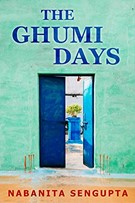
Recessing into Nostalgia: A Review of Nabanita Sengupta’s The Ghumi Days

Review by Basudhara Roy


The Ghumi Days

Juggernaut Books, 2021
Short Stories
Nabanita Sengupta
Pages 91 | Kindle Price ₹ 52.50 INR


What does a story bring to the world? Among the many things that a well-told story does - engage, enthral, inspire, instruct - that which stands out is the story’s ability and generosity to offer an alternate home to our imagination, a place, however briefly, to nest and reconcile ourselves with life and time. With short stories that constellate around a particular geographical region, the sense of homing-in is stronger. Gridded in story after story by the same locale, encountering a familiar set of characters, and being impelled by a dependable narrator, the reader is apt to drop her guard, surrender to the idiosyncrasies of this fictional world, and allow herself to inhabit the stories as one inhabits the recesses of a loved landscape. Nabanita Sengupta’s eighteen tender stories in The Ghumi Days impact one similarly as they beckon the reader away from the chaos of ICT, capitalism, consumerism, politics, and the environmental crisis into the leisured motions of a communal way of life that is fast fading, even in sub-urban and rural pockets of India.


Ghumi, in Sengupta’s fiction, is a small industrial town located near Hazaribagh in the Chota Nagpur Plateau. Dominated by the factory around which the town has sprung, the lives of the inhabitants of Ghumi are structured, both by its natural beauty and its strict industrial regime:


Flanked by a river and a hill,, Ghumi was as fresh and vibrant as a teenager living a life of bounty as well as discipline. The residents were tied together in a disciplinarian regime, strictly maintained by the regular factory shifts. Since each and everyone drew their livelihood from the factory and its corresponding offices, they had to follow the pattern of life set by it. […] In the first few months of her unsupervised domesticity, away from both sets of parents and in the land of her husband’s work, the factory siren took up the role of the mother-in-law, ensuring an order amidst the desired and novel anarchy of this new phase of their conjugality. (‘A Night too Long’)


Modest and enterprising, Ghumi is a cosmopolitan space – multicultural, multilingual and liberal in a way that industrial centres with a diverse settler workforce, usually are. It is also small and secluded and therefore, close-knit, and provincial. Cut off from the wider world and contoured by the factory’s unchanging routine, life in Ghumi seldom ventures out of the zone of familiarity. Also, with everyone drawing their livelihood from the same source, there is a synchronicity of lifestyles here that leads to a warm communality among its residents. Close to nature on the one hand and economically self-reliant on the other, Ghumi offers an ideal site of anchorage in the world, undisturbed by poverty, hunger, corruption, ostentation, and the rat-race for dominion over scarce resources and opportunities.


This does not, however, render the place a complete utopia. Sengupta does summon ripples of crisis upon Ghumi’s surface. Young girls are not always safe from lecherous eyes (‘Serpent in Eden’), friendship and trust may not always be reciprocated with integrity (‘Trouble at the Workshop’), timber thieves are decimating the forest cover around the township (‘The Threat note’), professional decisions may lead to personal insecurity and danger (‘The Gossipers’) and the threat of lay off and unemployment loom large over the workforce (‘Lay off’). But Sengupta’s characteristic fictional method is to keep the crisis at bay through timely intervention of the community and without allowing it to penetrate its core of trust, resilience and self-esteem. In story after story, crisis and tragedy that lurk around the corners of the narrative, are deftly averted to lead to a satisfactory resolution and a reassertion of Ghumi’s benevolence.


Significant to Sengupta’s focus as a narrator is Ghumi’s essential strength and its potential to offer an alternate viewpoint and way of life that reclaim space for individuality, humane bonds, empathy and holistic growth. Description is her forte as is keen observation and she is at her best in narrative sections that take in both the place and its people in one meditative sweep. Consider the following lines from ‘@Nostalgia’:


…Ghumi was not exactly real. It was almost like a simulation for the real thing – like those driving lessons you know you can take on your computer screen before the actual driving? It was like that. Rough edges of dangers padded off in a very large extended family. That place was my whole world and a place that I had to leave for the real one because Ghumi did not hold back anyone. It trained you, taught you, helped you with important inputs for sustainability but ultimately let you go.


A distinct lyrical quality emanates from Sengupta’s best passages in this collection as she goes about reclaiming and reinstating what has been lost – “the days of large-hearted people, living in homes with large windows and even larger balconies and sleeping in large beds”, a “freely flowing largeness of existence, not necessarily reflected always in their material possessions.” (‘Table Tale’) A disciplined, communal way of living as against that alienated haphazardness of contemporary life is essential to her social vision. People can grow only in a common soil and with each other, Sengupta seems to say. Such communal nurturance is especially important for the younger generation to bequeath to them values for a harmonious and sustainable existence. Many of these stories, therefore, weave themselves around a pre-adolescent girl, Raya, and her family. The first and last stories of the collection are especially significant to this thematic frame. The first story describes a three and a half-year old Raya who feels lost in Ghumi’s ‘babble of tongues’ because she has recently been displaced from her linguistic environment in Bengal. The terrified child is finally put to ease only when the local inhabitants get together to build a familiar linguistic home for her through the broken pieces of Bengali that they know. In the last story of the collection, a restless artist returns to his native Ghumi to be healed from rootlessness and nostalgia and to reawaken his moorings in art.


Life in Ghumi, as the narrator repeatedly emphasizes, is simple, steady and humdrum. Here, opportunities are limited and choices in life are few. But it is also fertile, emotive and empowered in understanding and empathy. A diverse and close-knit community teaches its young and new members to be kind, compassionate, brave and socially useful. The presence of negative forces within this world vanquished, eventually, by the forces of good, reinforces the values of humanity and social cohesion. Ghumi is a valuable place to be nurtured in and to begin from. It is also a precious place to return to. It is, most importantly, a place to be acknowledged, spoken about, recreated and celebrated in fiction in order to preserve the best of all the old-world values that inhere deep within its structures.


“Stories are soul vitamins,” ,” writes Clarissa Pinkola Estes in Women Who Run with the Wolves. “Stories set the soul into motion, and this is particularly important where the inner life is frightened, wedged or cornered.” In a society rendered claustrophobic by social apathy, mindless acquisition, cut-throat competition and human mechanization, Ghumi offers its readers a soul vitamin, an alternate way of being and connecting with the world. It speaks for the value of small towns across the length and breadth of the country that have managed to negotiate between industrial practicality and rural ethics and which, largely, go unacknowledged in the country’s intellectual and cultural map. Offering short and deft character portraits and plots that resolve themselves into a peaceful denouement, these are stories that are saved from the brink of tragedy by an empathetic storyteller’s deep love for a place and its people. Stirring within the reader, reminiscences of the grace of Narayan, the benevolence of Murty, and the charm of Bond, Nabanita Sengupta’s The Ghumi Days will definitely find some forgotten, wistful hole in your heart and resolutely, fill it.

***


Bionote: Basudhara Roy is a poet, academic and faculty of English at Karim City College affiliated to Kolhan University, Chaibasa. Her latest work is featured in Madras Courier, Lucy Writers Platform, Berfrois, Gitanjali and Beyond, The Aleph Review and Yearbook of Indian English Poetry 2020-21, among others. Her recent (second) collection of poems is Stitching a Home (New Delhi: Red River, 2021).


Championing an Identity sans Signifiers:

A Review of Kalki Subramaniam's We are Not the Others: Reflections of a Transgender Artivist

By Basudhara Roy*


Kalki Subramaniam

We are Not the Others: Reflections of a Transgender Artivist

Notion Press, 2021
ISBN (Paperback) 978-1-63940-487-2
Pp 166 | Price 
http://www.museindia.com/images/rup.png 350


“I too stand

in the thick of the battle field

destroying stupidity

and defeating

the emasculated,

let us celebrate life,

come.”

(Kalki Subramaniam, ‘Arise, My Precious’)


Kalki Subramaniam’s latest collection We are Not the Others: Reflections of a Transgender Artivist published by Notion Press this June, is a book that will leave your heart open for ever. An honest, unapologetic, and fiery narrative of a transgender’s lived experience presented through poetry, prose and through deeply figurative and unsettling illustrations by the talented writer herself, here is writing that takes the heart by storm, wreaks havoc on our complacencies, upsets the neat and futile categories of definitions that have been drilled into us through a prolonged process of socialization, and liberates us by the overwhelming strength of its optimism.


Artist, activist, poet, actor, and writer, Kalki powerfully places her transgender identity at the centre of her rich and multifarious work. Founder of Sahodari Foundation, an organization that works for the social, political, and economic empowerment of transgender people in India through various creative projects, Kalki combines art and activism with a commitment that is not just intellectual or social but defiantly humanist. One of the most prominent voices in the LGBTQI+ community of India, she is well-known for championing the recognition of the legal rights of transgender people which resulted in the historic 2014 verdict of the Supreme Court of India whereby the rights of the transgender community as the third gender were recognized not merely as “a social or medical issue but a human rights issue”. Widely awarded for her social work, art, film performance, and literary contributions, Kalki continues to be an inspiration both within the transgender community and beyond it. Her poems, as N. Elango writes in his Foreword to the collection, are “clarion calls, not only to the LGBT community, but for those whosoever seek to break themselves free from the shackles and fetters snapped around them by the hegemonic conspiracy.”


Comprising sixteen poems, some of which have been translated from the original Tamil by N. Elango, four personal essays, and magnificent quotations and artwork, including the actual handwritten scripts of her Tamil poems, the book takes us into an autobiographical journey of growth, strength and faith through the trauma, angst and painful discrimination that transgenders undergo every day in this country. In her Author’s Notes to the collection, Kalki writes:


This book is a bundle of so many of my emotions – joy, pain, anger, fury, distress and hope. Through this book, I tell some parts of my story and that of the others like me. You will hear their voices through me.


Poetry and art give a richness to my life. They give beauty, strength and hope. They heal. I couldn’t have survived my tormenting teenage years without them.


Signification, one realizes, is a complex process and often, self-defeating. The complexity of signification stems from the fact that the signified, rather than being an objective presence in the real world, constitutes an abstracted idea of it in our minds. Our ideas, often being entrenched by particularities such as history, society, religion, culture and conditioning, the looming possibilities are that a wrong, erroneous and unwarranted idea may root itself over time into a vindictive stereotype. Around us and across the world, the negative effects of such stereotyping are rampantly visible. Stripped of distinctive individual virtues, identity becomes an allotted story of signification that may have no correspondence to fact. Every human and non-human Other is the victim of just such a process of signification whereby the assumed has offset the actual, and ushered in practices of prejudice, discrimination, hatred and violence. When it comes to people who identify themselves as LGBTQI+, the trauma and suffering that pernicious narratives of signification can produce, is heightened by the fact that there is no appeal to a common truth. The only truth about sex and gender is that which also challenges their greatest fallacy viz. they are binary. Nothing can be farther from biological fact. In From Transgender to Transhuman, Martine Rothblatt writes:

… sex in humans is a continuous variable, a complex of phenotypic and genotypic factors as unique as one’s fingerprints. While male and female categories are useful to group biological characteristics for medical purposes, these same categories have socially detrimental effects when used outside the field of medicine. Sex should really be the sum of behaviors we call gender—an adjective, not a noun. People should explore genders. When they settle on a set of gender behaviors, the name for that set describes their sex.

Rothblatt insists that the resting point for gender “depends upon the same complex of mental propensities and chance socialization that leads people to adopt one or another career, hobby, or religion.” However, in a country like India where sex is, in most quarters, destiny and where patriarchal thought largely reigns, transgenders are routinely judged by society for their bodies, voices, physical appearance, sexual choices and morality, so much so, that the ordinary prerogatives of ordinary people everywhere in the world become for them, exclusive privileges they must fight to earn.


In ‘If You Don’t Mind’, the poet describes how the claim of transwomen like her to womanhood, is continually contested by mainstream society that reserves the right to judge her body as an anomaly, and in a blatant invasion of her privacy, to ceaselessly question her about  it. ‘Don’t Tell That to Me’ documents, in the same testing spirit of the irritable receiver, what transgenders receive most from the world – curiosity, sympathy, stares, whispers, questions and requests for blessings as if they were divine in their departure from normative humanity. Kalki writes:


To you and to

the million others

I want to shout

I am made of

flesh and blood,

of fear and hope,

of joy and pain.


I am like you

I am human too.


On the terrain of gender identity, gender affirmation for transwomen is no less traumatic. As far as the socio-cultural binary thinking about gender goes, it is not sufficient for a person to identify as a woman. One must also offer evidence of ‘being’ one as per mainstream norms of body-type and behaviour. Such socio-cultural determination of questions of ontology does grave injustice to real life by refuting the immense variety of embodied gender experience and imposing a blanket uniformity on the internalization and articulation of womanhood. ‘Piece by Piece’ that examines gender identity as a process of becoming rather than de facto being, is a poem that talks of the poet’s struggle to painstakingly establish her claim as a woman:


I am not a woman by birth

I was born as a shattered

Rubik’s cube,

all my life I worked

step by step

to reclaim my honour.


To correct the wrongs,

I collected all of me,

my body, mind and soul

and put together in patience,

vouching with perseverance.

I endured shame and guilt,

yet I stood strong with grit.


In the heart-wrenching poem ‘Nirvaanam’, the multi-layered issues surrounding gender – biology, culture, policing and performance – poignantly coalesce. The transwoman’s joy in her anklet and her ecstatic dance invite ridicule from the moral police, “those/ who have their manhoods/ hanging about them”. The only way for the woman here to “stand my ground/ to prove my womanhood”, is through biology:


with tears rolling down

I remove my saree.


In this moment,

I do not want any Krishna

to save or rescue me


The act of disrobing is transformed here into an act of agency and defiant transgression. Its complex and potent symbolism is heightened by the mythological subtexts that it skilfully builds, both evoking and rejecting the need of a male God to protect the sham cultural notion of ‘honour’. The female body which has historically borne the brunt of violence against women in society now becomes a vital site for the empowered assertion of female identity, beyond the need of patriarchal intervention or safeguard. This is not to say that the element of victimization is absent here but the conscious attempt is to wrest power for the woman against all odds.


‘Truth and Lie’ documents another painful moment of rejection, this time, in love. In a potential bond of marriage, the poet-speaker’s revelation of her real identity as a transwoman, spoils all her conjugal hopes:


“I told you not to out

yourself as a Transwoman.

My parents rejected you,

I need them and

can’t reject them,

so I reject you”

you spoke.


This is a culture that, as the poem points out, punishes honesty and will forgive and even welcome inauthenticity at the cost of maintaining its illusions intact. In her prose pieces ‘My Perfectly Imperfect Vagina’ and ‘Will an Indian Man Ever Bring a Trans Woman Home and Say ‘Ma, I Love Her’?, Kalki evocatively describes the transwomen’s existential necessity to acquire the biological gift of womanhood through sex-reassignment surgeries and society’s prejudiced rejection of them as women despite their fierce identification as members of the female sex.  In the former essay, she writes:


Women who are ‘born women’ are gifted with a perfect vagina, they don’t have to spend a dime or a rupee to have a perfect one. But our stories, the transwomen’s stories are entirely different. Before we did our sex reassignment surgeries, those days whenever we looked down naked, we were ashamed and wanted to pluck it off whatever was hanging there. We loathed it.


The essay throws light on the various experiences of gender dysphoria and the non-seriousness of the government in dealing with it. In poems like ‘She’ and ‘Clap Aloud’, Kalki deconstructs the stereotyping of transgenders by establishing their clapping as an act of empowerment and liberation from the misplaced and hypocritical values of society – “Clap aloud/ Thirunangai/ clap aloud!/ Like a crack of thunder/ that shocks the world/ during a great rain,/ clap your hands aloud!” The ability to have both hands free for oneself and for service to humanity becomes a higher form of ethic than the selfish engagements of the workaday world. The act of clapping, thus, becomes an assertion of humanity and of the superior knowledge of identification of the self with the world.


Rothblatt states that the “apartheid of sex” by which we are cast, from the time of our birth, into a sex-type based on our genitals and socialized into a “sex-type-appropriate culture called gender” is extremely detrimental to society. “Freedom of gender is,” in her opinion, “therefore, the gateway to a freedom of form and to an explosion of human potential. First comes the realization that we are not limited by our gross sexual anatomy. Then comes the awakening that we are not limited by our anatomy at all. The mind is the substance of humanity. Mind is deeper than matter.”


Kalki, in her writing, also strongly argues for the evaluation of humans as humans, irrespective of gender. In her prose piece ‘A Letter to a Transgender Kid’, she attempts to put forward a narrative of androgyny that is gloriously human:


Do remember that there is no complete man or complete woman in this world. If anyone as such existed ever, they can never understand the emotions of the opposite gender. In every man, there is a woman and, in every woman, there is a man. How much of a man is a woman, and how much of a woman is a man is what makes them. Makes us all.


Each piece of writing in We are Not the Others: Reflections of a Transgender Artivist deconstructs the idea of transgenders as Others by deconstructing cultural signification and offering an insider’s account of their dreams, desires, hopes, pain and suffering that are all too universal and all too human. Challenging the stereotyping of signifiers, these are pieces that vehemently bring home to us the fact that boy/girl/man/woman/first gender/second gender/third gender are hierarchical categories that we forcefully impose upon human experience with severe injustice and irreparable damage. It is important to acknowledge the diversity of life, of living and of performing humanity across bodies, genders, cultures and sexual orientations. “This book,” writes Laura Sherwood, “is essential for all academic institutions and programs working to dismantle dominant narratives or facilitate dialogue around gender beyond the binary.” I would like to affirm that this is a work that must be read by everyone who wishes to know, first-hand, of human grit,  perseverance, and the human ability to, both, fuel and transcend them through art. Also that, once read, this is a book no reader will be able to permanently disentangle her memory and consciousness from.

___________________________________________________________________________


*Basudhara Roy teaches English at Karim City College affiliated to Kolhan University, Chaibasa. Drawn to diaspora, gender, and ecological studies, she is the author of three books - Migrations of Hope (criticism) and two collections of poems, Moon in my Teacup (Writer’s Workshop, 2019) and Stitching a Home (Red River, 2021). She loves, rebels, writes and reviews from Jamshedpur, Jharkhand, India.