 SetuVolume 8; Issue 4; September 2023Setu PDF Archives EditorialPoetryShort FictionCreative NonfictionMy Favourite WorksAuthor of the MonthNovel in Instalment: Eighth PartSetu Video Series of Literary and Critical ConversationsSetu Initiative: Setu Series of Virtual Readings
|
Showing posts with label 202309E. Show all posts
Showing posts with label 202309E. Show all posts
Contents, September 2023


Three Books, Three Authors, Three Guest-Edited Sections
Hi everyone,
The nature is playing with colors currently. Autumn is here in the northern hemisphere and I believe, the spring is already there in southern hemisphere. While US children are excited about the Halloween, India is celebrating the "Ancestor's' Fortnight" (Pitr Paksha in Indic languages). Different cultures, various colors, different languages, all interacting with each other with your help through bridges like Setu, that is able to perform its role with your help. Thank you!
A journy that started with a humble beginning of two monthly journals of art and literature resisted publishing of books for some time. Still considering ourselves as a 'reluctant publishing house', we have indeed published 36 books in Hindi, English, and a few other Indic languages so far. Of course, our resources are thin, and we don't charge any fees for the books, we take all necessary steps to ensure high quality at every stage of production. The books published by Setu are available globally on Amazon network.
Setu family is proud to present three new paperback books recently published by us. The Kindle ebook editions of the same will be made available soon. Please join me in congratulating Preethi Govindaraj, John Thieme, and Sunil Sharma.
 |
| Thoughts Themes and Images Preethi Govindaraj |
Thoughts, Themes and Images (Paperback)
This is a collection of poems written by Preethi Govindaraj. Preethi’s poems cover a range of ideas, deeply personal emotions, random musings, and insightful commentary on social and current-day issues, some of which are reflected in the accompanying paintings. The collection of more than one hundred and fifty poems reflects the depth and range of her poetic mind and imagination.
The book is full of surprises – love, suffering, chuckles, serious social commentary are brought together like a quintessential Indian curry. Preethi’s poems examine the mundane and the sublime with equal honesty, sincerity, and zeal. Something in this potpourri of reflections on family, festivals, relationships, nature and the changing seasons, and serious social issues should appeal to every poetry lover.
***
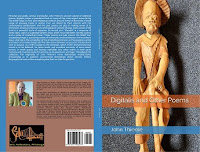 |
| Digitalis and Other Poems John Thiem |
Digitalis and Other Poems (Paperback)
This collection by John Thieme brings together a series of individual poems, which for the most part are not closely connected, and ‘Massiah’, a sequence of verse narratives told in a Guyanese barber shop, where there is continuity from one to the next. Some of the individual poems were written in response to invitations for submissions on particular subjects. These include three on war and peace and five short pieces written during the time of the pandemic, but the remainder are more scattered in theme, tone and form.
***
 |
| What trees tell the mortals Sunil Sharma |
In this new poetry collection, Sunil Sharma aptly describes the intersection where two worlds converge as the majestic wonders of nature become artificially entwined ever more tightly with modern civilization. These dualistic energies are keenly observed when Sharma points to a scene of children playing innocently in the snow as the adults around them have their attention sucked into smartphones. Whether these Toronto-based reflections are illustrating trails that cut through the wintry woods, flocks of geese soaring overhead, theatric pulses of a cosmic skyline, the symphonic sounds of night’s harmonic song, or skeletal trees that have shed their leaves for the season, we are guided on a journey being told through the lens of a contemplative pagan who longs for a restoration of peace and balance upon the earth.
Not just three new books, this issue of Setu has three special guest-edited supplements too, which are listed below:
- Towards Visibility: Poetry by BIPOC, women, individuals with disabilities and non-binary voices: guest edited by Anita Nahal, Sangeeta Sharma, and Candice Louisa Daquin
- British Working Class Poetry: guest-edited by Paul Brookes
- Poetry as a Medium of Peace. guest-edited by Paramita Mukherjee Mullick
Enjoy the books, September 2023 issue and the three supplements.
With love, this is
𝓐𝓷𝓾𝓻𝓪𝓰 𝓢𝓱𝓪𝓻𝓶𝓪
Setu, Pittsburgh
Of Diversity, Working-Class Poetry and Peace
 |
| Sunil Sharma |
Hi,
Here are the September servings
for you.
Happy to share that Setu crossed
more than 40 lakh views sometime back.
An important milestone for the
monthly online bilingual journal with its motto of “Dil-se-dil-tak",
things that directly touch hearts; the heart-to heart
communication, connections forged via arts.
Another glittering milestone
worth mentioning: The current issue carries three special
calls!
Yes, three calls! A feat
of its kind!
Critical initiatives taken up by
your favourite journal with a desire to serve you fine creations that are
relevant and timely.
It is a record for any
journal---triple calls; triple special sections, combined with the general
section running prose and poetry.
A remarkable feat achieved by our
eminent guest-editors and poets!
Guest edited by brilliant
professionals who are also brilliant writers.
Broad categories and themes handled by the invited poets in the following calls given by Setu globally, and happy to say, the responses were pretty overwhelming.
The titles are self-explanatory:
---Towards Visibility: Poetry by
BIPOC, Women, Individuals with Disabilities and Non-Binary Voices. Guest-edited
by Anita Nahal, Sangeeta Sharma & Candice Louisa Daquin
According to the poet Anita, the focus was on diversity and minority voices, linguistic variety and flexibility: "This extraordinary issue of Setu is, therefore, exclusive as it’s rare to have a collection of so many minority voices in one issue…thirty in all! We have retained the variances of American, British, and other forms of English be it, to offer a smidgeon of linguistic variety and flavor. We have also preserved the different grammatical usages because we believe that poetry is a genre that allows us to experiment more with language than any other writing medium."
Indeed!
---British Working Class Poetry.
Guest-edited by Paul Brookes
Talking of his experience of curating this for the second time, Paul---a poet who loves to articulate the views of this class in his incisive poetry--- says in the guest-editorial: "These are vibrant, important voices that should be heard. I am glad to be given a platform, to
promote their intimate, angry, domestic and incisive accounts, and pointed lessons for us all. In the spirit of the Chartist poets who insisted on being heard, on encouraging and cajoling those without a voice to make themselves heard."
Yes, the world is listening, Paul and his poets!
---Poetry as a Medium of Peace. Guest-edited by Paramita Mukherjee Mullick
Explaining the process, poet Paramita shares her thoughts on this urgent call for action: "September being a special month of Peace as 21st September is celebrated as the International Peace Day, Setu worships Peace through Poetry. Twenty-one
brilliant poets from all around India and the world have come together to usher
in peace with their emotions, their expressions and their words. It was a
wonderful and enriching experience to go through their poems."
We heartily agree!
.
The general section carries prose and poetry that is equally thrilling.
Famous author-poet Santosh Bakaya shares her favourite works with us.
Our deep gratitude to the guest-editors and all the featured contributors for their support.
Hope you enjoy the spread.
The general section carries prose and poetry that is equally thrilling.
Famous author-poet Santosh Bakaya shares her favourite works with us.
Our deep gratitude to the guest-editors and all the featured contributors for their support.
Hope you enjoy the spread.
Take care!
Sunil Sharma,
Editor, Setu (English)
Amrita Valan (Towards Visibility)
 |
| Amrita Valan |
Brandish mop, broomstick
Wash vessels, countertop,
Make floors brand new
Varnish door knobs.
Wash vessels, countertop,
Make floors brand new
Varnish door knobs.
Paint Ma Laxmi’s feet outside
Worship God’s immaculate bride,
Do daily Pranayama, Surya Namaskar,
Sit with your children watch Avatar,
Discuss with them the daily news,
Watch a stand-up comic rant and vent
Your secret pent up pressured views.
Cook and clean, make the beds,
Be sure the chicken or lamb marinates.
Do this until you are done to death.
After two score years or more, hey woman,
Running on empty since you hit the floor
Neither pity not pittance paid, in the name of
Love and duty, your labours never monetised.
A ghost in your mansion, queen of your hive,
Invisible, busy churning out honey for your tribe.
Running on empty since you hit the floor
Neither pity not pittance paid, in the name of
Love and duty, your labours never monetised.
A ghost in your mansion, queen of your hive,
Invisible, busy churning out honey for your tribe.
***
WOMAN
You are a valuable
commodity. Man is like gold, fallen into a ditch,
His muck can be washed off, emerging good as new, good as gold.
But alas! You frail fabulous silk, forever spoilt by a trace of dirt.
Unsullied, a girl child is precious, untouched.
Like a car, first ownership is all.
Woman you are owned. You claim freedom,
A voice, a choice. Hush your noise. Look upwards,
Your liberty granted under the aegis of permission,
Glass ceilings make you fantasise about infinite scope.
Woman, you walk a thin high wire, tight rope artist of dangerous heights
As perfect work of art, plundered, caged, collected, displayed, framed,
Showcased luxury good. Cossetted, Beloved. Pampered, praised.
As audacity, stifled, shaved, paraded naked like punishment,
Stoned, burnt, by fire or acid, berated, warned, cautioned
To be aware. Beware woman, you are on thin, slippery ground,
Once fallen. It is downhill all the way; only prodigal males return.
Woman you have been told; your grace lies in soft submission.
My face hardens, I curse like a man, spread broad shoulders
Protecting my family because I can. Do it all. A learnt élan.
But I am still, your appendage rib, only an accessory, woman.
Amrita Valan is a writer from
India with two published works, Arrivederci Fifty Poems, (Gloomy
Seahorse Press, 2021) and a collection of 17 short stories, In Between
Pauses, (Imp Spired Press, 2021). Her poems, essays and short stories have
been published online, in national and international journals and anthologies,
such as Outlook Weekender, Piker’s Press, Shot glass Journal,
among others. Her short story A Normal Day was featured in the 2021 Best
of the Best anthology by Potato Soup Journal. In 2021 she won a jury award for
an ekphrastic on Van Gogh’s Café Terrace from the Friendswood Ekphrastic Poetry
contest and was shortlisted again in 2022. She has narrated her short stories
for Alan Johnson’s Storyboard. Amrita podcasts her stories on Spotify at: https://open.spotify.com/episode/6dk3S7FOUh72OE9wByoRGt...
Amita Ray (Towards Visibility)
 |
| Amita Ray |
THE MATRIARCH
age sculpts a framed face animating
an unobtrusive corner of haveli
in the hollow of her venerable womb
posterity sketches its roots,
branches wrinkle in flawless mesh
capturing the indecisive count of her age,
the sunken sockets of the matriarch
epitome of empowerment
hold pedigree in spine entitled
its fluidity diverge in veins a continuum,
years arrested in furrows of her hallowed gaze
immortality palpates unblinking,
her mystic gaze registers cryptic dialogues
coupling the mortal with immortal.
* Haveli: old private mansion
***
THE RAG DOLL
she looks at herself lacklustre,
staring at the red dot between her brow
the fateful sun bridging flights of darkness
in a life less than a decade and half years old
days trundle dos and don’ts pieced together
she pines for her child, a rag doll left behind
in penniless sundry joys of childhood
she now festers in a squalid den
of a knotted city slum
daily chores pile up
as does her body needs
pangs of hunger coalesce
with a seedling in her womb
the burgeoning life terminates
in spasms of unpardonable abuse
the miscarriage bleeds, bleeds, merges
in embers red of a doll forsaken, her child
between the vermillion parting of her hair.
***
Amita
Ray,
a former associate professor in English and Vice- Principal of a college based
in Kolkata. She is a translator, short story writer, reviewer and poet. She has
four volumes of translations to her credit. The titles of her translations are Khirer
Putul (The Doll of Condensed Milk), Treats in Translation, Legends Speak
(Co-authored) and Dwipantarer Katha (The Story of Transportation).
She is a widely published short story writer. Her collection of short stories TRAIL
OF LOVE AND LONGINGS published in 2020 has received rave reviews. She is a
published poet and has brought out a collection of poems Until Birds Sing.
She is an executive council member of the Intercultural Poetry and Performance
Library, Kolkata. She is also an Advisory Board Member of Kavya Kumbh, Kolkata
Chapter. Her translation of Abanindranath Tagore’s Khirer Putul (The Doll of
Condensed Milk) was shortlisted for the Sahitya Akademy award for English
translation 2022.
Achingliu Kamei (Towards Visibility)
 |
| Achingliu Kamei |
NO NAME WOMAN
Story,
memory,
The periphery
realm is a part of the whole
The
very air no-name woman breathe
You
breathe, threads lost in the wind
Came
blowing by, searching for the lost fabric
Search
for meaning, for validation
Rising
under the same sun, and moon
No-name
woman in that realm
Famously known for what she was not
A malleable sheep on all the dark realms’ altar
Sacrificed. Yet the no-name woman
Realised all her dark realms
Her discordant attributes, a tapestry of the concordant weaves
On all her curves and contours
Weaving new visions of what is possible.
No-name woman’s threads continue to flow and weave
Resonating, profound shift in perspective
No-name woman weaves what was
Silenced, objectified, and oppressed
Breaking barriers and breaking hierarchical models.
A
short story writer, poet, and ultra-runner, Achingliu Kamei teaches literature
at Delhi University, New Delhi. She has a Ph.D. from Jawaharlal University. She
has published a collection of folktales, titled Naga Tales, Dawn (2017),
Songs of Raengdailu, a book of poems (2021), Liangtuang Pu,
Illustrated Novella for Children (2021), Headspace, The Mind’s Realm
(2022), and Naga Tales Morning Blush (2023). Several of her poems have
also been published in anthologies and journals from the USA, Canada,
Singapore, and India, such as in the Setu Journal, Poetry Pea Journal
of Haiku, and Senryu etc.
Poetry as a Medium of Peace - Guest Editorial
 |
| Paramita Mukherjee Mullick |
“Peace is the first shower on
the scorching earth.
Peace is like a new life, a
baby’s birth.
Peace is the chirping of birds
in the morn.
Peace is after darkness, the
dawn.”
With these few lines from a
poem of mine I tried bringing in the essence of peace. But peace is difficult
to define it is like love…it is intangible and not visible and also like love,
crucial for human existence and development. Without peace there can be no
advancement of an individual, without peace a nation cannot grow and without
peace the world cannot progress and prosper. Unity and kindness to others is
the core of peace. So Dalai Lama says, “Peace is the manifestation of human
compassion”. The Bible says, “In peace I will both lie down and sleep; for you
alone, O Lord, make me dwell in safety”. Safety and security of all is ensured
when there is peace.
AI has brought in so much of
progress and development in our lives but we are scared that one day AI may be
more powerful than us but no, AI can never be greater than human intellect and
human emotions. Poetry is an amalgamation of emotions and intellect. So, can
poetry bring in peace? Great philosophers, great scientific minds, poets and
singers have repeatedly expressed that peace is a conscious decision. In the
present scenario, where some parts of the world are still ravaged by war;
terrorism still destroys cities and humans still lacerate the dignity of their
own kind, we need peace. Poetry may not be a direct instrument of peace but can
surely inspire and ignite people’s imagination and empathy towards peace. In
poetry, varied and numerous thoughts can be expressed through few words. Poetry
touches the hearts of people much quicker than a sermon or a speech. The words
of poets have brought in many a revolution and rebellion against atrocities. Their
words and expressions have brought in many changes. So quoting a Sama Veda
mantra I will say Poetry is “The Sun in seeing; like Fire in brilliance; like
Lord Brihaspati in intellect; like the Ashwins in beauty; like Indra-Agni in
strength”. So with brilliance, strength, intellect and beauty Poetry is surely
a medium of peace.
September being a special
month of Peace as 21st September is celebrated as the International
Peace Day, Setu worships Peace through Poetry. Twenty one brilliant poets from
all around India and the world have come together to usher in peace with their
emotions, their expressions and their words. It was a wonderful and enriching
experience to go through their poems. Some have brought in the conservation
aspect when peace prevails. Some have used lingering imagery to beautify peace.
Scenes of Mahabharata have been reproduced by some to collate with peace. Again
the aspect of inner peace has been put forward by some. Yes inner peace is the
most essential component of world peace. Buddha says, “Peace comes from within
and not without”. The calm and peace of the inner being diffuses all around
like a fragrant perfume, to the society, to the community and to the
world. The beauty, the strength and
power of their poetry will certainly stir our thoughts and we will be more
conscious about bringing in and spreading peace around.
I am humbled and honoured to
have guest edited this section of peace poetry in the September issue of Setu.
I am grateful to the Setu team.
Poetry as a Medium of Peace: Authors
British Working Class Poetry: Guest Editor Preface
 |
| Paul Brookes |
Immensely grateful to the editors of Setumag for inviting me in 2022, and again this year to curate a selection of some British Working Class Poets. Also, thankyou to Peter Raynard who provided a basic list, and to the poets who recommended others. If your suggested poet is not included, this will be due to them not replying before the deadline, replying that they have no unpublished poems available, or that they felt themselves to be more middle class than working class.
When I worked eight years for The Workers Educational Association as a part-time tutor many of my students were superb writers. Some did not want to pursue a literary career and were just happy to submit work in the workshops. I love promoting, fresh, neglected, or side-lined voices with their vibrancy and urgency, their richness and diversity. I do it on my blog, The Wombwell Rainbow, too. I give a platform in the form of interviews about their creativity and ask in detail about their work. It is important to me that this is not behind a paywall, so any may read it.
These are vibrant, important voices that should be heard. I am glad to be given a platform, to promote their intimate, angry, domestic and incisive accounts, and pointed lessons for us all. In the spirit of the Chartist poets who insisted on being heard, on encouraging and cajoling those without a voice to make themselves heard.
All F Bombs have been replaced by an X.
Paul Brookes is a shop assistant. His chapbooks include As
Folktaleteller, ( ImpSpired, 2022), These Random Acts of Wildness,
(Glass Head Press, 2023), Othernesses, (JCStudio Press, 2023). He edits The Wombwell Rainbow Interviews and
challenges and has had work broadcast on BBC Radio 3 The Verb and BBC Radio
Sheffield. Nominated for the Rhysling Prize, and twice for the Pushcart Prize.
thewombwellrainbow.wordpress.com
Forthcoming, Wolf Eye, Red Ceilings Press,
British Working Class Poetry 2023: Authors
SPECIAL ISSUE: Towards Visibility
Poetry by BIPOC, Women,
Individuals with Disabilities and Non-binary Voices
Guest Editorial by
Anita
Nahal, Sangeeta Sharma & Candice Louisa Daquin
 |
| Candice Louisa Daquin |
This special issue of
Setu showcases poetry by individuals who identify themselves either as
Black, Indigenous and People of Color (BIPOC), as women, as individuals with
disabilities or as non-binary voices. Current world demographics reveal that
women are 49.58%, Black people are 7.8 billion, Indigenous people are 6%, 1.3
billion individuals with disability and about 2% of the population in 27
countries identified themselves as non-binary in a 2023 survey. [1]
Obviously, statistics
never paint a whole picture, and likely there are many more than these numbers
who identify as such. Ultimately these groups are not a minority but a
flourishing major part of society but despite this their voices have
historically been marginalized. Hence our enduring efforts toward visibility.
Human nature prevents
some of us from recognizing and accepting the distinctive diversity of others. As
a species we have the potential of generating bias and fear in our brain
synapses, consequently shifting to a “fight-or-flight”[2] mode rather quickly when
encountering ‘difference’. Princeton university researchers, Janine Willis and Alexander Todorov have concluded
that it takes only 1/10 of a second for us to make a judgement about someone
based on optic perceptions.[3]
 |
| Sangeeta Sharma |
The
questions this issue wishes to address include: what attracts the interest of
our poets and provides an impetus for them to express themselves? Are they
addressing bias, injustice, violence, abuse or seeking the lost bonds of
camaraderie, or lamenting over the digressing environmental richness? Do they
yearn for spatial connections with cherished or disliked places or people, or
are they engrossed in imaginary fascinations with non-human species or beyond
in space? Or is magic their main poetic stay?
 |
| Anita Nahal |
Or are
they articulating their personal lives and beauties or challenges therein,
prejudices, and world views towards them or others? Or are they writing poetry
about love, loss, survival, family, parenthood, various “isms”, music, dance,
sports, food, travel, etc.?
Also,
are these poets expressing in realism or surreal terms? What kind of semantics
do they employ? In what forms do they create poetry—free verse, prose, haiku,
ekphrastic, etc.?
Perhaps
none of these themes or styles can be expressed in a vacuum and poetry
outpourings are simply an amalgam of related or unrelated thoughts, feelings,
and expressions.
This
extraordinary issue of Setu is, therefore, exclusive as it’s rare to
have a collection of so many minority voices in one issue…thirty in all! We
have retained the variances of American, British, and other forms of English be
it, to offer a smidgeon of linguistic variety and flavor. We have also
preserved the different grammatical usages because we believe that poetry is a
genre that allows us to experiment more with language than any other writing
medium.
“Although poetry should abide by most traditional
language rules, how a poet chooses to use them is critical. Whether they decide
to follow them or break them, they’re making a statement and conveying a
message with this choice.”[4] It’s that message, loud
and clear, of poetry by BIPOC, women, individuals with disabilities and
non-binary voices that you will find on the pages of this issue. We humans have layered identities within us, lapping
and overlapping just like in British mathematician John Venn’s Diagram, though
unlike his equal circles, our circles can change shapes and sizes depending
upon what is dear to us at a particular moment in time.[5]
We thank all the
contributors for their time and effort in submitting their precious creativity.
Without writers, we wouldn’t have any journals or books!
We also thank Setu,
Sunil Sharma, and Anurag Sharma for their support to the theme and hope they
don’t find any editorial gaffs! We did our best! It’s certainly hats off to us
three, as we worked from different global time zones, effectively employing
Zoom and emails to get our work done quickly and harmoniously. As three women editors for this distinctive Setu
issue, each one of us is unique, and we also represent a multitude of
divergences in our personal and professional styles which gelled extremely
well! In the end, another deep gratitude to our contributors and to
Setu!
[1] Published by Statista Research
Department and 9, J. (2023) Gender Identity Worldwide by country 2021, Statista.
Available at:
https://www.statista.com/statistics/1269778/gender-identity-worldwide-country/
[2] In the 1920s American
psychologist, Walter Cannon was the first to write describe the fight-or-flight
concept.
[3]
Wargo, E. (2006) How many seconds to a first
impression? Association for Psychological Science - APS. Available
at:
https://www.psychologicalscience.org/observer/how-many-seconds-to-a-first-impression
[4] writingjournal_xdluy8. (2023, July 30). Do poems
need to follow grammatical rules? - letter review. Letter Review -.
https://letterreview.com/do-poems-need-to-follow-grammatical-rules/#:~:text=Poems%20don’t%20need%20to,a%20message%20with%20this%20choice.
[5] Nahal, A. (2016) Diversity
& Inclusion applied in layers (DIAL) model by dr. Anita Nahal, CDP, Society
for Diversity. Available at:
https://societyfordiversity.wordpress.com/2016/03/01/diversity-inclusion-applied-in-layers-dial-model-by-dr-anita-nahal-cdp/
Authors
Naomi Wood (British Working Class Poetry)
Naomi is a performance artist merging the circus with
storytelling and poetry. She creates pieces that incite riotous acts of joyful disobedience
celebrating empowerment and rebellion. Naomi has self published a first collection and
regularly runs creative writing workshops online and in the South East of the
UK as well as hosting performance poetry events.
Gobbess
At what point did we become afraid of reality?
We’re more palatable, somehow, as manic pixie
dream girls and we were
Busy burning brightly
Trying to tell the world that we were free
But lately it’s occurred to me
That maybe the witch hunters had just got in
our dreams.
See what is it about ourselves that we are just
so damn afraid of?
What is it about you lately that the world has
got you hating?
Got you feeling like you’ve always got to
constantly be creating?
Got to swallow down your humanness so being
alive in all its strangeness feels just like suffocating.
On every street corner there’s an order that
you should smile more.
Lobotomise, self criticise
Until you forget what you are here for.
I want to be in the dirt, face down snuffling
for truffles like a pig. Not a xing goddess. Not a Maiden, but a pig.
Snout first soaking in the muck and the mire,
rooting out what precious gems have been burnished in the fire and buried deep
for us to find in all our stupid humanity.
Beyond the kind and the irreverent and the world’s blustering insanity.
I don’t want to be a deity if it means I have
to keep my hands clean.
Because from what I’ve seen
Divinity lives everywhere you’re brave enough
to see it.
It lived in my grandmother labelling her
sockets and plugs-
A quiet kind of alchemy
Her hands wrapped around a mug.
The way she wielded a power drill every time
that we moved house.
It lives in the hands of a farmer I know
freeing the foot of a fox caught in a trap
With her weather worn fingers and an axe
strapped to her back.
I saw it in my friend who took her paintbrush
and cleaned the webs from the wings of a struggling bumblebee-
This endeavour scoffed at by some in the room.
But she knew the secret- that our time here is
only worth anything if all of us are
free.
And they say I’m in the ‘mother’ stage of this
Three Headed Gobbess phase-
The way women’s bodies have always been
subdivided, indexed, ranked and then erased-
And I don’t know what it is I’m nurturing but I
think it might be rage.
But this thing that I’m growing seems to be a
lot to do with earthing.
Being messy and unsightly, I’m giving names to
what I’m birthing.
Because divinity and holiness aren’t about
restrained purity
They’re in the hands of the woman at the food
bank who cleans and makes the tea.
Cracks
Who are we when nobody is watching?
What are we but the grit and grain
Rolled and polished under the shell
Of the stories we tell about ourselves?
Our footsteps were once rich forest deep
Now we’re walking these streets
And I’m meant to be older now
But I still hold my breath when I skip paving
stones.
Boom box, busy streets and broken locks
This city is full to the brim
With flashing fluorescent smiles
And see-through skin.
Plastic epiphanies
Grease wrapped
Fast tracked
Another Amazon parcel
But not robed in rainforest splendour.
And the kids were yelling
Telling us for years
But we don’t listen.
Instead we just cup our hands to our ears.
Press our faces to the walls
Of buildings and stories
That have grown too tall.
We are too many.
Too many questions
About trickle down economics
So I bite my lip
Fold origami cranes out of old bus tickets
And try not to step on the cracks.
And the men in suits are up there
Looking down
Just shifting their weight.
A business lunch, or a trip to the moon
Plate piled high-
It’s just another play-date.
And I don’t know exactly what it’s going to
take
For us to believe that our borders are
Imaginary and the hour is
Getting late.
Your bedtime story read aloud
In the voices of old white men.
They’re reading from an ancient book
But they’re also the one’s holding the pen.
While they throw toys from their towers
Over the shape of invisible things
They’re pouring poison in your ears
To keep you from believing.
And if you keep splitting the atom
Maybe you’ll find what you already
Knew to be true.
That this whole world has many layers
And the divine already lives in you
And you’re not here
To decide that everything belongs to you
When it’s all borrowed anyway
And the sun rises each day brand new.
There’s always been gaps beneath the
Fence for the wild ones to climb under
And seedlings growing through
Pavement cracks with voices of rolling
Thunder.
So on a day when there’s so much to do
And so little time for play
Will you remember who you really are
Put your hands back in the earth
And turn this dirt to clay?
On The Morning of Voting
I'm getting up early for all the people who
couldn't.
I rise in the dark emboldened by the voices of
those who came before me
Because this may just be paper and I like to
think outside the box.
But we've been standing empty handed in the
fields praying for a harvest for too long.
And they've been pissing on us and calling it
rain for some time now
That we forgot to question why the crops
weren't growing.
Chopped down our forests and carved us into
chess pieces that they divide
But won't conquer because we have our hands
deep in the dirt now.
And if you think your voice is insignificant
then
You have not seen how the smallest creatures
create their cathedrals.
It's a mess. Things are farcical. Life like a
ripe piece of Halloween satire.
TV barking like a dull eyed bear with boulders
for fists.
Meanwhile the tide is rising and it's
threatening to take back the land.
And we small huddle of fools stand gazing at
the sky.
But occasionally we look into each others
faces,
We make a life raft from each others limbs,
We sail into luminous waters on Wednesday
And transcend velocity at weekends.
A girl on the bus smiles right into the middle
of you
And you see old ladies laughing
Small dogs don't understand the stock market.
In the end, like them, we're all just
chasing our own tails.
But trees still get fatter on a full moon and
We are made of the same sap.
A murmuration that would carry us, too,
South for winter following the pull of planets.
While crickets rub their legs together in the
long grass.
A man on the checkout comforts a teenager
And in the park someone is feeding the birds.
We are grains of sand that snag
On the fabric of each others dreams-
White water rafting
The spin cycle rendering all of us; laundry.
Ultimately our colours all bleed into one
On a warm wash.
And I can taste familiarity in a stranger's
walk.
Sometimes.
There are fires raging and monsters
Living in all of our bellies but
Some days
You see hugs instead of handshakes
Or a grown-up riding a scooter to work.
Subscribe to:
Posts
(
Atom
)