Showing posts with label John Maurer. Show all posts

Guest Editorial: John Maurer

John Maurer
Clearly, the meaning of freedom has evolved, and continues to evolve. We live in a time when the meaning of freedom, or democratic freedom, must be considered not only in national terms, but in global terms as well. Freedom must be considered as more than simply the basic state of not being imprisoned. Understanding freedom requires us to elevate the concept beyond autonomy to include the right to a voice and the right for that voice to be heard. We are beginning to recognize that freedom isn’t something endowed entirely upon everyone equally, even in democratic societies. It is more complex than just a law or a system of government. Laws can be written, but that doesn’t mean they are always upheld, let alone enforced without bias. And in places where everyone has the right to vote, not everyone has the same access to the polls. At a time when so much divides us, even our interpretations of the democratic system pull us apart. Some claim that anarchy is the only true freedom. Others would say a direct democracy, such as that in ancient Athens, is the truest form of democracy and freedom. While others prefer the American model of a republic in which elected officials vote on behalf of their constituents.

While India celebrates its 75th birthday and year of independence this very month, Ukraine is simultaneously fighting to maintain its democratic freedom in the Russo-Ukrainian War. We are at a global crossroads where we can see both the beauty of a blooming democracy and the resilience of another that is under attack and threatened with a loss of freedom. Where India achieved its freedom through peaceful protests directed at the British Empire, Ukraine has been forced to defend its freedom by repelling a Russian invasion. We are seeing the different circumstances where freedoms are withheld or threatened, as well as seeing the different ways that different groups of people respond, or are forced to respond, to these threats. We’ve come to see that freedom is delicate, fragile, and precarious; that the places where democratic freedom exists are places where people have had to fight for it, in one way or another, in more and more instances. 

More than all of this, freedom extends well beyond just the political construct. It is a multi-faceted word that means different things to almost everyone. Some search for psychological freedom, to be free of worry or anxiety or other thoughts that restrain them. Others search for financial freedom to rescue them from the monotony of their daily lives, from their jobs, household chores, and worry for the future. Everyone has things in their life that they feel are holding them back, bad habits or being too busy or a lack of resources, financial or other; but everyone is searching for greater freedom within society, within themselves, and within our governments. Though our interpretations may differ, we all share in the desire for autonomy and freedom.

In this issue, the editors of Setu and I wanted to bring together poetry, prose, and visual art that spoke to all these facets of freedom, and perhaps others as well. I’ve curated a collection of writing and art from a diverse set of artists and writers; old and young, experienced and amateur, from a variety of countries, and with a variety of perspectives.  Though all these artists and writers are from different backgrounds and have had very different life experiences, you will likely find that their ideas of freedom are far more similar than they are different. Though we may have different ideas of how to get there, we all are headed for the same destination, to a place of greater freedom for ourselves and others.

It has been a privilege and an honor to have had so many writers and artists share their work with me, as well as having the opportunity to guest edit this issue on a topic that is near and dear to my heart. 

“Freedom, in any case, is only possible by constantly struggling for it.”—Albert Einstein

John Maurer
Guest Editor, SETU, August 2022, Special Edition on Freedom

Bio: John Maurer is a 27-year-old writer from Pittsburgh that writes fiction, poetry, and everything in-between, but their work always strives to portray that what is true is beautiful. When not writing, they enjoy spending their time playing basketball, making music, and taking long contemplative walks through the woods. They have been previously published in Setu Bilingual, The Bitchin’ Kitsch, Thought Catalog, and more than a hundred others. @JohnPMaurer (johnpmaurer.com)

Special Edition: Freedom
Featured Authors

1. Jass Aujla
2. Pallavi Baruah
3. Don Carpenter
4. Alice Chains
5. PS Conway
6. Kellasandra Ferrara
7. David Garcia
8. Athena Kaiman
9. Sasha Lauren
10. Frances MacGregor
11. George Miller
12. Maria Perez
13. Giselle Phillips
14. Steven Ross
15. Crow Rudd
16. J.A. Savage
17. Angela Thompson
18. Samra WaHeed
19. Antonia Wang
20. Cassondra Windwalker


Jakiela, Newman, Matcho and Catello Pack the Brillobox

John Maurer

-John Maurer

Standing room only is a rare sight at a poetry event. But such was the case the evening of August 4th, 2022, as dozens of people convened on the top floor of the Brillobox Bar and Restaurant in Lawrenceville for a four-author book launch. The size of the audience truly spoke to the impact of the featured poets. The night of poetry was emceed by Phelan Newman, daughter of two of the presenting poets of the night (Lori Jakiela and Dave Newman), who warmly welcomed the audience to the reading. She followed this by introducing the first poet of the night and her “best friend,” Cilia Catello, who read a selection of her work.

Catello, filling in for Kareem Tayyar, read a selection of poems and a short story, Lucky Lotto, which was a story set around modern themes but relatable to all generations. The story depicted a group of teenagers loitering outside a convenience store chiding each other into having the confidence to walk in and try to buy cigarettes without being carded. Catello’s associative and referential skills were clear in lines of the story such as her reference to a pack of Marlboro Reds as being “the Gucci of cigarettes.” After the reading, in conversation, when asked if she had any upcoming publications, Catello responded by saying, “not right now, I’m just focusing on finishing high school.” There is no doubt that Catello is an up-and-coming poet to watch here in Pittsburgh.

Brillobox Bar and Restaurant
Next to take the stage was Adam Matcho who read a selection from his latest book, Ask Your Undertaker, the cover of which was illustrated by Ms. Newman. In his poem, Petra from Work, Matcho conveys the way we work next to people for years, people we do not intend to become close to, but over time we learn their entire life story. What is so captivating about Matcho’s writing is that it does not read like narrative poetry, but by the time he reads the last line, you realize you’ve arrived at the end of a narrative arc you did not even notice. Matcho is also able to inject poignant and resonant lines through character dialogue, such as a conversation had with his wife in this poem, where his wife says, “Kindness is helping someone who can do nothing for you.” When asked why he chose to focus his poems on the topic of retail work, Matcho replied, “I think it’s something everyone can relate to; we all work.”

Dave Newman
Next, Dave Newman did something unusual for any poet, let alone a poet of his caliber and level of accomplishment; he stepped onto the stage and read just one poem. Before starting his reading, Newman said, “I’m old, I’m sensitive, I’m reading about a friend who’s dead. I apologize if I get really emotional.” To which Jakiela responded from the audience, “You said you weren’t going to cry.” Newman responded, “I know, I said I wasn’t going to cry. I’m such a fucking pussy.” (A comedic exchange which juxtaposed the serious and challenging subject matter of the poem to come.) The audience sat captivated through the longer narrative poem and quickly understood exactly why Newman felt he did not need to read any other poems alongside it. His poem told a heart-wrenching story about watching a friend struggle with drug and alcohol abuse, going on a bender, and arriving on his couch where his wife offers to make him food. It is a story of being witness to a loved one in a vicious cycle and wanting to help them but not being able to when they cannot recognize their own problem.

Lori Jakiela
The last poet of the evening was Lori Jakiela who sat down at the microphone with the sense of comfort and calm one would expect from a poet of her experience and achievement. Before beginning her recitation of poetry, she prefaced it by saying, “A lot of what I write about is death…but it’s funny.” She read a number of poems from her newest collection, How Do You Like It Now, Gentlemen?, a title that leaned on an Ernest Hemingway quote. When asked why a quote of Hemingway was used as the title, as well as being inserted between poems in the collection, Jakiela said “because he’s the fucking best.” She started off with a poem from her collection titled, Former 90s Super Model Cindy Crawford Says People Shouldn’t Worry About Aging, a poem about how we perceive our own aging as compared to the media. It was about a number of photos of Crawford that showed wrinkles and scars, something many reacted to with joy as it made them feel more confident in their own skin; only to have those pictures turn out be fake and for Crawford to post pictures of herself still looking as unattainably flawless as ever. After the show, Jakiela was asked about another poem from her collection, In Line at the Drive-Through Pharmacy, in which a man was screaming obscenities at her and her daughter while they waited for her daughter's medicine. If her daughter wasn’t with her, she said, "I would've got out of my car and fought him." This answer may seem unexpected, but certainly show’s Jakiela’s Hemingway-like bravery and the concise and direct voice with which her poetry speaks.

Overall, the evening was filled with as many moments of uproarious laughter as it was with groans of heartbreak and moments of contemplative silence. This slate of poets delivered poetry that was set in Pittsburgh, a setting seen, understood, and shared by every audience member, making all the poetry feel more relatable and grounded within this topical constant. Beyond just sharing their work, every author shared a great deal of themselves, staying after their reading to talk to every audience member who wanted to speak to them as well as signing autographs of their own books.

Poetry: John Maurer

John Maurer
The Effect of Building a Greenhouse Out of Red Brick

I know as much about the wild as a houseplant, though I couldn’t enter into it even if I wanted to
It isn’t a choice is what I tell myself while I weigh out my options and ignore the scale’s balance
Upon a tree line, I look through leaves; I see me leaving the world more honestly than I entered it

Trust me, there’s a difference between cabin fever and a fever dream set in a cabin, I’d know
I’m going through both right now, right here where my delusions dilute each other’s strength Down into the soil that I grew from which now festers more problems than my roots can grasp

From a skyscraper away, the concrete makes the tangible just seem laughably unnecessary
I don’t fit in at public occasions and I’d further argue that I don’t feel like I fit in even in private
Even just a party of one is no fun for me if I know that I’m going to attend the event

Aiming for any vein of distraction while these statues carved out of words all fall the same way
To dust and all at once, and once again it’s just you and your thoughts trying to find a way back To a home you haven’t known but have imagined fully enough to carve its floor plan in stone

With your only visual reference being the back of the hand you are using to chisel it out
***

 
A Headstone on a Treadmill

Sometimes we need to run just to prove to ourselves that we still can
I’ve been to enough funerals that sometimes I cry for the same reason

Sometimes the acceptance isn't worth the gauntlet of rejection between itself and I
This is what the collective voices of doubt chant from the cavernous depths of my mind

Don't assimilate, don't let your life get plotted out on a bar graph or a pie chart
Don't get boiled down into crumbling numbers and a blur of integer residue

Don't get lost or caught in a web of finesse that protects their interests but never yours
Instead, find a way out from the same place where they say there certainly isn't one

This is playing Russian roulette with blanks in every chamber…if I remember correctly…
This is white paint on white canvas, a napkin poem invisibly inked that never radiates legibility

That being said, don't let them confuse you from writing memoirs that didn't happen
And don’t let them make you think twice about writing fiction that did
***


An Imagined Migration

I'm still learning how to inhale and exhale with proper timing
To draw in deeply an acceptance of self and a comfort in vulnerability
To push out without stress the selfish hauntings and the trauma too old

I'm trying to learn to let go of what's on my mind without losing hold of it entirely
I’m learning to let go of surface-level convictions and to resort more to refortifying my passion
While relearning how to believe in myself, I’m made to remember that it's a leap of faith

There will always be nothing but a thousand-foot fall beneath, but this has always been the case
So, if you hesitate at the cliffs edge and look back, you’ll remember why you were running
As Occam taught us with his razor, it doesn’t matter if it’s impossible when it’s the only option

With nowhere else to walk, it’s worth a try, I think while watching iguanas dive into the sea
And it makes me wonder; if you took away the water, how many weeks or generations 
Would it take for their scales and talons to turn into feathers and beaks?
***


Over Practiced and Undereducated

I don't require the validation of others, but I am still irked when I don't have it
I've laid the groundwork for the ground to be reworked into a garden
The petals of its flowers will be no less beautiful being unseen by my eyes
But I want to see them anyways; I want to see what the dirt I’m buried in transforms into

Maybe I've grown into the hedge maze, maybe I'm not lost at all
Losing over and over to analyze it, trying to reverse engineer it
That seems to be alchemy to me, only silver-tongued pablum to my ears
That I could ever write a poem that more than poets ever hear or read

I hope I don't die this year but, as I live and breathe, I have a funny feeling
like when you can’t remember the joke anymore, just how your lungs felt 
like they were going to collapse as you laughed yourself into hyperventilation
Like maybe I've done the best I can do, maybe it's time to rest
Yet, I am awake through the early and late hours still looking

Foraging for phonetic reflections of refracted light to paint these faceless portraits
Looking for words, looking for an order to put them in, looking for a way to say what I feel Without having to spell out my personal life for my books to sell out; I’m trying to tell you how
The record stays broken no matter the speed of the platter or the condition of the needle
All the while, I maintain my ability to claim I didn’t say this, I just said it without saying it

I think the stained glass pinatas look far more beautiful in mosaics on the floor
The milk glass used as a milk glass is better shattered too, most things are
Just ask the genuflection splinters still sitting deep under the skin of my kneecaps
Which have grown large enough and long enough to have rings that can be counted now
But instead, I sit in the back of my mind wondering if it is me who is counting me out

On my deathbed, I turn my head towards the white light, and I look my identity in the eye
When I finally am made to take the time to take stock of what I have and what I’ve lost
It is only in this final moment when paying the price that I recognize what life has cost me
In a twilight between temporal and whatever is or isn’t beyond, I plead at my own soul’s feet
And at the exact moment my soul speaks, I cease to exist to hear what I had to say to myself

As I fizzle out amongst my echoing whispers into the endless abyss of sonorous silence
***

Bio: John Maurer is a 27-year-old writer from Pittsburgh that writes fiction, poetry, and everything in-between, but their work always strives to portray that what is true is beautiful. They have been previously published in Setu Bilingual, The Bitchin’ Kitsch, Thought Catalog, and more than a hundred others. @JohnPMaurer (johnpmaurer.com)


Bekezela Mguni Offers Poignant Exhibit in Light of Ukraine War

John Maurer

-John Maurer

Timing is everything. And while artist Bekezela Mguni began creating her latest exhibit – entitled I come from a holy place – in 2018, the now completed collection of art provides an even greater cultural context today given the 2022 Russian conflict with the Ukraine. Mguni’s exhibit was discussed Saturday morning, July 23rd at the Mattress Factory’s Boxspring Cafe in the Mexican War Streets of North Pittsburgh. Mguni, a queer artist and an immigrant from Trinidad and Tobago has lived in Pittsburgh’s Hill District for the past two decades. Her current installation, I come from a holy place, is a part of a larger artistic project, a collection of works from both Russian and American artists entitled Pop-Aganda: Revolution & Iconography, where the art provides commentary of the moral ideology that underlies propaganda as we know it, while simultaneously the pop-art sensibilities in the works put those commentaries within a cultural context from which to view them. All of which are timely and compelling themes in today’s current events in Europe.

Bekezela Mguni

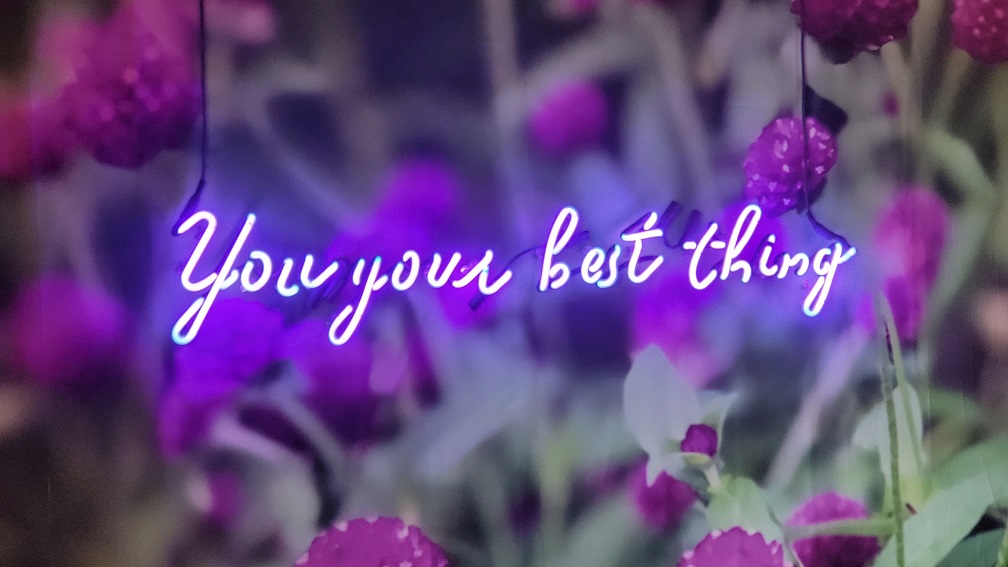
Mguni’s exhibit is a four-wall collection on the fourth floor. As soon as the elevator doors open, one is immediately greeted with Mguni’s piece, Affirmation, a circular mirror wreathed in hand-assembled dried flowers with the phrase and title of the exhibit, “I come from a holy place” printed in capital letters along the bottom curve of the mirror. Within the viewer’s own reflection, this piece serves as a portal into which one enters the installation understanding that the artist isn’t just trying to communicate where they come from but asks the viewer to consider their own origins. Upon further exploring the violet painted sub-room, one is greeted by an enlarged photo of Gomphrena flowers captioned by a purple neon sign that reads, “You your best thing.” This is a quote from Toni Morrison, the Nobel and Pulitzer Prize winning novelist that Mguni refers to as her “ancestor.”


Foundation / Altar

This flowed into the next piece, Foundations/Altar, an assemblage piece built from salvaged tin, steel, and a black marble fireplace mantle and ornamented with small statues, shells, flowers. These materials provide the “foundation” to two photos of Mguni’s parents holding her as an infant. According to Mguni, she mused while creating the piece “How do I affirm black people in a world that tries to erase and destroy us?” Perhaps her hypothetical answer is offered in a photo of graffiti Mguni currently has as her Facebook banner which reads ”More Black Self-Care.” Ultimately, the piece places the artist and her parents in a context which empowers and uplifts her and asserts that when looking for truth, we shouldn’t look outside but inside, a message that could also be taken from the previous piece, Affirmation.


On the third wall was a collection of a dozen printworks made utilizing both screen printing and inkjet printing. Each one was composed of a background image of flowers overlaid with patterns of yellow circles and dots and images of June Jordan and other culturally impactful Black women. All three elements – the background photos of flowers, the screen-printed patterns, and the portraits – were all used repeatedly in similar, but not exact, compositions that create a feeling of defamiliarization causing one to scan each and every one over and over again to find the details that differentiate them.


Beside this collection of images, vertically arranged and constructed from more salvaged metal were three Adinkra Symbols, one of which was Gye Nyame (which means “the omnipotence of the creator,”) could also be seen in the earrings being worn by Mguni.

The fourth wall was comprised of a myriad of different pieces. The first piece the viewer is drawn to is the television screen playing footage of Toni McClendon, a peace activist, speaking at the 1987 World Congress of Women in Moscow. Alongside this piece is a dozen books in stacks of four, each stack sitting upon a metal L-bracket fastened to the wall. Among these books were Beloved by Toni Morrison, Feminist Theory by Bell Hooks, and Dawn by Octavia E. Butler. These pieces are arranged among a few more printworks including images of icons such as Audre Lorde, Gladys Bentley and Zora Neale Hurston that were composed in a distinctively different style than the printworks on the opposite wall, and a collection of family heirlooms including a cocoyea broom, an antique clothes iron, and a mortar and pestle.

Beyond the artwork itself, it’s important to understand Mguni’s process for this installation. At points, there are other less obvious connections to her social activity. For example, the wall-sized photo of Gomphrena wasn’t just taken by the artist, but she grew the flower itself, and other flowers used in her prints, in East Liberty Garden. This was part of a program Mgnuni sponsors called “Flowers for Black Girls.” As part of this initiative, Mguni and a group of others gathered at the Wood Street “T” station on October 24, 2014 with over 500 flowers with messages attached such as “You are valuable,” to hand out to Black trans/women and girls. Mguni chose October 24th because it was the birthday of Teaira Whitehead, a Homewood teenager whose body was found nude and doused in bleach on a trail in Riverview Park a few weeks earlier. No arrest has ever been made for the crime.

In total, Mguni’s creativity, artwork and messages are poignant and moving in any decade or generation. But viewed juxtaposed the headlines of today’s Ukraine conflict, they were especially impactful and worth the trip to the fourth floor.


Brice and Other Pittsburgh Poets Perform Live at Riverstone Books

John Maurer

-John Maurer

Despite a wet, drizzly evening outside, there was nothing dreary about the poetry reading at Riverstone Books on Forbes Ave in Squirrel Hill on July 13. Held in the stunning, gallery-esque back room reading space of the bookstore, the evening’s slate of poets included Charlie Brice (being celebrated for his new collection of poetry, The Ventriloquist); Judith Alexander Brice; Jim Daniels; and Matthew Ussia (pinch-hitting for ML Liebler)

Nearly every chair was filled and according to event planner, Eowyn Randall, there were dozens of attendees via the reading’s live feed. Charlie Brice was the host of the evening, introducing the other poets there to celebrate his work and share some of their own.


(LtR) Jim Daniels, Judy Brice, Charlie Brice, and Mattew Ussia

Matthew Ussia (introduced as a failed death metal singer turned poet who is currently a professor and director of Duquesne University’s first-year writing program) kicked the evening off. Ussia provided a sampling of his occasionally absurdist, but consistently poignant, poetic verse. He began with a poem titled At the Moment He was Conceived. He followed this poem about conception with a poem about death. While perhaps a dark turn, Out to Lunch showcased Ussia’s ability to balance the comedic and fantastical with the macabre and existential, and was met with applause and an uproar of laughter. The unique and versatile voice of Ussia’s poetry can be seen through his imagery of a corpse set in rigor mortis wedged between a toilet and a bathroom wall, followed by Ussia imagining the reader ordering a tuna melt after his own death and him feeling that situation as unfair, or in his own words, “bullshit.” His third poem, Stepping in Dog Shit at 5:12 AM While Naked at 43, (inspired by one of Charlie Brice’s poems), was sobering yet lighthearted, as Ussia relives a bar crawl in Toledo from 30 years earlier.


Judy Alexander Brice, retired psychiatrist and both wife and proclaimed ”favorite poet” of Charlie Brice, has published more than 80 poems and penned three collections and a chapbook. Judy read a yet unreleased poem titled First Grade which detailed all the things she learned in first grade outside the classroom – from a fixation on her teacher’s “cantaloupe-sized breasts” to navigating the school’s intentionally flooded bathrooms and the gum under the desks that stuck to her clothes  – all led to her fond memories of walking to and from school with her friends, one of whom, Jenny, stopped walking with her and attending class due to brain cancer. This poem showcased Judy’s unique ability to make you look at one narrative while she puts together a larger arc of story that, as a reader, you won’t realize until the last stanza or line. Judy’s work was also introduced as often utilizing her “acquaintance with illness within herself and others.” These skills were on full display in her poem In Search of Comfort, which explored loss, grief, and illness as the poet experienced them during the global COVID-19 quarantine with turns of phrase that clearly resonated with the audience. Even after the event in conversation, Judy expressed her empathy to all of those who suffer.

Jim Daniels is a Detroit native who has spent the past 40 years in Pittsburgh and is the Thomas S. Baker University Professor Emeritus at Carnegie Mellon. Daniels read from his most recent book of poetry, Gun/Shy, as well as a selection of newer standalone poems. In a villanelle titled Private Room, he discussed his daughter falling ill in high school and juxtaposes her worry about dying with the dying of embarrassment that she, like most teens, experienced around her parents at that age. Daniels’ ability to not only put the reader into his shoes but to make them walk in them as well is uncanny. He brought the reader into the hospital room and made the reader feel like they were sleepless on the ground at the foot of his daughter’s hospital bed sick with worry. Watching Daniels pull on the audience’s heart strings with this poem of great personal vulnerability was something to behold, as many wiped away tears and applauded the poem. It was quite clear why he is widely regarded, according to Charlie Brice, as “one of the best poets in the country.”

Charlie Brice
The evening’s centerpiece was poetry written and read by Charlie Brice. Two-time “Best of the Net” nominee and three-time “Pushcart” nominee, Brice was introduced by Ussia as being “in beast mode” referring to Brice’s recent run of publications; an impressive eight books in just the past six years. Brice began by reading Cleaning Up Cat Puke Naked at Seventy, which won first place in the Field Guide Poetry Contest in 2021 and was also the poem that inspired the earlier performed work by Ussia. This poem describes the tumultuous process of trying to find one’s identity not only as a youth but into adulthood as well and asks you to view coming-of-age as more iterative than linear. This narrative is then paralleled with an image of the narrator, feeling his greatest certainty in life at 70 years old, cleaning up cat puke. This certainly wouldn’t be the moment most would expect Brice to point to given his incredibly accomplished career, but that’s exactly what gives the poem its incredible impact and lingering curiosity. Vietnam Again, read by Brice, showed off his ability to effortlessly interweave compelling narrative with incisive and evocative imagery and intricate phonetic styling. This poem discussed the author’s choice not to enlist during the Vietnam War on grounds of conscientious objection. He also compared this experience with that of his friend, Owen, who enlisted and, after practicing gutting a human being at bootcamp, showed up at the narrator’s front door gone AWOL on his way to Canada. It was a heart-wrenching narrative poem about a politically feverish period of American history which Brice reflected on after the reading with a heavy sigh, saying “there was no winning."

In total, the poetry reading was a fitting celebration of Charlie Brice’s work and yet another great example of the quality verse being crafted in Pittsburgh. Credit should go to Riverstone Books, Eowyn Randall, and the talented slate of writers for such a wonderful event.


Poetry: John Maurer

John Maurer
A Waste of Art


Oh so messy

I sit in my work

Or lack thereof

For I say I am a poet

So I know the meaning

Of every word but that one

What a laugh

With an Arctic chomp

This tank can make your lungs

Into cold party balloons

A Pittsburgh painter,

Would call this art

Your father,

Calls this a waste of time

You ask,

What’s the difference?

Not sure either

If these pages would be more useful

As tissues for the leaking eyes

Of mothers who choose to keep them

Leeches belong only

In-between survivalist teeth

Or should I become a contortionist

And just put myself on the shelf

It isn’t that I don’t care,

But that I simply don’t notice

The way you don’t even run

Your fingers over my gold embossments

***


One Hundred More


Indication of the intricate is how we can't tell if it's simulated
Intoxicated when I talked in college presentations
on the dangers of drugs and alcohol
The teacher believed it but even funnier is that I didn't

That same week I watched my brother puke away
hours of blood on a beach under the crescent moon
911 pre-dialed but he kept saying not yet, not yet
And he was alright, I'm certainly alright
But I don't need to chase the dragon
the dragon chases me, but he hasn't caught me, not yet, not yet

I wrote this on the walls with Pabst boxes and Swisher wrappers
Built a throne from the tricyclic cylinders I've emptied into myself
Taking shots to suppress the fire licking its way up my throat
They told me to just say no
but I just say one more

***


Eating Western Wheat in the East


I love you        I hate you

right now         soon after

Eyes closed     Well aware

I stare              of nothing

I know             I lie

what’s past      in the grass


It's like college kids and collagen

Obsessed with camouflage collages of lives we won't live

At what point do you switch from telling your child

You can be anything

to

You probably can't do most things


Like how you let them find out Santa isn't real on their own

Wait and hope they will realize the same thing about god

Hope they never realize the opposite about Satan 

Not literally but figuratively that figure is each and every one of us

There's an evil stirring inside; not dying but killing to get out

One day you will see it in us, someday after you will find it in yourself

***

Bio:
John Maurer is a 26-year-old writer from Pittsburgh that writes fiction, poetry, and everything in-between, but his work always strives to portray that what is true is beautiful. He has been previously published in Claudius Speaks, The Bitchin’ Kitsch, Thought Catalog, and more than seventy others. @JohnPMaurer (johnpmaurer.com)